Showing posts with label opera. Show all posts

Sunday, February 6, 2011

Missing music: Meyerbeer's Hallelujah

I recently gave a talk on Jewish art music. While prepping for the talk I realized that I couldn't find recording's of two fascinating piece. Here's the story of the first.

In the 1830's and 1840's, Giacomo Meyerbeer owned grand opera in Europe. His opera's Robert le Diable (1831), Les Huguenots (1836), Le prophète (1849), and L'Africaine, (which was produced posthumously in 1865) were immensely popular and critically acclaimed.


Unlike Felix Mendelssohn, and many other Jewish artists of the time, who either converted to Christianity, or attempted to downplay their Judaism, Meyerbeer was a committed Jew. While Meyerber never directly included references to Judaism in his operas, he was known at the time for his inclusion of religious, as well as religious tolerance, themes.

Born in Tasdorf, near Berlin, Meyerbeer's given name was Jacob Liebmann Beer. He was the son of Jacob Judah Herz Beer and Amalia Liebmann Meyer Wulff, both from wealthy Jewish elite families and active in the Jewish community in Berlin...a community that was busily contributing to what would become the Reform movement and contributing to a renaissance in both traditional and modern Jewish liturgical music.

The renaissance was being driven by Louis Lewandowski (Berlin), Salomon Sulzer (Vienna), and Samuel Naumbourg (Paris). These great cantors and composers were creating a new Jewish liturgical music that took in equal parts traditional nusach and Western classical music. The result was both the basis of modern chazzanut (cantorial singing) and controversial innovations such as the inclusion of the organ into Jewish liturgy.

In this atmosphere Meyerbeer, the reigning king of the grand opera, received a commission that he didn't like but couldn't say no to. His father, who had started an early Reform temple in his home, commissioned Meyerbeer to compose a piece for choir and organ. Meyerbeer was firmly against the use of organ in Jewish music, thinking it a shallow apeing of Christian music and an interference with man's direct communion with God through prayer. Yet he composed the Hallelujah anyway.

The manuscript for Meyerbeer's Hallelujah exists, and is held by the US Library of Congress. But I haven't been able to find any recording, or even evidence of public performance in the last few decades. I have no idea why not.
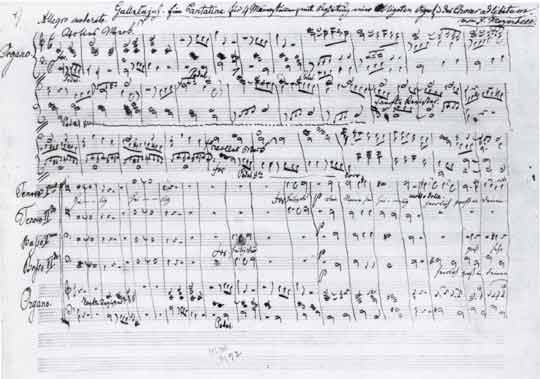
Manuscript score for Meyerbeer's Hallelujah, from the Library of Congress (via the Jewish Virtual Library)

Another great Meyerbeer story....why are Meyerbeer's operas not performed often any more? Two main reasons. First, they're huge performances requiring large numbers of expensive lead and secondary performers. Second, after his death Meyerber's music was denounced by his most notable musical protege, the next king of opera and raging anti-semite, Richard Wagner.

For more info on Meyerbeer see his wikipedia page and the wikipedia page "The Reform Jewish Cantorate during the 19th Century," David Conway's excellent resource Jewry in Music, and the Jewish Virtual Library page "Judaic Treasures of the Library of Congress: Giacomo Meyerbeer." Also, hat tip to YouTube user LindoroRossini for uploading the Meyerbeer opera video. There are lots more video recordings of Meyerbeer compositions on Youtube, check 'em out.

Thursday, April 10, 2008

Cantor Yosef Gottesman, Opera in the Synagogue!

Whew, I haven't posted since Monday but not for lack of material. I was just out late smoozing with other conference goers and trying to find out if I was in trouble for a little ruckus I caused at one of the conference panels. I told a bunch of emperors they had no clothes. Yikes. I normally keep my little rants to myself or my friends. This time I said it into microphone in front of about 100 people.

Anyway, I'll be heading home tomorrow, so I thought I'd get in one more post about Jewish music in Florence. Today's feature is Cantor Yosef Gottesman. According to his bio, he was born in Florence, educated in England, and attended yeshiva in Israel. He tours regularly and has five albums out and (drum roll please) "His cover version of the title track from the Titanic movie "My Heart Will Go On" sung in Hebrew, is becoming a staple song for Jewish Weddings all across the world."

I don't think I needed to know that there's a Hebrew version of music from the Titanic. Sigh.

Anyway, sappy love songs aside, Cantor Gottesman has fine voice and sings in the operatic cantorial style that once lit up synagogues all over America. Here are a few of his sample tracks that I particularly enjoyed. (yeah, I guess I can get sappy too).


Kevakrath (From Gotteman and Sons)


Tevienu (From Yosef Gottesman sings Carlebach with Sthimme)


And here it is, in all it's smaltzy glory...
Titanic - Eshet Chail (From Opera in the Synagogue)


If your interested in purchasing one of Cantor Gottesman's CD's, you can contact him through his website. He also performs at all sorts of festivals and events. He even does weddings.

Monday, April 7, 2008

Mario Castelnuovo-Tedesco

Continuing this week's theme of Jewish music from Florence, Italy, today's find is Mario Castelnuovo-Tedesco (hereafter abbreviated MCT). According to a Milken Archive press release for the recording, Naomi & Ruth / Sacred Service for Sabbath Eve, MCT was "born in Florence to an Italian Sephardi Jewish family with roots in Tuscany dating back 400 years, the composer himself identified three primary inspirations at the core of his musical expression: his Tuscan background, his fascination with Shakespeare, and the Bible--not only its narratives, but the Jewish spiritual and liturgical heritage developed over the centuries." According to his Wikipedia entry, while MCT was born in Florence, he emigrated to the US in 1939 to escape the pre-World War II race laws that had cut short his Italian career. Once in the US he quickly became a successful and influential film and opera composer.

Amazon.com has the CD and plenty of sound samples for Naomi & Ruth / Sacred Service for Sabbath Eve as well as many of his secular compositions including the Tarantella played here by Giulio Tampalini.

GIULIO TAMPALINI - M. Castelnuovo Tedesco: Tarantella


You can find more info about MCT at the Milken Archives biography page and his wikipedia entry.

Monday, February 18, 2008

Broadsheet: Jewish Music in the News

Reports about Jewish music show up in a lot of odd places. I'm going to try to keep up with the more interesting reports. Here are some recent ones...

"La Mar Enfortuna and Pharaoh's Daughter: Expanding The Jewish Musical Tradition", All About Jazz, February 17

New and Notable (Golem and Pharoah's Daughter play the Houston JCC), Houston Chronicle, Feb 15

"Yelling Melodiously" a review of The Shondes' Red Sea, The Forward, Feb 13

From Niggunim to Led Zeppelin, Cleveland Jewish News, Feb 14

A new kind of aria for Dershowitz
, Harvard University Gazette, Feb 14

James Conlon's mission: Revive operas banned by Hitler, International Herald Tribune, Feb 13

A Rare Jewish Bid for the Classically Sacred Concert, The New York Times, Feb 12

Berel Lazar called Grammy’s laureate Yury Bashmet a pride of Jewish people
, Interfax Religion, Feb 12

Kosha Dillz spearheads Jewish rap movement, University of Wisconsin Advance Titan, Feb 11

American Jewish Rockers Seek to Boost IDF Morale, Israel National News, Feb 10

UCLA receives $1 million to establish chair in Jewish music, UCLA Newsroom, Feb 6

Jorge Liderman, award-winning composer and music professor, dies, UC Berkely News, Feb 6

Music biz ponders Amy Winehouse's plight
, Detroit Free Press, Feb 3

Tuesday, January 22, 2008

Gimpel the Fool accordian duo

After posting about the opera La Juive (The Jewess), I went looking for videos of other Jewish operas. The first that I looked for was David Schiff's "Gimpel the Fool". While I didn't find the video I was looking for, I did find this gem. It's a Japanese duo calling themselves the "Jabara Sisters" playing a composition by Hankus Netsky, of the Klezmer Conservatory Band, also called "Gimpel the Fool." According to the video notes, the Netsky piece was written for a radio drama presentation of Issac Bashevis Singer's story. According to the Klezmer Conservancy Band's website, their version of Gimpel is available on their album "Dancing In The Aisles." I haven't been able to track down the radio program yet, but I'll keep looking.

Gimpel The Fool


Hat tip to the Jabara Sisters for posting the video.

Thursday, January 17, 2008

The Jewess - a Jewish opera

On one of my whims, I punched "random musical term + Jewish" into google tonight. Just to see, you know. Tonight's term was Jewish Opera. I've gotten educated enough to know that something would pop up. There had to be.

The first thing that popped up is a JewishTheater.com article by Philip Kennicott about an opera called "La Juive The Jewess" in which "audiences watched an old Jewish man -- called the "Shylock of opera" and inevitably referred to as "vengeful" or "implacable" -- send his adopted daughter to her death in a vat of boiling oil. The character of Rachel, in Fromental Halevy's opera "La Juive," was being punished for the crime of marrying a Christian." The article goes on to explore some of the history of the opera and discuss the recent Neil Shicoff production.

Ah, melodrama set to music, opera how we love thee. But this is a wonderful production and Shicoff has a marvelous voice. If I understand correctly, this video is from a Deutsche Grammophon DVD that's available from your local music store, Amazon or favorite one line vendor.

Halevy - La Juive - Neil Shicoff