Showing posts with label folk. Show all posts

Tuesday, July 31, 2012

Planet Hava Nagila: Aly Raisman's Olympic Floor Routine, The Wall Street Journal and Hava Nagila the Movie

It's been a big month for Hava Nagila, that favorite of bar mitzvah's, hockey games, celebrity appearances , and enterprising musicians worldwide. The excitement started on the 19th when director Roberta Grossman premiered "Hava Nagila The Movie" to a sold out crowd at the San Francisco Jewish Film Festival.
"...featuring interviews with Harry Belafonte, Leonard Nimoy, Connie Francis, Glen Campbell, Regina Spektor and more, the film follows the ubiquitous party song on its fascinating journey from the shtetls of Eastern Europe to the kibbutzim of Palestine to the cul-de-sacs of America. High on fun and entertainment, Hava Nagila (The Movie) is also surprisingly profound, tapping into universal themes about the importance of joy, the power of music and the resilient spirit of a people."

The film is getting good press and hopefully will be playing soon at a film festival near me. And you, too.

This past weekend, Hava Nagila (the song) showed up in the Wall Street Journal, that bastion of stock tickers and pinstripe, in an article titled "At Some Happy Events, Hava Nagila Isn't Invited." WSJ author Lucette Lagnado claimed that "Hava Nagila isn't in danger of becoming a musical relic. It already is one" and backed up the claim with quotes from from sources including enthomusicologist / musician Henry Sapoznik and Klezmatics vocalist Lorin Sklamberg, Manhattan Rabbi Haskel Lookstein, and Neshoma Orchestra, a NYC simcha band, leader Elly Zomick. Lagnado noted that Hava Nagila will live on in YouTube videos, such as those I linked above, and in new Jewish music bands reinterpreting the song, including Abraham Inc (see below) but that its been retired as a Jewish American favorite. As can be imagined, the article ruffled features around the Jewish world.


Finally, Hava Nagila was the backdrop for some Olympic drama on Sunday night.  Much to the delight of the US Jewish community, Team US Olympic gymnast Aly Raisman used an upbeat Hava Nagila as the soundtrack for her floor routine, an amazing performance that edged out US team All Around favorite Jordyn Wieber and sealed Raisman's position as one of two Americans to advance to the All Around competition.  As Haaretz reports,  Raisman's use of Hava Nagila was both tactical and traditional.  Raisman, a Jew from Needham, Mass, chose the music for it's folksy appeal and ability to get the audience engaged and clapping, something that helps her as an athlete focus and connect with the judges.  As an internationally known folk tune, Hava Nagila has been used a number of times by other gymnasts for similar reasons. A JTA article, cited by Haaretz, includes links to historic videos of gymnasts Gael Mackie of Canada, 2004, and Sandra Izbasa of Romania, 2010, using Hava Nagila for their routines. Raisman repeated her routine today as the anchor exercise sealing USA's team gold medal.  Let's hope it does as well when she competes for her personal All Around medal.

Neither of her two Olympic routines are available yet, but here's Raisman performing her Hava Nagila routine from the 2012 Olympic Trials.


Best of luck, Aly. We're rooting for you!

Hat tip to YouTube users richklebanIgnitedSoul13schillidstalkerokyagul and Anim3Mast3r for posting "Jake's Bar Mitzvah", "Jerome Iginla,""Bob Dylan Hava Nagila," "Indian Hava Nagila," "Rootwater - Hava Nagila," and "Final Fantasy - Avent Children Hava Nagila Techno" respectively. Also, hat tip to YouTube users HQ4Music for "Abraham Inc. - The H Tune aka Hava Nagila (Jazz à la villette part5)" and Susaluda for "Aly Raisman Floor - 2012 USA Gymnastics Olympic Trials Day 2"

Monday, July 9, 2012

Freedom Season's "Along the Way" - the best Jewish folk rock album of the year.

For the last couple of days I've had Freedom Season on heavy heavy rotation. I'm on another work trip and this is exactly the kind of soul music to get me through. Listening to the YouTube video below, you'll definitely get a strong Shlomo Carlebach vibe. Well done, but pretty much everyone with tzizit and a guitar wants to be Carlebach, right?

Ok. Now listen to the tracks from their studio album, Along the Way. Check out Taste of Heaven, Havdalah, or Old Friend. Fantastic harmonies and melodies and bluesy acoustic riffs that echo 1960's and early 1970's Americana folk pop bands like the Byrds. And strong strong well crafted lyrics that pick up some deep ideas without taking easy 'let's do another arrangement of one of the psalms/zimrot/Carlebach/classic niggun' shortcuts*. Their song Havadallah is going to become a camp standard. You wait and see.
Wow. Where did these guys come from? Where have they been all my life? The Cool Jew blog recently compared Freedom Season to 8th Day. I can see the comparison, but I'm not buying it. 8th Day's got a much more straight up modern rock sound. Freedom Season's way more the softer side of folk rock. I will say that if they can get their stage show up to the level of the album, they'll be selling out halls the way that 8th Day does and Blue Fringe did.

In addition to scoring "Along the Way" through Bandcamp, you can grab it from iTunes and Amazon MP3. You can also follow their adventures on Facebook. And you really should.


* Just to be clear here, I love "psalms/zimrot/Carlebach/classic nigguns" as much as the next Jewish music obsessed guy. I'm just excited to see a couple of songwriters who can really write lyrics and aren't afraid to divert from the traditional Jewish community's standard music formula's.

Tuesday, August 2, 2011

Black Ox Orkestar

Emerging from the vibrant Canadian art-rock music scene of the early 2000's, Black Ox Orkestar released two albums, Ver Tanzt? and Nisht Azoy (Not Like This) of contemporary Jewish music that are dark, haunting and intense. The albums clearly draw on Askenazi Jewish roots, with evocations to klezmer, cantorial and Yiddish folk motifs. The albums draw on contemporary jazz, folk, and art-rock influences as well, but without the 'aren't we clever and eclectic' feel that often mars musical hybrids. These albums are on a short list of my favorites, both for their musical depth and for their ability to evoke, for a few moments, a world where new Jewish culture thrived and renewed itself instead of degenerating into apathy, nostalgia, or pastiche.

Nisht Azoy
Nisht Azoy - BLACK OX ORKESTAR by Constellation Records

Here's the Orkestar's official blurb. Gotta love the phrase "Anchored to tradition without being suffocated by it." Exactly. We need more of that.

"The second record by Montreal’s Black Ox Orkestar placed the group at the forefront of a ‘new Jewish music’ that rejected contemporary fusion and musty nostalgia in equal measure. With backgrounds in folk, punk-rock and free jazz, the group’s four musicians distilled Balkan, Central Asian, Arabic and Slavic sources into a coherent, impassioned sound that gave teeth to old Jewish songs. Never relying on museum-piece reverence or an obvious, forced collision of musical forms, Black Ox rewrote a Yiddish songbook in ways that sound organically anchored to tradition without being suffocated by it."

Friday, July 8, 2011

The Russian Jewish Experience Part II: Shalom Comrade!

Shalom Comrade! album coverIn doing a little more homework on Russian Jewish music, I came across a wonderful archive album titled "Shalom Comrade! Yiddish Music in the Soviet Union 1928-1961." The album, which was produced in 2005 by ethno-musicologist Ritta Ottens and ethno-musicologist / klezmer musician Joel E. Rubin, both through it's music and extensive liner notes helps fill a critical gap in Russian Jewish history. As I noted in yesterday's post, there is a tendency by American Ashkenazim Jews (including myself) to marginalize the history and experience of Soviet and post-Soviet Jews. It defies the 'escaping the old world of the Shtetl (poverty, orthodoxy, anti-semitism) to the new world of America (opportunity, liberalism, assimilation)' foundation myth that underlies a lot of our cultural narrative. The Soviet Jews didn't escape. Instead, under pressure of the Soviet system they were slowly transformed, with results no less dramatic than the transformation Ashkenazi Jews experienced in the West.

One of the drivers for the Russian transformation was the conflicted view that the Soviet leaders had toward Judaism. As Ottens and Rubin note,
"Stalin’s cultural ideologues planned to deploy the music of the Yiddish-speaking Jews of the Soviet Union as a building block for the new Soviet music, whereas the Jewish religion with its traditional way of life was damned as counter-revolutionary."
As I've written previously, when talking Russian Jewish art music, there was an amazing output of art music in the early days of the Soviet system that drew on Yiddish folk and Jewish liturgical music. This music was composed by Jews and non-Jews alike, including Dmitri Shostakovich, one of Soviet Russia's premier composers. This activity faded though as the religious life of Soviet Jews came under more and more attack by the Soviet regime. As Ottens and Rubin note, not more than 200 to 300 (Yiddish popular and liturgical music) recordings were released up to 1967. They compare this with approximately 10,000 similar pieces recorded in the West.

This scarcity of these recordings make the Shalom Comrade! album that more special. At 24 tracks, it contains over 10 percent of the entire recorded output of Soviet Jewish music of that period and covers a range of thematic topics the show integration and tensions of Soviet Jews. This first sample (from Rubins website) is a Yiddish art song composed by B. Bergolt, lyrics, and Moses Milner (score). The song is performed by Misha (Mikhail) Aleksandrovich, who was born in Latvia, lived in Britain, and after World War II became one of Soviet Russia's most popular performers. Here's a translation of the lyric from the album liner notes.
Last night grandma suddenly remembered how grandpa came back from the Civil War front. Her big tears shone happily as she embraced him, danced and cried. That’s how they partied, into the deep of night, the tables broke under all the honey-cake and wine. A glass and another glass, higher and higher in the hand, to spite the enemies and to the joy of our country. Many years pass by with peace everywhere, and an old lady sits with her grandchildren around her and tells of the Great Fatherland War [World War II] and what a holiday it was when grandpa came back in victory.
Misha Aleksandrovich / Di bobe hot zikh dermont (Grandmother Recalled)(M: Moses Milner; T: B. Bergolts)


This second sample was, as Ottens and Rubin note, "belonged to the handful of warhorses which every Soviet interpreter of Yiddish song had to have in his or her repertoire." This version, performed by Zinovii Shulman, was the one that popularized the song.
Oh dear! Where do you get flour to make varnitshkes? [A plain
dumpling ]?
Without yeast or salt, or pepper or fat. Where do you get a board
to roll out the varnitshkes? Where do you find a stove to cook
the varnitshkes? And where do you find a lad to eat the
varnitshkes? Without yeast or salt, or pepper or fat. Where do
you find one, where?
Zinovii Shulman / Varnitshkes


The album can be purchased through The Workman's Circle and, of course, Amazon. And did I mention the extensive liner notes?

Sunday, July 3, 2011

Lana Ross: Jewish Classical Guitar

Here's what I know. Lana Ross plays classical styled guitar and has three recordings on CD Baby, two of which are Jewish themed. Lana Ross based out of Canada and is associated with married to Russian - Canadian classical / flamenco guitar player Andrei Krylov. That's it. That's all I've got. Which is very weird, normally musicians go to great lengths to provide all sorts of bio material and contact information. Ah well. We can just enjoy the music.

Variations on themes of Odessa, Klezmer, Sephardic, Hasidic, Jewish Folk Songs and Dances for Classical guitar, (2011) and Fantasy on Themes of Sephardic, Hasidic, Odessa Jewish Folk Song and Dances (2009) are sprawling series of finger-picked folk and classical style guitar pieces that, as the title suggests, cover a lot of territory through Jewish music. Which in itself is a small wonder. I rarely see that much specific knowledge of Jewish music repertoire in single recording. Ross plays beautifully, with a lot of bounce and humor, weaving classical and folk sounds in a manner that reminds me a bit of John Fahey style 'primative guitar." Not quite at Fahey's level, but very solid.

To get a feel of her work, check out these tracks. From Variations, the lyrical and lush Bessarabia Romance sits next to aptly named Klezmer Guitar - Funny And Sad. From Fantasy, her Fantasy to theme of Jewish folk song Avinu Malkeinu and Variations to theme of Jewish folk song Lo Jisa showcase her classical and folk styles.

Bessarabia Romance


Klezmer Guitar - Funny And Sad


Fantasy to theme of Jewish folk song Avinu Malkeinu


Variations to theme of Jewish folk song Lo Jisa
If anyone knows more about Ross, please let me know. I'd love to track down a live recording or video or, even better, to catch her performing live. I've contacted Krylov and will report back if I get more information.

Update: I was able to reach Krylov, who confirmed that Lana Ross is his wife and that they live pretty far out in the country and don't use the internet much. Anyone interested in Ross's work can grab the albums from CD Baby or get in touch with her through Krylov's website.

Thursday, June 30, 2011

Reb Yosil Rosenzweig - Still rocking and davening

You want to hear a track that rocked my world recently? Press play.


Now go read the story.

Wow. What an wonderfully simple, wonderfully intense recording and an immediate add to my playlist.

So who rocked my world? Reb. Yosil Rosenweig, my (handsome and modest) pal Benji's dad, and long time Jewish music fixture. I want to say icon, but can't quite. Reb. Yosil has written songs and made music with two of the most important folks in Jewish music in the 20th century; Chassidic rabbi and folk singer Shlomo Carlebach and Avraham Rosenblum, founder of the Diaspora Yeshiva band, the seminal Israeli Jewish rock group. But he, himself, never rose to the icon status of Carlebach or Rosenblum. But, icon or not, Reb Yosil has been making great Jewish music for a long time. And as evidenced by the track above, he's still doing it as well as anyone.

Pitchu Li album coverAbout a year ago Reb Yosil released Pitchu Li, his first solo album. It's a recording of Reb Yosil with his Kosher Gravy Company live in concert, with Reb Yosil telling stories, giving Torah, and singing some of his many songs. He's backed by a fine, bluesy jam-band. Doing a more detailed review of the album had been on my to do list for a while (sorry Benji), but I'd had trouble getting started. I'm not much of a fan of fine, bluesy jam-bands. Just not my style. And Reb Yosil's voice is a bit rough in spots. I bet I would have loved the show... but the album? Good, but not great.

But then I heard Reb Yosil's Rosh Chodesh recordings. Particularly the Mah Ne'Daber. And I was hooked. There's a fire to his solo recordings that I didn't get from Pitchu Li. Mah Ne'Daber is incandescent. I now look forward every month to his next Rosh Chodesh song. They're offered monthly for free download. If you've missed them, go get them. Or wait a couple weeks. Pretty soon they're going to get bundled up as Reb Yosil's next album. It'll be a great collection. Then he'll start the process over with a bunch of new songs, one per month.

I got the chance to sit down recently with Reb Yosil and hear a bit of his life story. I was really interested in finding out more about his relationship with Carlebach and Rosenblum and, given his obvious talent, why he ended up in their shadows. And why the new recordings now after all this time? The answer revolves around the life of a Canadian pulpit rabbi and musician who found himself in Israel in the late 1960's, a moment when North American ba'al teshuva were coming to Israel in waves and creating a new Jewish music scene that mixed rock music and spirituality, Zionism and Torah.

Reb Yosil and Shlomo CarlebachReb Yosil, far right with glasses and white yarlmuke, and Shlomo Carlebach, left with silver yarlmulke and guitar)

Reb Yosil moved to Israel in 1968 for "a four year summer." During that time he started composing music and met and played with Carlebach. Like Carlebach, Reb Yosil was interested in being able to use music as an emotional component of prayer. (And like everyone who knew Carlebach, he has some great Carlebach. Listen to the intro to Reb Yosil's Gam Ki Eilech for classic from the days of the Yom Kippor war.) At the same time he met and married his wife (whom he met at a Carlebach wedding) and opened a restaurant, and in 1971 started a band with Avraham Rosenblum called B'nai Tzion that included original material and popular Jewish song by The Rabbi's Sons and the Simchatones. B'nai Tzion played regularly on the stage in Reb Yosil's restaurant and at NCSY event. At that time he composed the songs Tzadik Katamar Yifrach and Pitchu Li, songs that went on to be hits for Rosenblum's next band, The Diaspora Yeshiva Band. Performed by DYB, Pitchu Li won Israel's 1976 Chassidic Song Festival. In 1978 DYB won again, this time with Reb Yosil's song Hu Yiftach Libeinu.

Reb Yosil (guitar, on right) Avraham Fried (the fellow with the beard who's standing and singing) and friends
Reb Yosil (guitar, on right) Avraham Fried (standing and singing) and friends

But DYB won these songfests without Reb Yosil, who was never a member of the band. Yosil wanted to be a rabbi, not a full time musician. Prompted by that and the opportunity to work with the Canadian Zionist organization, Yosil and his wife had already moved back to Canada when Pitchu Li won the festival. Yosil spent the next 30 years as a pulpit rabbi and raising a family, using music in his rabbinic work and playing community concerts and kumzitz. After a recent bout with illness, Reb Yosil retired from the pulpit and started playing music regularly again, putting together the Kosher Gravy Company band and playing concerts around Ontario and Detroit.

It's pretty exciting for a Jewish music geek like myself to see someone writing and performing new material in the style that was popular in Jewish music the late 1960's / early 1970's at that birth of Jewish rock. Particularly, it's exciting to see that music from someone who was there at the time and contributed classic songs to the repertoire.

Wednesday, June 1, 2011

The Feenjon Group - Israeli music in 1960's NYC

NYC is a churning, transient city. In the 1960's, Israel had been around long enough for Israelis to find themselves part of that churn. Menachem Dworman, an Israeli ex-pat, started a folk club called the Feenjon Cafe and it's house band, the Feenjon Group. The group also contained Jewish-American musician Jerry Sappir as well as range of Greek, Turkish, Russian, and Arabic music and musicians. The Feenjon group recorded 4 or 5 albums, the only one of which that is still easily available is alternately titled "Bellydancing at the Cafe Feenjon" and "An Evening at Cafe Feenjon" and is available through Smithsonian Folkways (and, believe it or not, through iTunes). Check it out.


I love running across albums like this. For someone my age, who wasn't born yet when this album was recorded, it's a bit of lost American Jewish history. Yes, we really did have an Israeli ex-pat scene in the 1960's. And yes, Israeli and middle eastern folk music did exist in the US at that time. And yes, it sounded great.

See the excellent Record Fiend article "The Feenjon Group - Belly Dancing at The Cafe Feenjon (Monitor, circa 1969) for more details." For some great discussion and remembrances of the Feenjon Group, check out this thread at Tribe.net.

Also, hat tip to Tzvi for pointing me to the FeenjonGroup and to YouTube user Village Underground for uploading the video.

Wednesday, February 2, 2011

Yiddish Songs, Forgotten and Remembered

Being ignorant in public is a bit of hobby for me, so I'll fess up. I don't know much about urban Yiddish music. I've got all the usual stereotypes about Yiddish music...sentimental lullabies, rural folk songs, and the occasional immigrant 'so this is America' angst. Clearly there's a lot more to it, and I need to get in gear and get my head around it. (I'm about to get scolded by my buddy, vocalist Lori Cahan Simon to learn Yiddish. I just know it.)

I got a bit of help today from the folks on the Klezmershack mailing list. One of them pointed to a great recording on YouTube of a song called Budapescht, sung by the German Yiddish art song vocalist, Karsten Tryoke on the album Forgotten Yiddish Songs. (The album is unavailable on Amazon, but there are a few copies on Ebay at the moment.) Forgotten Yiddish Songs is a collaboration between Tryoke and Sara Sliwka, a Holocaust survivor who taught him an entire repertoire of Yiddish songs from her youth. There's a nice writeup on her story at HaGalil.com


Budapescht is a classic unrequited, cross-cultural, love song, sung from the perspective of a Jewish boy pining over a Polish girl. (See the YouTube page for the full lyrics)

Wail ich bin a Bucher jîng în frisch,
´ch gai sech ous mamesz far a Kîsch,
tref iech mir a Lodze Ponienka,
sie red poilisch în ich mîss stenkn:
Ja sze kocham a ty ´spysz!

Because I'm a young lad
I aspire to a kiss
I meet a girl from Lodz
She spoke polish and I had to listen:
Ja cię kocham a ty śpisz !" /I love you and you fall asleep !
By the way, for another exercise in ignorance. I've actually been to Budapest, and have a few funny stories about being a college student abroad. What I don't have, and have kicked myself for 20 years, are stories of me wandering through the old Jewish section of Budapest. I hadn't thought through the possibilities of the trip at all. Grr. Hopefully I'll get back there some day, but until then I'll have to make do with the Jewish Virtual Library's Budapest Virtual Jewish History Tour and Yale Strom's documentary "A Man from Munkas: Gypsy Klezmer."

Hat tip to YouTube user albertdiner for posting the video and to "Heizler" for providing albertdiner, and us, with the lyrics.

Monday, November 29, 2010

A White Goat Under the Bed. A night of Jewish lullabies.

I just got back from a fun night at my synagogue which included a talk on Mussar by one of the congregants and a talk (and concert and singalong) on Jewish lullabies by our Cantor Annie Rose. Mostly I enjoyed the lullabye part. Go figure. (The Mussar talk seemed to be well received by everyone but me. I found the speaker to approach it from a fuzzy faux-spiritualized self-help perspective that was sadly disconnected from any Jewish meaning. I'm just cranky I guess) The lullabies were great, though.

I know a bit about Yiddish and Ladino lullabies but Cantor Rose brought up a number of points that I didn't know including....

1. Lullabies typically express the yearnings of the mother, sometimes for the return of an absent father, sometimes for the future of the child, sometimes for love or peace

2. Lullabies typically tell a story, even if it's just the story of the day's activities and dilemmas

3. Yiddish and Ladino lullabies have a strong sense of Jewish culture and community, with common references to rabbis, prayers, and Torah study, Jewish superstitions (white goats are lucky), and Jewish experiences (the father conscripted into the army, merchant trades)

4. Did I say that white goats are lucky? Yep. Having one under your bed is a good thing. Really.

My favorite of the night was Unter Dem Kinds Vigele (Beneath the Baby's Cradle). The lyrics, which include a white goat, are:

1. Unter dem kinds vigeleBeneath the baby's cradle
Shteyt a vayse tsigele.Stands a white kid.
Di tsigele iz geforn handlenThe kid has gone away to trade
Rozhinkes mit mandlen;In raisins and almonds.

Rozhinkes mit mandlen iz zeyer zis,

Raisins and almonds are very sweet,
Mayn kind vet zayn gezunt un frish.My child will be healthy and alert.


Gezunt iz di beste skhoyre,Health is the best of goods,
Mayn kind vet lernen toyre,My child will study Torah;
Toyre vet er lernen,Torah is what he'll study,
Sforim vet er shraybn,He will write holy books.
A guter un a frumerA good and a pious person
Vet er im yirtse hashem blaybn.will he stay, God willing.

Unfortunately, I can't find a good version online to share. So here's Hannah Roth singing the lovely Yiddish lullabye "Shlof Mayn Kind (Rest my kid)," Lyrics by Shalom Aleichem.


Monday, August 16, 2010

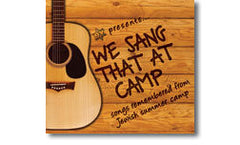
We Sang that At Camp (didn't we?)

I'm a huge fan of the Oy Baby discs. The first two (Oy Baby I and II) are the best performed, produced, and arranged Jewish kids discs out right now. From the smart and eclectic song selection to the wonderful harmonies of Stephanie Schneiderman and her sisters these albums are spot on perfect. Ask my kids how to sing Eli Eli, the Shehekianu, or a dozen other tunes,...you'll hear the Schneiderman arrangements coming back at you.

So I was delighted when I got their next Jewish album "We Sang That At Camp." And there it was, the same great voices, now with a fine male singing partner, but I couldn't quite get into it. My kids, now 3 years older than when they were first hooked on Oy Baby, couldn't quite get into it. I've been listening to it on and off all summer and I think I finally figured it out.

I never went to Jewish camp in the 1970s. And neither did my kids.

And that, it seems, is a bit of a problem. The album is setup to feel a bit like a campfire or a singalong in a mess tent in a camp. A fine conceit, that allows for a mix of liturgical pieces such as "Ma Tovu." Israeli folk pop pieces such as "Salaam," and American folk pop pieces such as "Leaving on a Jet Plane."

"Leaving on a Jet Plane?" Really? Seriously? That got sung at Jewish camp? My dad is a big fan of 1960's folk pop. I grew up on Peter Paul and Mary, the Weavers, the Kingston Trio, and the like. But hearing covers of "Leaving on a Jet Plane" and Harry Chapin's "All My Life's a Circle" is just odd and points to my fundamental problem with the disc...I really don't understand who the intended audience is.

A 40 year-old guy who, unlike me, went to Jewish camp? Maybe, but this is still a pretty kid friendly album. The arrangements are only a hairs-breadth more adult oriented than the Oy Baby discs. My kids? They dig the Jewish songs. "Ba Shanah Haba'ah" was a favorite. But the Harry Chapin number just lost them. They had no interest in a 40 year old light folk pop number made even lighter. Honestly I didn't either. My sense of nostalgia doesn't include this kind of material.

So this disc, for all that it has some great moments and very worthy tracks, never made into rotation. Which was a bummer. My kids are ready and primed for a new Oy Baby disc. Just not this one. Maybe one that sounds more like their current Jewish camp, the local Gan Israel camp, that mixes some of the very same tunes, with bunk songs that mix Miss Mary Mack style word play with current pop radio verve and swagger. Now that they'd groove on.

But this is very much a "your mileage may vary" kind of situation. If you went to camp or have a different sense of nostalgia, you might love this disc. Or your kids might. Check it out and see...


Friday, August 13, 2010

Danny Kaye and Harry Belefonte sing Hava Nagila

Shabbat Shalom everyone.

Fine. Groan if you want. But I've found yet another great version of Hava Nagila in the history dumpster that is YouTube. This time it's my fav's Danny Kaye & Harry Belafonte singing (and doing some very strange neck dancing) on a 1960's TV show. Danny goes very flat at the end and gets teased by Harry. This is Must See TV.


I got a request for some contemporary and celebratory versions of the old warhorse. So don't be surprised if I play a few more this week. If you've got a favorite contemporary recording, let me know!

Hat tip to youtube user bellecourse for posting the video.

Wednesday, August 11, 2010

Pioneers for a Cure: The Israel Sessions Volume 1

I'm sitting in San Diego, in a hotel overlooking the bay, listening for the dozenth time to Pioneers for a Cure: The Israel Sessions Volume 1. I'm a sucker for compilation discs. It's like getting a great radio show on one CD. In variably I fall for bands I'd never heard of and probably wouldn't have. Right now Uri Miles is crooning and playing pipes over a gentle rhythm that is both Matti Caspi lounge, Celtic drone and Mizrachi wailing at the same time. Odd but beautiful.

Pioneers for a cure is a charity compilation that trading up and coming musicians exposure for an opportunity to raise money for cancer research. The Israel Sessions is the second phase of the project. The first phase, produced by one of my favorite musicians Rabbi Greg Wall (of Hasidic New Wave and the Later Prophets) featured a wonderful cross section of contemporary Jewish music. This phase focuses on Israel music and other than an inclusion Greg Wall's Later Prophets is full of artists I don't know. Great fun and great music, gentle pop and driving rock, Israeli folk and art music. I think the Later Prophets and the Uri Miles tracks are my favorites, but there's not a dull track in the set.

Here's Greg Wall's Later Prophets Featuring Shai Bachar and Rabbi Itzchak Marmorstein, playing Sobu Tzion live in Beit Avi Chai, Jerusalem, August 24, 2009. A studio version is part of the Israeli Sessions.


To get in on Pioneers, check out tracks yourself. Donate and download the tracks you like. Only the first 5 tracks of the collection are up on the site, but the rest are coming soon. And while you're there, check out the songs from the first phase. They're all still available and just as great. They include tracks by Teruah favorites David Broza, Y-Love, Stereo Sinai, Sway Machinery, and Adrienne Cooper, just to name a few.

Here's a short video article on Pioneers for a Cure. It was made at the time of the first set of songs, not the current set, but it will give you the right idea.

Friday, August 6, 2010

Julie Geller - From a narrow place I called to you

Shabbat shalom everyone. July was a long month. Sorry for going AWOL. My day job and some family adventures took their toll. (Hey. I had my car engine explode on way to the Chicago Jewish Music Festival. Cut me some slack). I really need Shabbat tonight.

It's been a while, but here's great 'get in the Shabbat groove' track. It's courtesy of Julie Geller, a Denver based folk and Jewish signer/songwriter and is off her new album "You're With Me." I dig the album clips I've heard. A contemporary folk / light rock sound, but with some stylish arrangements and a strong lyrical voice. At times she reminds me of Austin-based country songstress Nanci Griffith and at other times college folk darling Dar Williams. Both high compliments. And when she kicks into her Jewish tracks I swoon. Seriously. Love it.


You can here the clips from the album tracks here..


Press kits


Quantcast

Monday, June 7, 2010

Two from Sefarides: Juan Bau and "Por ke llorax"

Today I want to feature two great videos from Sefarides, a website and Facebook stream dedicated to "a la información sobre la cultura y la historia sefardí" (Which I'm assuming means "information about Sephardic history and culture" Gotta love cognates). I just got linked up withe Sefardies Facebook stream, which is now sending me lots of fascinating Sephardic videos.

Here's the first one...

Por ke llorax blanca ninya? Sephardic song on hurdy gurdy


I love this version of the song. I've got two different contemporary recordings of it, one by Psychedelic Sephardic rock band Deleon and one by Sephardic Indie-Pop band La mar Enfortuna (both tracks with the titled transliterated "Porke Yorach"). It's great to hear this more traditional version. That said, I'm not ready to go along with the videos notes that describe the song as "a sad Sephardic Jewish romance from pre-inquisition Spain." One thing I've learned about Sephardic music is that while the lyrics may be pre-inquisition there's no real evidence that the melody is that old. This shouldn't detract from my (or anyone else's) appeciation of the song or the recording. It's just that the mythos of Sephardic musical antiquity is a bit overblown.

This second video is a hoot.

Juan Bau - La estrella de David


When I close my eyes, I really love the vocals and imagine the singer in a suit on a theater stage. When I open my eyes I all I see is Bay City Rollers. But generational fashion quirks aside, Juan Bau is a seriously good vocalist working, at least in this recording, in a Sephardic context. And from looking at his website, Facebook page, and myspace page, Bau is a vocalist that is still performing and recording. My Spanish isn't good enough to get too far into these sources, but I get the impression that he's a popular Spanish singer who recorded one or two Sephardic recordings during a much longer recording career. If anyone knows more about him and can help fill in some details I'd appreciate it. I'm going to try to hunt down this album. Have to have it.

Hat tip to YouTube user flautadeorfeo for posting (and recording?) the hurdygurdy video and to mireyaesc for posting the Juan Bau video.

Wednesday, April 21, 2010

Demonic Anarchy. For Children. A Tribute to Barry Polisar.

Somehow I missed out on Barry Louis Polisar when I was a kid. Which, I think, explains certain mental imbalances in me as an adult. Polisar has been entertaining children for three decades with albums titled "I Eat Kids," "My Brother Thinks He's a Banana," "Naughty Songs for Boys and Girls," and the wonderfully misnamed "Songs for Well Behaved Children." It was this last album that earned him a letter that read "This is demonic anarchy and I've added you to the top of my prayer list." Which, of course, means that Polisar and the listener both truly understand childhood..which is mostly demonic anarchy, punctuated by times tables and naps.

Polisar wrote to me recently about a tribute album that was just released, called "We're Not Kidding: A Tribute to Barry Polisar." The album is the result of his song "All I Want Is You" appearing, 30 years after it's first release, in the open title sequence for the hit movie Juno. This got Polisar a lot of media attention and reconnected him with a generation of fans who's grown up on his albums. It turned out that his fans started a LOT of bands, who came together to record 60 covers of his songs for the 2-disk album.

It also turns out that a lot of his fans are Jewish, as is Polisar who's also written his own Haggadah. (Which, it turns out, I happen to own). The result is that there are an entertaining number of Jewish-music influenced recordings on the tribute album. A quick scan turned up:
  • Sephardic indie-rockers, DeLeon, covering "My Brother Thinks He's a Banana" and "My Name is Hiram Lipshlitz.
  • Deborah Berman and the Nogoodniks, performing "Shtek Nit Dayn Finger in Der Noz," their own Yiddish translation of Polisar's "Don't Put Your Finger Up Your Nose."
  • Kid Kazooey and His One-Man Klezmorkestra Band, performing "I've Got a Teacher, She's So Mean and He Eats Asparagus, Why Can't You Be That Way?"
  • The Brothers (Boaz and Moshe) Vilozny performing a When the House is Dark and Quiet. "
That a whole lot of other great bands doing spirited renditions. If updated, rollicking, versions of some wonderful and seriously demented kids songs are your thing...definitely check out the tribute album. You can hear clips of most of the tracks on the website. And while you're at it, check out Barry Louis Polisar's original albums and stories. Like a fine whine, they've aged very well.

For the record, I recently introduced my (happily demonic) 5 year old daughter to his song "I Used to Have A Sister." She's been wandering around the house all weekend singing it to herself and imagining her elder sister turned into an apple tree. Yeah. He gets kids.

For a final treat, here's a truly awesome video. It's about a minute of Polisar making his first TV appearance, on the "Bozo The Clown's Wide World of Wonder" show in 1975, singing "He Eats Asparagus, Why Can't You Be That Way?." According to Polisar, his "little sister was watching TV with her friends when he came on singing. They all got very excited and said, "Emily, isn't that your brother on TV?" She said, "No."

Barry Louis Polisar in his first TV appearance: Bozo the Clown, 1975

Wednesday, April 7, 2010

The Fugs - And on Shabbos...Nothing.

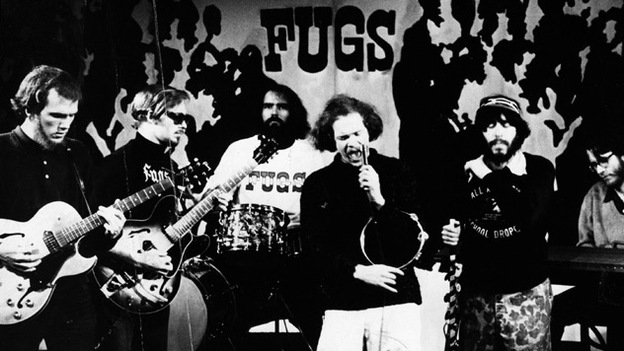
The Fugs in actionGot a call from my wife at work yesterday. "DID YOU HEAR THAT?!" Sure did. She was talking about the NPR radio spot on the seminal political beatnik rock band The Fugs. (I told you my wife was a radio junkie. And an alternative music queen. And a fantastic interior decorator. Love my wife. Oh. back the Fugs...) Here's Steven Lee Beeber's description of The Fugs from excellent his book "The Heebie-Jeebies at CBGB's, A Secret History of Jewish Punk"
"Still far from the hipster paradise it would become, the East Village (of NYC) - especially the Bowery area.....-had been growing steadily since Warhol had decamped in the late 1960s. It had seen initial settlers like Tuli Kupferberg of the Fugs, who, along with the rest of his beatnik friends in the band, performed radical political songs as informed by Yiddish melody as by Jewish humor"
Specifically, the Fugs were settled (Ed Sanders) into the Peace Eye Bookstore, which he housed in a decommissioned kosher market, and (Tuli Kupferberg) over Lifschutz wholesale egg market.

The NPR spot was in honor of a new (!!!!) Fugs album, The Final CD part 2. The clip that got my wife's attention was from the classic Fugs song "Nothing." In addition to the distinctly Yiddish melody, my wife had immediately gotten the joke the NPR commentator had missed. The lyrics, a nihilistic assessment of the times, followed the pattern of a classic Yiddish joke "Monday: potatoes. Tuesday and Wednesday: potatoes. Thursday and Friday: potatoes. But on the Sabbath, something different: a lovely potato kugel!" But there's no kugel in the Fugs version. No Shabbos. Nothing special. Just potatoes. Just nothing.

Here's a wonderful video of Coby Batty of the Fugs performing Nothing, which was written by Kupferberg.
The Nothin Song

Hat Tip to YouTube user jadeDragon1351 for posting the video.

* By the way, the irony of me writing posts titled "I could not run from God" and "And on Shabbos Nothing" back to back isn't lost on me.

Tuesday, April 6, 2010

I could not run from God - Girls in Trouble in Michigan

Girls in TroubleI just got back from Cafe 1923 in Hamtramck, MI. Hamtramk is an ethnically diverse, seriously hip, blue-collar industrial town just north of Detroit. Cafe 1923 is about my favorite kind of place in the world. It's a small indy coffee shop, with a barrista who knows her trade and a book and couch filled back room. Just right for hearing one of the best new Jewish bands in the world doing an intimate 'parlor' concert.

So what do I mean by "one of the best new Jewish bands in the world?" I'll get to that in a moment. First, let me set the stage. Alica Jo Rabins, the band leader and songwriter, was up first singing over intricate and lovely looping violin and gently strummed guitar. Rabins has a gorgeous, heartbreaking voice and the rare ability to give her songs individual narrative voices. The girl singing Snow is not the girl singing Mountain, even if both are Alicia. Rabins was joined by her touring bandmates, Aaron Hartman on upright base, Elaina Morgan on electric guitar, backup vocals and xylophone, and Jonathan Vincent on accordion. (I think this was the line up. Someone correct me if I goofed.) Together, they created a lovely pop sound that evoked American folk and British pop.

Again..so why the "one of the best new Jewish bands in the world?" Because in 10 years the songs I heard tonight will be part of the American Jewish songbook. Sitting on the couch a few feet back, listening to Rabins and Morgan sing the stories of girls in trouble in the Torah, I suddenly knew what Debbie Friedman's first audiences must have felt. Strip away the talented musicians. Strip away the lovely harmonies. Strip away even Rabins voice. What's left are lyrics that give immediate, visceral life to people who's pain, joy, and faith was written down between three to four thousand years ago. Miriam. Hannah. Judith. What's left is a simple, memorable, and singable melody that captures those emotions. I can imagine arrangements of these songs sung to a solo guitar at a campfire, sung a cappela by friends holding hands, sung on stage or even on a bimah. These aren't Debbie Friedman's liturgical anthems, they're way to intimate. But they have that resonance.

Lucky for me, anyone who sees them live, or can grab their album, we don't have to strip away anything. We get the songs wonderfully performed. Here's a video from a recent concert of one of my favorite of Rabins songs, "Snow." Sorry, the performance I went to tonight was even better than this one. Hey, don't complain. You were invited.

"Snow / Scorpions and Spiders" by Girls in Trouble


The title of this post, by the way, comes from the Girls in Trouble song "Mountain." I couldn't find a video of Mountain that came close to the performance I saw tonight, but this one from their album release party is ok.

For more more info on Girls in Trouble check their Myspace page and JDub Records page. Also check out Rabins other band, the klezmer punk band Golem! and Aaron Hartman's other band Old Time Relijun. There are still a few East Coast dates left on their tour and they'll be heading south in a few months. See them live. That way you can say you were there when it happened.

Update: Check out a second review of last nights show by Detroit writer Des Cooper.

Wednesday, March 31, 2010

Flory Jagoda's "Pesah ala mano (Passover is at hand)"

My favorite Sephardic psychodelic rock band, Deleon, tipped me off to this Passover song by Flory Jagoda. Jagoda is Sephardic Jew from Bosnia, a winner of an NEA National Heritage fellowship, and composer of the Chanukah classic* "Ocho Kandelikas." It's the first Passover song I've heard that focuses on cleaning up after Purim. Which is exactly how I feel most years. My last hamentashen is just crumbs, and now I have to clean up the crumbs (chametz). Really. Already?

Click through to the YouTube page for the full Ladino lyrics and English translation.


* I've always hated the term 'classic.' It's like the word obvious, only used when something wasn't. But Jagoda earned it for Ocho Kandelikas. The song has been recorded a zillion times, to the point where I've seen it mis-labeled as "traditional."

Monday, February 15, 2010

When I Wake Up, Music from Putti Uganda

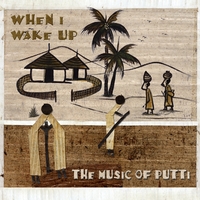
Some of you might remember a few years back when the wonderful Smithsonian Folkways album "Abayudaya: Music From The Jewish People Of Uganda" was making the rounds. Recently, a new album was released on the same theme...this time music by Jewish Ugandan's from the town of Putti. The album, Music from Putti, is part of a fund raising effort. If you like the video you should go grab a copy of the album from CD Baby.

Ugandan Jew praying in fieldI love listening to recordings like this. First, I love hearing new (to me) Jewish songs and melodies. Second, I love straight-forward, no frills, no big production, albums. And this one's a joy from both counts. It's maybe a bit rougher than the Smithsonian Folkways album, but no less fun. If you want to know more about the Abaydayan Jewish in Putti, check out a short history on the Jews in Uganda website. On interesting bit on the website is the

Putti Jews Original - "Bless Hashem"

Saturday, October 17, 2009

Notes on my "Silver Age of Jewish Music" talk

I normally don't post on Shabbat, but I'm up at 3 in the morning and my brain is buzzing about my upcoming Ignite Ann Arbor talk "The Silver Age of American Jewish Music is Happening Now! And Why We're Missing It." I posted earlier this week about the talk, so I won't repeat the details here. Other than to say giving a 5 minute talk is not easy and I'm more than a little bit stressed. I can't convey a real nuanced story in 5 minutes. Anything I say will be fundamentally wrong or misleading in some major way. I just have to deal with it.

I've spent the last 2 hours working out a rough storyboard of my 20 slides. I get 15 seconds for each one. Whew. Here's a pretty close approximation of what I sketched out. Sorry the formatting's crummy, but it's 3 am. Comments anyone?


#DesignNotes
1?Fast intro: I write a blog on Jewish Music. Not a musican
or expert. Just a rookie fan.
2Words/album covers 'klezmer/Dave Tarras', Cantorial/Jan Peerce', 'theater/fiddler', 'folk/hava nagila'I knew a few random bits that had come through what passed for a national Jewish musical culture in the 1970's.
3Avant-garde / Kelka Red & Frum-Pop / LipaI found this. (play 7 second music clips)
4Jazz / David Chevan & Reggae / Matisyahu(play 7 second music clips)
5House / Ghettoplotz & Misrachi Chamber / Davka(play 7 second music clips
6Sephardic Indie / DeLeon & Pop Liturgical / Sam Glaser(play 7 second music clips)
7Hip Hop / Y-Love & Yiddish Blues / Wolf Karakowski(play 7 second music clips)
8fill screen with album coversAnd lots more. Art music. Bible-gum. Yiddish Gothic. Boy Choirs. Niggunim. All happening now. But how come I didn't know about this?
9Pictures of 1930's Jewish NYC
Because I don't live here. I'm not living in a predominately Jewish are w/ defining a Jewish culture & media
10Picture of 1940's Catskill resort
The Golden Age of Jewish Music was in the 20's through 40's, right along with the big wave of Jewish immigrants from Europe
11Picture of Jewish big band / swing albums?
Who like most immigrant groups clung to culture & community while at the same time radically assimilating and reinventing themselves
12pics of a yiddish radio station, theater, newspaper and the Eldridge Street Synagogue. Their media, and cultural lives, were tied up the local Yiddish radio station, theater, and newspapers and shuls with a superstar cantors.
13?I, and most Jews in the US, are products of that assimilation. We don't have that community & media because it's largely vanished.
14pics of Orthodox & Chassidic media (e.g. JM in the AM, a Big Event type poster, the Jewish Jukebox logo, a current frum-pop album cover.Though it still exists in pockets, predominately in the small but vibrant Orthodox and Chassidic communities
15pics of 1950's through 1980's JM albums. Bagles & Bongos. 'Hear O Israel: Service in Jazz.' 'Brothers Zim' 'Jan Peerce' 'Israeli Kibbutz Singers'Jewish music didn't die but it lost relevance and focus. It became marginalized, attenuated, and self-referential.
16kapelye album cover, Sholomo Carlebach cover, Jeff Klepper or Debbie Friedman cover. Flory Jagoda album coverNow it's exploding again. Kicked off in the 1970's by the klezmer revival and by Reform camp music & Chassidic folk-niggunim entering the liturgy, and in the 1980's by a world music scene that pushed local ethnic diversity as a marketing gimick.
17map of Jewish population centers in the US with a television in the middle of it.But I live here. We American Jews get our media awareness through mainstream American channels. Unless you're visible to the mainstream media (eg. Matisyahu) most American Jews don't know to look. We're in a silver age of Jewish Music, but most American Jews don't know it.
18images of YouTube, MySpace, CD Baby, Teruah blog, Jewish Music Report The Internet is making a difference. It makes everything more accessible, but you still need to know to look and now what to look for.
19image of a social media graph. maybe with facebook or twitter logos.Without a central media, we are only exposed to it through word of mouth. This is a classic social network problem. And the new social media tools might be part of the answer. There is a rich community of transnational & transdemonational Jews self-organizing on facebook & twitter .
20overlay faces taken from twitter & facebook feeds I follow. So if Jewish music is interesting, go to synagogue, go to concerts, buy mp3s and CDs, watch videos & read blogs. But talk about it, tweet or status update about it, and let people know. Culture only happens in a vibrant community. It's time to rebuild one.


I think I need to shrink the Golden Age section by one slide and expand the social media section by one slide at least and give a really concrete example maybe use Patrick A from Can Can / Punk Torah as my poster boy of musician use. (you cool with that Patrick?) Also should think about a good example of non-musician/publisher/blogger usage. Maybe a page of interesting recent twitter comments.

* note, I'm thinking about using a light gold background on slides relating to the Golden Age and a light silver background on current slides. I'm not sure if that will work or not.