L'shanah tovah, everyone. May you be inscribed and sealed for a good year.
Shofar Jam Session
Hat tip to the folks at TuneUp Media for posting the video.


TTT :: Sois Osis • Dovid Gabay
12 years ago

 This video was released last year so some of have probably seen it already but some how I missed it. I actually ran across it looking for some Rosh Hashanah themed songs for a Rosh Hashanah party I'm going to on Sunday. My primary contribution to the party will be home made candy apples. I'm all for the traditional apples and honey, but ever since I was a kid fall meant country fairs and country fairs meant candy apples. As an adult, the Days of Awe have a lot more meaning, but candy apples still capture the season. They're also a lot of fun to make. This year I hope to only give myself one serious burn. That'd be nice.
 Recently I started paying more attention to Jewish contemporary political songs. The first set I looked at focused specifically on the Israeli Palestinian conflict. Today I want to look at two songs about Jonathan Pollard. Pollard has been a cause célèbre among a segment of world Jewry for the last 20 years or so after being sentenced for passing classified material to the Israeli government. The reason for his celebrity is two-fold. First, he claims that he only provided information to Israel that was critical to its security and that the US had pledged and failed to provide. Second, his sentencing was considered overly harsh. He is still serving a life sentence for a crime where, according to JonathanPollard.Org "[t]he median sentence for the offense Pollard committed - one count of passing non-injurious classified information to an ally - is two to four years." There are lots of complications and counter claims made about this case (see wikipedia for a rundown), but the bottom line is that Israel and members of world Jewry still remembers Pollard and lobby for his release. And they write songs about him.
Well, the Gulf War came and soon the bombs would rain, but you know we were preparedDovid Kerner's 'Justice Denied'
As in days before, spreading blood by the door, awaiting the wonders that we all would share
We knew what to expect, we had a peak in the deck, because the deed was done
If it was Esav's hand it was Yakov taking his stand
You know there's nothing new under the sun.
 Just a quick side note, Kerner's album "Bond of Love" is worth a listen if you groove on the late 60's Dylan sound. To my taste it leans a bit heavy in that direction and the album has a few real duds on it. That said, though, the album has some fine moments, Justice Denied being only one of them. I'm particularly fond of Kerner's narrative songs including Pillar of Fire, Justice Denied, Thirteen Jews, and Ballad of Ruth & Naomi. Definitely worth a listen. You can learn more about Kerner and hear each of the songs at his website, KernerSongs.com.
"Lonely prisoner,
Sand runs through your fingers, days run through the bars,
And you sit... and you wait.
Lonely prisoner,
Has your hope turned bitter, lost faith in those you saved?
Still, you sit... and you wait"
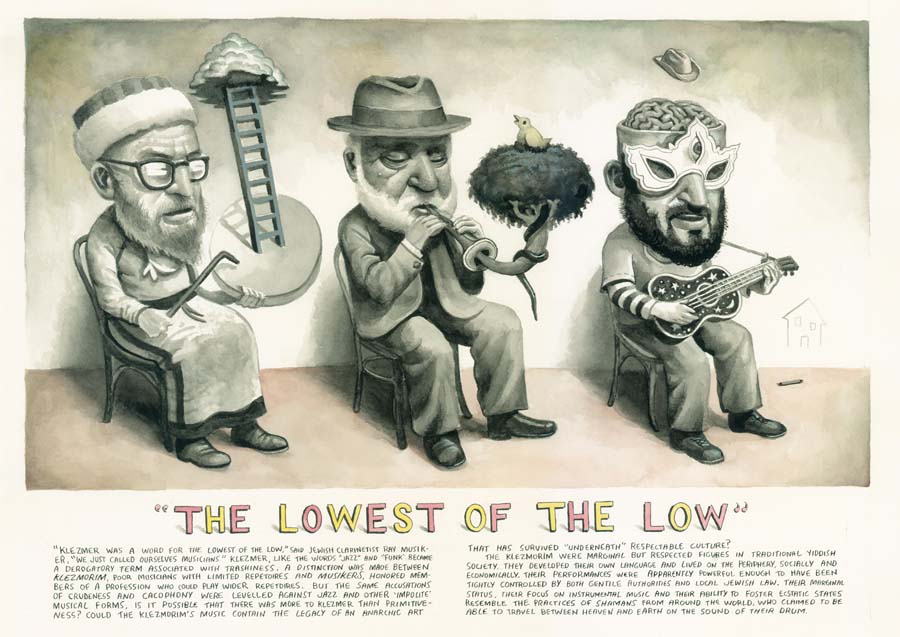
"Nice to hear from you. I had seen your blog before and dig it. "mix of skill levels"- ha! yes I guess that's one way to say it. As the accordion player I probably represent one extreme of those levels but hey, I'm having fun.Hat tip to YouTube user Accordiannutz for posting this video and a stack of others.
The WNKC is a group of folks who just get together occasionally and play off of a core repetoire of trad klezmer. We all live near Carrboro NC. My idea was that instead of band, we would be a loose affiliation of folks who could come and go as they please. I thought this might be an interesting way of building a community- slightly different than the sort you get in a traditional "band" situation. So far so good. Yup, it was a practice, right after we all had some tasty pickled eggplant, mushroom flatbreads, fried cheese thingies and some other tasty stuff I can't
remember."
 Svigals is a mainstay of the contemporary klezmer scene. She was one of the founding members of the Klezmatics and "All Woman Yiddish Song" group "Mikveh," as well as an amazing solo career. You can find more info her adventures and recordings at her website, AliciaSvigals.com. I hadn't been to her site in a while and was struck by this quote. Partially, because of it's such a capsule summary of the Klezmer revolution and partially because it reminds me of how little I know about Workman's Circle and the Yiddish Socialist movement. Another area I'll need to explore further.
"When I was little I divided my afterschool time between Bach violin concertos and weekly classes at the local Workmen’s Circle school, where we were taught, somewhat eccentrically, Yiddish and socialism, while the rest of the Jewish world was studying Hebrew and preparing for their bar/bas mitzvahs. I couldn’t have imagined then, a presumed future doctor of some sort, that eventually those elements would coalesce into a career that would take me around the world, and that I’d get to witness and even assist at the miraculous rebirth of Yiddish culture in our day. And that some pretty weird things would happen along the way.
At the Workmen’s Circle we were taught Yiddish folksongs, chestnuts which our teachers hoped would help innoculate us against assimilation. One day as a teenager though, I heard something that compelled and excited the musician in me: clarinetist Andy Statman bringing the old Jewish instrumental music now called klezmer back into the light of day. The complexity, beauty, mystery and power of the music gripped me. When I graduated college in 1985 I answered an ad placed by a musician looking to form a klezmer group; we soon became the Klezmatics. As I struggled to decipher how the musicians on the old 78s made those mysterious sounds – like a cantor singing, like Yiddish without words, sounds that sounded so Jewish – our career started unexpectedly taking off.
Looking back I can see that although Yiddish culture seemed sparse around the world at the time, and some thought my career choice a little flaky, the world was in fact pregnant with Yiddish culture, still hidden but ripe and ready to emerge again everywhere we turned, among Jews and non-Jews too."
"Symbolic of death and rebirth, the dance is traditionally done by men or boys after the ceremony when the status of the wedding couple has changed from single to married. The Tkhies hameysim tants or Death and Resurrection Dance, which I have witnessed at American Hasidic weddings in Brooklyn since 1975, is a freely choreographed pantomime for two men in three parts, accompanied by a medley of three separate melodies. Part I, a broyges tants, begins with two male friends sharing a bottle of whiskey in the center of a circle. One man tries to take the bottle, a fight ensues, and his friend lands on the floor as if dead. Part II, the revival of the dead man, is a slow doina section in which the Hasid, realizing what he has done, bends over his friend in order to resuscitate him. Using all manner of gestures with his handkerchief to bring him back to life again, the Hasid finally succeeds in awakening his partner, lifting him to his feet, and presenting him with the bottle. Part III, the final section is a freylekh of friendship and simcha. ... That the tkhies hameysim tants might have been transformed from the co-territorial non-Jewish population is suggested by comments from dance scholar Elsie Dunin, who saw this dance performed among the gypsies in Eastern Europe."See the cool things you miss if you don't get invited to Chassidic weddings? I was proud of myself for getting a hora going and for hoisting my cousin up in a chair at her wedding last week. Not for a minute did I consider involving chicken bones in the process. Major oversight on my part. One note before you watch this, from what I've been told this video is representative of the dance but not nearly the height of musicianship and choreography that some weddings achieve. All I can say to that is, you should me and my cousins dance at weddings. These guys do fine.
 Hi folks. I got a nice email a couple of days ago from Lisa Paglin of the New Voice Studio Italia that I thought I'd pass along.
"I am writing to you from Ancona, on the Adriatic sea below Venice. Ancona was once an important Jewish center and, sadly, like so many European cities and towns, now has a very small Jewish population. But we do have some interesting cultural activities and one of them is the International Adriatic - Mediterranean Festival which begins on August 30 the (the inauguration was yesterday!) and ends on (and includes) the European Day of Jewish culture, the 7th of September. It is a festival of theatre, cinema, music, poetry and art.A quick Google check supports what Lisa said. Ancona has supported a couple of klezmer festivals recently as well as the events in her email. That's a wonderful thing. It's really exciting to see the Jewish communities in Europe starting to blossom again. I was in Florence, Italy, earlier this year and was delighted by all of the Jewish music I found happening over there. Check out my previous posts "Cantor Yosef Gottesman, Opera in the Synagogue!," "Mario Castelnuovo-Tedesco," "Singing Dew: The Florence-Leghorn Jewish Musical Tradition," and "Enrico Fink - Italian Klezmer and Theater Music."
I am a pianist and singer and co-founder of the NewVoice Studio ITALIA. If you would like to look at our website, it is here: www.newvoicestudioitalia.com
I have been dedicated, for several years, to researching, restoring and sometimes re-arranging the music of composers who were persecuted during the 1930s and 1940s, and who were active in the Jewish ghettos. I have performed several concerts of music written by composers deported to concentration and extermination camps under Nazi fascism. I am planning a concert for next January, for Holocaust Memorial Day.
This year the theme of the Day of Jewish culture is "Music and Words," so, in addition to the usual opening up of all of the Jewish museums and Synagogues (with free guided tours for many people who have never been to a synagogue...), we are offering several musical events. The one that i am performing is combined with the presentation of a book ("words"!) entitled "Ricomporre l'Infranto". translated as "Reassembling the broken pieces".
Ancona is fast becoming an important city for Jewish music."


Check out my talk at the Ann Arbor District Library last year. "Ignite Second Stage: The Silver Age of American Jewish Music is Happening Now! And You're Missing It!"


 Posts
All Comments
Posts
All Comments


