Showing posts with label russia. Show all posts

Friday, July 8, 2011

The Russian Jewish Experience Part II: Shalom Comrade!

Shalom Comrade! album coverIn doing a little more homework on Russian Jewish music, I came across a wonderful archive album titled "Shalom Comrade! Yiddish Music in the Soviet Union 1928-1961." The album, which was produced in 2005 by ethno-musicologist Ritta Ottens and ethno-musicologist / klezmer musician Joel E. Rubin, both through it's music and extensive liner notes helps fill a critical gap in Russian Jewish history. As I noted in yesterday's post, there is a tendency by American Ashkenazim Jews (including myself) to marginalize the history and experience of Soviet and post-Soviet Jews. It defies the 'escaping the old world of the Shtetl (poverty, orthodoxy, anti-semitism) to the new world of America (opportunity, liberalism, assimilation)' foundation myth that underlies a lot of our cultural narrative. The Soviet Jews didn't escape. Instead, under pressure of the Soviet system they were slowly transformed, with results no less dramatic than the transformation Ashkenazi Jews experienced in the West.

One of the drivers for the Russian transformation was the conflicted view that the Soviet leaders had toward Judaism. As Ottens and Rubin note,
"Stalin’s cultural ideologues planned to deploy the music of the Yiddish-speaking Jews of the Soviet Union as a building block for the new Soviet music, whereas the Jewish religion with its traditional way of life was damned as counter-revolutionary."
As I've written previously, when talking Russian Jewish art music, there was an amazing output of art music in the early days of the Soviet system that drew on Yiddish folk and Jewish liturgical music. This music was composed by Jews and non-Jews alike, including Dmitri Shostakovich, one of Soviet Russia's premier composers. This activity faded though as the religious life of Soviet Jews came under more and more attack by the Soviet regime. As Ottens and Rubin note, not more than 200 to 300 (Yiddish popular and liturgical music) recordings were released up to 1967. They compare this with approximately 10,000 similar pieces recorded in the West.

This scarcity of these recordings make the Shalom Comrade! album that more special. At 24 tracks, it contains over 10 percent of the entire recorded output of Soviet Jewish music of that period and covers a range of thematic topics the show integration and tensions of Soviet Jews. This first sample (from Rubins website) is a Yiddish art song composed by B. Bergolt, lyrics, and Moses Milner (score). The song is performed by Misha (Mikhail) Aleksandrovich, who was born in Latvia, lived in Britain, and after World War II became one of Soviet Russia's most popular performers. Here's a translation of the lyric from the album liner notes.
Last night grandma suddenly remembered how grandpa came back from the Civil War front. Her big tears shone happily as she embraced him, danced and cried. That’s how they partied, into the deep of night, the tables broke under all the honey-cake and wine. A glass and another glass, higher and higher in the hand, to spite the enemies and to the joy of our country. Many years pass by with peace everywhere, and an old lady sits with her grandchildren around her and tells of the Great Fatherland War [World War II] and what a holiday it was when grandpa came back in victory.
Misha Aleksandrovich / Di bobe hot zikh dermont (Grandmother Recalled)(M: Moses Milner; T: B. Bergolts)


This second sample was, as Ottens and Rubin note, "belonged to the handful of warhorses which every Soviet interpreter of Yiddish song had to have in his or her repertoire." This version, performed by Zinovii Shulman, was the one that popularized the song.
Oh dear! Where do you get flour to make varnitshkes? [A plain
dumpling ]?
Without yeast or salt, or pepper or fat. Where do you get a board
to roll out the varnitshkes? Where do you find a stove to cook
the varnitshkes? And where do you find a lad to eat the
varnitshkes? Without yeast or salt, or pepper or fat. Where do
you find one, where?
Zinovii Shulman / Varnitshkes


The album can be purchased through The Workman's Circle and, of course, Amazon. And did I mention the extensive liner notes?

Wednesday, July 6, 2011

The Russian Jewish Experience: Soviet Jewish alienation with excellent production values

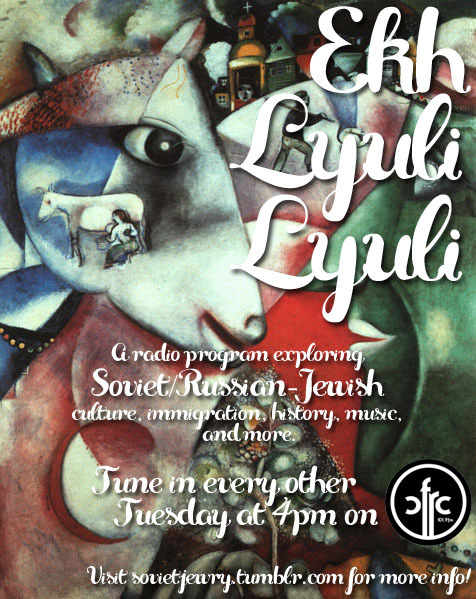
Ekh Lyuli Lyuli radio program posterI've been chatting on twitter with Russian/Canadian Jewish blogger @vladislavab. She did a fascinating mini-documentary recently called "Soviet-Jewish Alienation within the "Bagel-and-Lox Culture" with an accompanying blog and now radio program & podcast. She's interested in how her experience, the Soviet Russian Jewish experience, differs from and enriches the dominant North American Ashkenazi Jewish culture. I'm looking forward to chatting more with her. We share (I think) very similar views about a mutually enriching trans-national, trans-denominational Jewish community.

What we've been chatting about is, of course, Jewish music. She was looking to add to the collection of interesting Russian Jewish musicians that she plays on her show. I tossed out a few of my favorites including Lampa Ladino, Lana Ross, Psoy Korolenko, and Turetsky's Choir. This got me obsessing about Russian Jewish music and needing to find more.

Enter Yakov Yavno. Actor. Singer. Russian Jewish Icon. My new music crush.

Like Turetsky's Choir, he mixes the over-the-top theatrics and earnest sincerity that I love about Russian productions. There is no ironic detachment here. This is the Russian Jewish experience to the max, baby. More is definitely more.

Here's his blurb...
Yakov Yavno, also known as YaYa, is one of the most preeminent performers to immigrate to the United States from the former Soviet Union.
He was raised and came of age surrounded by the intertwining of a variety of cultures and peoples that have shaped and developed whom he is as a human being and as a performing artist. Within this melding of cultures, he often faced a difficult daily reality, witnessing firsthand the struggle between the ancient and modern, opposing religious factions and cultures, and in particular, the unique journey of the Jewish people of Russia.
Following studies at the Gnesin's Academy of Music in Moscow, Yavno became the leading star of the Jewish Musical Chamber Theater of Moscow. In 1987 the Russian government awarded him the coveted title of “Artist of Special Merit”.
His captivating performances are filled with a sense of purpose; a vision, as is evident with numerous sold-out concerts throughout Europe, Asia, Australia and the Americas. His festive staged showcase "The Road Home" incorporates an orchestra with choirs and contemporary dancers as well as cameos by well-known local guest-stars from the countries in which he performs. It was filmed as part of a documentary by the same name. Yavno’s solo show, “Revelations”, intersperses a musical program with tales of the artist’s journey from Russia to America; it features international combos integrating storytelling and philosophical discussions. His memorable solo performance, “Songs of Our Soul”, premiered at New York’s Kauffman Concert Hall in 2007.


Unlike Turetsky's Choir, he's based out of New York City, which means I have a chance to see him perform live. I will make this happen. I will. I will.

Getting back to vladislavab's point about how Russian Jewish culture should be thought of as enriching Ashkenazi culture, and not being an inferior shadow of it. Who in the Ashkenazi community hits the stage with the energy of Yavno or Turetsky's Choir? Yeah we've got some great cantors concerts. And no shortage of klezmer bands. And my favorite Jewish pop bands. (Yes Matisyahu, I'll be seeing you on Sunday night). But they don't even get close. We Ashkenazim have got a lot to learn.

Wednesday, March 30, 2011

Turetsky's Choir - the Russian Jewish answer to Riverdance

If you want a full on Jewish music pageant, it's hard to beat the Russians. The following video, from the Turetsky Choir, is a great example but only one of many I run across. It's an incongruous (to me) mix of some seriously good male vocalists, Jewish folk and liturgical music, and a high production value stage and pop instrumentation. Much like Riverdance does for Irish music and dance, it at the same celebrates and trivializes Jewish music.

I'd pay big bucks to see it live. And then need to take a shower.

The Turetsky Choir is led by Mikhail Turetsky, who first came to prominence in 1989 in Russia as the choirmaster of the Moscow Choral Synagogue, the main synagogue in Russia. Initially, Turetsky's choir was exclusively an art music project that produced concerts and recordings of primarily Jewish music. Over time, though, it added the flamboyant sets and pop sensibilities it's known for and began to mix Jewish music with pop and musical theater pieces.

And no, I don't know if any of the choir members, including Turetsky, are Jewish or what being Jewish might mean to them. To read the YouTube comments on this video, you'd think they were either treif impostors or best thing since Golda Meir (who, for the record, infuriated the Soviet authorities by visiting the Moscow Choral Synagogue back in 1948). And I'm not sure how much it matters. Seeing a bunch of seriously good male vocalists singing Jewish music to a huge crowd of Russians, in the face of the centuries of discrimination that Russian Jews have faced, does my heart proud.

Sing it loud, guys. Who cares if you know what you're singing. (Though I'm betting you do.)


For more info on the Turetsky Choir, see their website, for their recordings, see Amazon. Amazon doesn't actually stock them, but has them listed. If anyone knows a good source of import Russian recordings let me know. I'd love to pick up a couple.

Update: Score. I picked up one of Turetsky's early recordings at the Moscow Synagogue on eMusic. It's a very good recording of a synagogue male choir. No pop. no fanfare. Great singing. Now I have to track down one of the later recordings.

Monday, October 8, 2007

Sophie Milman - Jazz Canadian Russian Israeli

Sophie Milman in Jewish MagazineMy wife and I had National Public Radio on for background noise this weekend (though, why, with two kids, we think we need background noise I'll never know) when an interview with jazz singer Sophie Milman came on. Milman is an interviewer's dream. She's got the requisite amazing history (born in Russia, moved to Israel and then Canada, a (not quite) debut album, and a big buzz working for her. And she has that kind of deep warm buttery toast voice that had earlier generations of jazz fans falling in love with Sarah Vaughan, Rosemary Clooney, and Dinah Washington. My wife was blissing out to her singing in general, but snapped out of her reverie long enough to grab me away from the sink when Milman launched into a jazz arrangement of the Israeli Jewish standard Eli, Eli.

Eli, Eli was poem written by the poet Hannah Senesh in 1942 in Israel, before she volunteer to parachute into Yugoslovia to help Jews escape. She was executed by the Germans in Hungary in 1944. Eli Eli, with music by David Zehavi, is a powerhouse of a song and has become a classic Shabbat z'mirot.

"O Lord, my God, I pray that these things shall never end.
The sand and the sea,
the rush of the waters,
the crash of the heavens,
the prayer of man."


Milman's take on Eli, Eli may miss a bit of the fervor I've heard in other arrangements, but the slow measured pace picks up a wonderful sense of longing that more than makes up for it.

You can listen to Milman's recording of Eli, Eli at her myspace page and read more about her at her home page. Here album, "Make Someone Happy" is available through Amazon or your favorite music store. And check out this George Robinson Jewish Week article and interview with her.

"In Canada, I’m Jewish first, Israeli second. When people start on the Jews, that’s when I get very Jewish. Obviously I’m Israeli whenever I turn on the news. I’m Canadian when I’m in the United States. I am a collection of all these things..."