Showing posts with label liturgical. Show all posts

Thursday, June 30, 2011

Reb Yosil Rosenzweig - Still rocking and davening

You want to hear a track that rocked my world recently? Press play.


Now go read the story.

Wow. What an wonderfully simple, wonderfully intense recording and an immediate add to my playlist.

So who rocked my world? Reb. Yosil Rosenweig, my (handsome and modest) pal Benji's dad, and long time Jewish music fixture. I want to say icon, but can't quite. Reb. Yosil has written songs and made music with two of the most important folks in Jewish music in the 20th century; Chassidic rabbi and folk singer Shlomo Carlebach and Avraham Rosenblum, founder of the Diaspora Yeshiva band, the seminal Israeli Jewish rock group. But he, himself, never rose to the icon status of Carlebach or Rosenblum. But, icon or not, Reb Yosil has been making great Jewish music for a long time. And as evidenced by the track above, he's still doing it as well as anyone.

Pitchu Li album coverAbout a year ago Reb Yosil released Pitchu Li, his first solo album. It's a recording of Reb Yosil with his Kosher Gravy Company live in concert, with Reb Yosil telling stories, giving Torah, and singing some of his many songs. He's backed by a fine, bluesy jam-band. Doing a more detailed review of the album had been on my to do list for a while (sorry Benji), but I'd had trouble getting started. I'm not much of a fan of fine, bluesy jam-bands. Just not my style. And Reb Yosil's voice is a bit rough in spots. I bet I would have loved the show... but the album? Good, but not great.

But then I heard Reb Yosil's Rosh Chodesh recordings. Particularly the Mah Ne'Daber. And I was hooked. There's a fire to his solo recordings that I didn't get from Pitchu Li. Mah Ne'Daber is incandescent. I now look forward every month to his next Rosh Chodesh song. They're offered monthly for free download. If you've missed them, go get them. Or wait a couple weeks. Pretty soon they're going to get bundled up as Reb Yosil's next album. It'll be a great collection. Then he'll start the process over with a bunch of new songs, one per month.

I got the chance to sit down recently with Reb Yosil and hear a bit of his life story. I was really interested in finding out more about his relationship with Carlebach and Rosenblum and, given his obvious talent, why he ended up in their shadows. And why the new recordings now after all this time? The answer revolves around the life of a Canadian pulpit rabbi and musician who found himself in Israel in the late 1960's, a moment when North American ba'al teshuva were coming to Israel in waves and creating a new Jewish music scene that mixed rock music and spirituality, Zionism and Torah.

Reb Yosil and Shlomo CarlebachReb Yosil, far right with glasses and white yarlmuke, and Shlomo Carlebach, left with silver yarlmulke and guitar)

Reb Yosil moved to Israel in 1968 for "a four year summer." During that time he started composing music and met and played with Carlebach. Like Carlebach, Reb Yosil was interested in being able to use music as an emotional component of prayer. (And like everyone who knew Carlebach, he has some great Carlebach. Listen to the intro to Reb Yosil's Gam Ki Eilech for classic from the days of the Yom Kippor war.) At the same time he met and married his wife (whom he met at a Carlebach wedding) and opened a restaurant, and in 1971 started a band with Avraham Rosenblum called B'nai Tzion that included original material and popular Jewish song by The Rabbi's Sons and the Simchatones. B'nai Tzion played regularly on the stage in Reb Yosil's restaurant and at NCSY event. At that time he composed the songs Tzadik Katamar Yifrach and Pitchu Li, songs that went on to be hits for Rosenblum's next band, The Diaspora Yeshiva Band. Performed by DYB, Pitchu Li won Israel's 1976 Chassidic Song Festival. In 1978 DYB won again, this time with Reb Yosil's song Hu Yiftach Libeinu.

Reb Yosil (guitar, on right) Avraham Fried (the fellow with the beard who's standing and singing) and friends
Reb Yosil (guitar, on right) Avraham Fried (standing and singing) and friends

But DYB won these songfests without Reb Yosil, who was never a member of the band. Yosil wanted to be a rabbi, not a full time musician. Prompted by that and the opportunity to work with the Canadian Zionist organization, Yosil and his wife had already moved back to Canada when Pitchu Li won the festival. Yosil spent the next 30 years as a pulpit rabbi and raising a family, using music in his rabbinic work and playing community concerts and kumzitz. After a recent bout with illness, Reb Yosil retired from the pulpit and started playing music regularly again, putting together the Kosher Gravy Company band and playing concerts around Ontario and Detroit.

It's pretty exciting for a Jewish music geek like myself to see someone writing and performing new material in the style that was popular in Jewish music the late 1960's / early 1970's at that birth of Jewish rock. Particularly, it's exciting to see that music from someone who was there at the time and contributed classic songs to the repertoire.

Friday, April 8, 2011

A lo-fi freak-folk Shabbat: Rob Markoff's "Sabbapath: To the Seventh Sunset"

Shabbat shalom everyone,

I'm getting a bit to close to shabbat for a long post, so just a quick pointer to a great new Shabbat album that just hit the streets. JDub just released, for free download, Rob Markoff's lo-fi rock album "Sabbapath: To the Seventh Sunset."

"Sabbapath, through Markoff’s vision, remixes and re-contextualizes the traditional Friday night service. It features spirited singing, droning voices, flutes, harmonium, strum stick, guitars and autoharp to create a singular, psychedelic, celebratory freak-folk album."

This one's a keeper, gang. Check out JDub for the full story and the download.

Tuesday, April 5, 2011

Performing Piyyutim

Last Thursday, WNYC's NEXT New York Conversation series put on a fascinating lecture and concert titled "Performing Piyyutim: Sephardic Music, Poetry and Spirituality." I missed the webcast. I was at the Detroit JCC's Stephen Gottlieb Music Fest that night. Fortunately for me and the rest of us, WNYC put the webcast up for viewing. I knew that ethnographer Samuel Thomas and his group Asefa was performing (see my previous post) but forgot that Asefa included the amazing Yoshi Fructer, who graced the Gottlieb Music Fest stage the previous week with his amazing avant-garde jazz/rock group Pitom. In addition to Thomas and Fructer, the evening included the Moroccan born Rabbi Gad Bouskila of Congregation Netivot Israel, Brooklyn and Rabbi Joseph Dweck of Congregation Shaare Shalom, Brooklyn. This is a must listen, folks.

Here is WNYC's description of the event.
"Today in Brooklyn, where disparate Jewish groups from the Middle East are engaging one another in an unprecedented way, the piyyut – the Hebrew term for a sacred poem – serves as an expression of a specific type of Jewish identity. Spanning five centuries since the expulsion from Spain in 1492, these piyyutim express unique conceptions of the relationship between humanity and the Divine and serve as the backbone of the quasi-classical musical traditions of different Sephardic immigrant groups who now call New York home.

Following an introductory discussion, Thomas, accompanied by his ensemble Asefa and other traditional musicians, will present a lively musical performance of Sephardic piyyutim. Intertwining musical performance with discussion, Syrian Rabbi Joseph Dweck and Moroccan Rabbi Gad Bouskila will illuminate how the intersection of Kabbalistic and Sufist thought in Sephardic cultural history inspired piyyutim."


Finally, three last shout outs... First, Asefa just released their second album, Resonance. The samples from the website are gorgeous. Check it out.

Second, Pesach is coming. I recently ran across a wonderful CD of Sephardic Pesach music recorded by the folks at B'nai Jeshurn, NYC.

Third, during the performance / lecture Samuel Thomas talked about contrafactum music, where existing music is re-purposed with new lyrics. The always excellent "On the Mainline" blog recently wrote a post on this topic titled "The original Shlock Rock: R. Yisrael Najara's 16th century religious Hebrew poetry set to Middle Eastern rock music."

Sunday, March 27, 2011

For salvation, Kaddish. For redemption, Kaddish. For revolution, Kaddish? Ofra Haza, Twitter, and the Yemeni Revolution

It's rare that Jewish music has international prominence and when it does it's usually because of some dustup over Israel. For a current example, check yesterday's Israeli National News article "Jewish Music Group Rejects Israeli Money After Threat." While an interesting and frustrating article, Jewish music itself plays a small role. The article could just as easily been about a Jewish literary group or student group. Not so this morning.

Today I woke up to a twitter discussion between National Public radio strategist and digital technology community organizer Andy Carvin and Maria Al-Masani, a Canadian public relations agent, model, and former Miss Universe Canada. Al-Masani was telling Carvin, and others, about how Ofra Haza's song Kaddish was becoming the anthem of the current Yemeni revolution. Haza was a popular Israeli singer of a Yemeni-Jewish family who sang pop-Israeli, Yemeni-Jewish, and Yemeni-Arabic music.

Here's the exchange:
Al-Masani Saturday 3/26, 23:09: @acarvin @TomOdell Andy you are jewish? That's wonderful! Have you heard the music of Yemeni-Jewish singer Ofra Haza? http://bit.ly/Ja6MB
Acarvin Saturday 3/26, 23:11: @ was a big fan of hers before she passed away, RIP.

Al-Masani
Saturday 3/26, 23:13: @acarvin same here. :-) Her music in general but especially her song kaddish is played by so many in Yemen as sound track to uprising

Acarvin Saturday 3/26, 23:14: Yemeni Jewish singer Ofra Haza and the revolt. Wow. RT @al_masani: her song Kaddish is played by so many in Yemen as soundtrack to uprising

Al-Masani Saturday 3/26, 23:14: Awesome! @jilliancyork Loving how @acarvin is standing up for Muslims against Twitter hate tonight.

zweever212 Saturday 3/26, 23:22: http://youtu.be/GG0ic19pL2o Israeli singer Ofra Haza's song Kaddish played by many in Yemen as an inspiration for uprising. / @al_masani

Al-Masani Saturday 3/26, 23:26: @zweerver212 to us she is Yemeni. She also sings many songs in traditional Yemeni dialect.

Al-Masani Saturday 3/26, 23:27: @gfry @emilylhauser Ofra Haza is a source of national pride for Yemenis. We have a Yemeni-Jewish population, many are Israeli citizens

zweever212 Saturday 3/26, 23:28: @al_masani well yes, she's a yemeni jew, i've heard her songs in the dialect since im an arabic student. we're all one people.

Al-Masani Saturday 3/26, 23:27: @zweerver212 exactly, Jews, Christians Muslims united against brutal regimes #MENA #Egypt #Yemen #Libya
Ofra Haza singing Kaddish at the Montreux Jazz Festival in 1990*

Haza's Kaddish isn't the liturgical prayer of the same name. But, similarly to Alan Ginsberg's poem Kaddish, picks up on themes from the prayer to create her own secular prayer for peace and redemption. It's a deeply moving song and it's wonderful to think of it being adopted by a people striving for redemption and peace.

The discussion is also fascinating as it shows how labels like Yemeni, Israeli, and Jew are negotiated. Haza fits all those categories, but the commentators, for their purposes, preferred more restricted descriptions. Yemeni. Yemeni-Jew. Israeli. When confronted both were able to step back to the larger label set. The result... the restricted categories turned out to be ways of describing the commentator, not Haza.

Just as a note, I don't have any independent confirmation that what Al-Masani said is true and that Haza's Kaddish is really being played in Yemen right now. If anyone has any additional information, please let me know.

* The video I posted is not the video linked in the twitter discussion, which is more pop and more English language. It's not clear from Al-Masani's tweets what recording is being played right now and the Montreaux recording has always been a favorite of mine.

hat tip to OfraFan for uploading the video.

Tuesday, November 30, 2010

Jewish liturgical work debutes...at the Vatican

Cantor Erik Contzius recently debuted his lovely new composition, "Mah Ashiv Ladonai - quid retribuam Domino" on November 16, 2010 at, off all places, the Vatican. According to the New York Jewish Week, "Twenty cantors of the American Conference of Cantors(ACC) will present for the first time a concert of Jewish music at the Basilica of Santa Marie degli Angeli e dei Martiri in Rome on Nov. 16 before Vatican officials, hoping to use music as another way to achieve closer relations between Catholics and Jews." The composition is a setting of Psalm 116. I find Mah Ashiv Ladonai, like Contzius' compositions, to be quite moving. Check out his website and, in particular, his recording "Teach My Lips a Blessing." I'm a fan.

Mah Ashiv Ladonai - quid retribuam Domino Premiere


Update: I just got a note from Ruth Ellen Gruber pointing me to her article in the JTA on the concert. It's a great read and provides a lot more detail and context for the concert. On of the elements of the story that she picks up on is dynamics of Jewish movements (denominations) and how they played out. While Italy has a Jewish community, their cantors have never sung for the Vatican. Why? Because they're Orthodox and wouldn't sing in a church. The ACC is Reform and didn't have an issue with it. Also, while Italy has a chief Rabbi, he didn't attend the show. Why? Because the ACC group included women cantors, which violates the Orthodox kol isha rules about women singing in public. Again, the ACC is Reform and have no such restrictions. What makes this double fascinating is that, in the four or five different articles on the even I read, only Gruber's draws out this critical detail.

Friday, November 19, 2010

A Contemporary Kabbalistic Kabbalat Shabbat: Shir Yaakov & The ADVA Network Reunion

Hi folks, Shabbat shalom.

I've mentioned before that I'm a fan of Shir Yaakov Feinstein-Feit and his many musical adventures. He's a deep and soulful guy. For this week's 'get in the Shabbat groove' music, I want to share a lovely Shabbat service that he uploaded to Soundcloud. This is a wonderful example of where a Jewish community can go with Shabbat service that includes instrumentation but isn't a folk-pop guitar focused songleader or piano accompanied communal sing (not that I have an issue with that style). It's something else entirely and not something that can be easily replicated on your average Shabbat. But it really took my breath away and dropped me right into a Shabbat zone in the middle of a work-a-day Tuesday. Wish I was there.

Here's the short description Shir Yaakov's provided on SoundCloud. After the player, is a longer explanation of the event and how the service was conceptualized and planned.

"Friday, November 12, 2010 about 100 alumni of the ADAMAH Jewish Environmental Fellowship and the Teva Learning Center joined their hearts and voices together in prayer at the Isabella Freedman Jewish Retreat Center"

ADVA Reunion Kabbalat Shabbat 2010 by shiryaakov
Shir Yaakov - "Two years ago the ADVA Network was combined to bring together alumni from two programs of Isabella Freedman Jewish Retreat Center: the ADAMAH Jewish Environmental Fellowship and the Teva Education Center. (Adva means ripple in Hebrew.) I lead Kabbalat Shabbat for our Reunion last year but didn't post the whole service. I posted almost all of this year's service, except one song which became very loud and overloaded the recording.

For the first time this year there were three Friday Night davvenen options: orthodox, traditional egalitarian w/o instruments, and the service I led. This gave me more freedom to move away from the traditional matbeah and develop a kabbalah-inspired form. It was parshat vayetzei, where Jacob has the dream of the sulam/ladder, so I built the service around the sefirot in the Tree of Life array....

The first song we sang — Hareni Mikabel Alai/Dear Friends — corresponded to Chesed/lovingkindness. The matches liturgically with it's theme of love, and also with the essence of the Kabbalat Shabbat service, first developed by the Tsfat kabbalists; the Ariza"l (R' Isaac Luria) taught his students that taking on the mitzvah to love thy neighbor as yourself was a pre-requisite to prayer. Also, the traditional Friday Night service begins with Lechu Neranenah (Psalm 95); the letters of "lechu" — לכו — are an acronym for v'ahavta l'rei'acha kamocha, so I see this as a allusive correspondance. This simple, one part chant also, musically, corresponds to the simplicity of mitzad chesed in the Tree of Life.

I chose a two part, "digging" melody — Lulei Siroscha by R' Shlomo Carblebach — for gevurah/strength-limitations. I wanted to use two-part melodies for mitzad gevurah, seeing as the left-side has the aspect of duality and judgement, sifting. This is apparently one of the only Carlebach niggunim that are still sung in the yeshivish world because he composed it before leaving Lakewood.

As I mentioned above our three-part melody is not in the recording because it became too full and loud for the recorded. I used another Carlebach niggun — Ki Va Moed, which is often sung to Psalm 96 on Friday nights. It's in a major key, and it's three parts allude to the balance, integration and harmony of tiferet/compassion-beauty.

For Netzach/endurance-victory, we return to the simple, one-part chant Yachid Ge'eh. I composed this on 18 Elul, the birthday of the Ba'al Shem Tov. The liturgical source is Ana B'choach (Tefilat R' Nechuniah ben Hakana) and we repeat the work zochrei/rememberers. Memory is linked with netzach and this piyyut has the supplicatory tone of Moshe, who often is voiced in the text as an interceder, and is linked with this sefirah.

Hod/glory-submission comes from a root meaning thankfulness, so I chose Modeh/Modah Ani as the text and this two-part melody to correspond with the side of duality. I also chose this (and other melodies) knowing they'd be familiar to the group I was praying with.

Yesod/foundation was linked with another composition of mine (written 2 Elul 5769); another three-part melody, as yesod is the synthesis of Netzach and Hod. Shabbat is often linked with malchut, however, I placed the two parts of Lecha Dodi there.

I had planned a longer meditation for ma'ariv, but as you can here, this part of our service went much longer than I'd expected.

The musicians involved were:
Cassia Arbabi, violin
Jonathan Dubinsky, percussion
Shir Yaakov Feinstein-Feit, guitar, vocals
Ilan Glazer, percussion
Joanna Kent Katz, harmonica
Rebecca Lemus, clarinet
Elisheva Margolis, flute
Yoshi Silverstein, octave mandolin
Tali Weinberg, vocals
Casey Baruch Yurow, mandolin

Wednesday, November 17, 2010

Getting smart about Jewish art music

I'm going to be giving another Jewish music talk at Temple Beth Emeth in Ann Arbor in January, this time on Jewish Art Music. I suggested the topic because a) it has a rich and misunderstood history and b) I richly misunderstand it as much as anyone. I know a lot less about Jewish art music than I do about other aspects of Jewish music. This has a bit to do with my taste in music and a bit to do with the challenges in tracking performers and composers in this space. I'll be writing a number of blog posts over the next couple of weeks that touch on Jewish art music, both as a way for me to get my thoughts in order and as a way for people to dope-smack me when I go astray. Which, I'm sure, will be often has already started.

Let me start by explaining what I mean by art music. Here's a pretty reasonable starting point, from Wikipedia. * (There is also a Wikipedia article on Jewish art music but I find it way too narrow.)
"Art music (or serious music or erudite music) is an umbrella term used to refer to musical traditions implying advanced structural and theoretical considerations and a written musical tradition. The notion of art music is a frequent and well defined musicological distinction, e.g. referred to by musicologist Philip Tagg as an "axiomatic triangle consisting of 'folk', 'art' and 'popular' musics." He explains that each of these three is distinguishable from the others according to certain criteria. In this regard, it is frequently used as a contrasting term to popular music and traditional or folk music."
In this sense, according to Tagg, Art music (as opposed to folk and popular music) is characterized by professional musicians, written scores, limited distribution, an agrarian or industrial culture, written musical theories and non-anonymous composers. It's a mouthful but you get the idea. This is fancy stuff, not the anonymous and ubiquitous oral folk tradition or mass-produced & distributed recorded pop stuff. A variety of different musics fit under this heading including orchestral and chamber music, opera, choral, and arguably more challenging versions of (sometimes) jazz and (rarely) rock music.

Thinking about Jewish art music raises a question that exists, but is less interesting, for Jewish folk and pop musics. Why make it at all? There are Jewish folk, who make music, so you get Jewish folk music. There is a Jewish populous and bands that play for them, so you get Jewish pop music. But in the theory-rich and abstracted compositional space of art music..how and why do you end up with Jewish art music?

There seem to be a couple of answers.

First, you don't. There is a long history of extremely talented and famous Jewish musicians, composers, and conductors that have been central to the Art music tradition but did not typically or ever produce recognizably Jewish art music. Some famous examples include Giacomo Meyerbeer, Gustav Mahler and Felix Mendelssohn, minimalist composers Philip Glass and Steve Reich, Leonard Bernstein, and 12-tone composer Arnold Schoenberg. Professionally, it was often not advantageous to advertise their Judaism and musically it was often irrelevant. (Note I said typically, my buddy Daniel just pointed out that both Reich and Schoenberg have composed Jewish works as well as non-Jewish works. That's also true for Meyerbeer and Bernstein.)

Second, you do if the composer is interested in liturgical compositions. Western art music (classical music) traces its history back to Gregorian chants which trace their history back to Jewish liturgical music. Art music and liturgical music have been influencing each other ever since. While there is a sense in traditional Judaism that our liturgical melodies go back to Sinai (and are referred to as "Mi Sinai" melodies), in truth these melodies have evolved and changed over time. In the 19th century, Samuel Naumbourg, Solomon Sulzer and Louis Lewandowski documented Ashkenazi liturgical music and added their own, now ubiquitous compositions. New liturgical works are constantly being developed. Some, such as the works of Hugo Chaim Adler and Samuel Adler and Aaron Blumenfeld fit well into the mainstream of Jewish liturgical works as well as art song. Some are quite idiosyncratic. I'm personally a fan of the Herbie Hancock composed Jon Klien composed, Herbie Hancock performed "Hear O Isreal, a Sabbath Composition in Jazz" which was composed in the mid 1960's as commissioned work for Rabbi David Davis. For a wonderful, focused, exploration of the evolution of Jewish liturgical music, check out Cantor Andrew Bernard's "A Guide to Kaddish in 16 Tracks."

Third, you do if, as a composer, you're interested in the development of national music or cultural identify. There was a fascination in the 19th century, and to a lesser degree the 20th century, in developing cultural and nationalistic identities through the development of identifying cultural art, including music. For example, the "New Jewish School*" of music, represented by the St. Petersburg Society for Jewish Folk Music,
"can be compared to other national currents, forming the European musical landscape since the middle of the 19th century. While Russian, Czech, Spanish or Norwegian national music was able to unfold and establish itself in the cultural conscience, the development of the Jewish school was violently terminated by the Stalinist and national-socialist policy after only three decades.

The history of the New Jewish School started in the first decade of the 20th century. In 1908 the Society for Jewish folk music was founded in St. Petersburg - the first Jewish musical institution in Russia. Important composers, such as Joseph Achron, Michail Gnesin, Alexander Krejn , Moshe Milner, Solomon Rosowsky, Lazare Saminsky and others joined it. In contrast to Jewish composers from Western Europe these young artists did not lose their connection to the Jewish community. The more than five million Jews in Russia (at that time about half of the Jews in the world) lived in old traditions, which remained a nurturing soil and a source of inspiration for musicians. [Musica Judaica website]

In the 20th century, outside of Israel, diaspora composers have often substituted the idea of Jewish identity for Jewish nationality but followed the same compositional lines... developing non-liturgical compositions inspired by Jewish religious practice, Jewish events (often the Holocaust), or themes from Jewish folk and/or popular music. Dmitri Shostakovich's Symphony No. 13, for example, was inspired by the poem Babi Yar, by Yevgeni Yevtushenko, which tells the story of a massacre of Jews in Kiev by the Nazi's but is also the story of Russian pogroms and of callous hate. (You can read the poem at Remember.org, and hear a performance of the poem and the symphony at the Museum of Jewish Heritage website. Avant-garde Jazz saxophonist and composer John Zorn developed the Masada Songbook of over 200 individual compositions based on a set of composition rules derived, largely, from his analysis of Jewish liturgical and klezmer modes. You can listen to an NPR spot on the Masada project on the NPR website. To develop an American Jewish identify, the Milken Archive of Jewish Music has produce well over 50 CDs of American Jewish art music ranging from Yiddish Theater music to contemporary symphonies. My personal favorite so far is Ofer Ben-Amots' etherial "Celestial Dialogues / Hashkivenu / Shtetl Songs"

By the way...what comes around goes around. Two of my favorite albums are pianist Uri Caine (and his ensemble) exploring Gustav Mahler from both an improvisational jazz perspective as well as a Jewish music perspective, including klezmer styled horns and vocals by the extraordinary Cantor Aaron Bensoussan. The studio album, Primal Light, and the live album "I Went Out This Morning Over the Countryside: Gustav Mahler in Toblach" don't necessary show that Mahler had Jewish themes, which is questionable, instead they show how good a vehicle Mahler is for improvisation, Jewish themed or otherwise. But the irony, as well as the music, is delightful.

As I noted earlier, keeping up with Jewish art music is difficult. Here are some of my favorite resources, but all have frustratingly narrow focus areas.

1. The Milken Archive of Jewish Music: The American Experience
2. John Zorn's Tzadik label (look for the Radical Jewish Culture sub-label)
3. Jewish-Theatre.com - "The Global Website to promote Jewish Theatre and Performing Arts"
4. The Jewish Music WebCenter - an online forum for academic, organizational, and individual activities in Jewish music.
5. American Society for Jewish Music - which "serves as a broad canopy for all who are interested in Jewish music. Its members include cantors, composers, educators, musicologists, ethnologists, historians, performers and interested lay members - as well as libraries, universities, synagogues and other institutions."
6. The Klezmershack, Hava Nashira, and Jewish Shul Music mailing lists. While no one list focuses on Jewish art music, each occasionally has something interesting in this area.

* The Wikipedia article has lots of useful and cluttering footnotes and citations. Check 'em out if you want further edification. The Tagg article "Analysing popular music: theory, method and practice" is particularly fascinating.

Monday, September 27, 2010

Jospel?

The idea of Jewish approaches to Gospel music isn't brand new. Anyone who's following contemporary Jewish music has been exposed to Jewish Gospel music through Joshua Nelson's "Kosher Gospel" project. Nelson's been making a big stir with a string of well received performances and is becoming a regular on the summer festival circuit. The basic idea is that Gospel music is an African American form of spiritual music that predates the African Christian experience. So why not bring it's power and energy to the Jewish experience as well?

It turns out that Nelson isn't the only one to make this connection. Sharon Alexander has been working this area for years, quietly developing a popular workshop series and working on a PhD through the University of Bern. Here's Alexander's blurb and a video that gives a taste of her workshop and approach...
"Many non-Christians are attracted to gospel singing but feel uncomfortable by the songs' Christian themes. However, the actual secrets to the techniques of gospel originate from much older African wisdom, which invokes the power of song to raise energy, build spiritual community, and affirm its goals.

In addition, gospel reintegrates fundamental Judeo-Christian metaphysical techniques back into the prayer service. Gospel uses the conscious praising of God to help a congregation ascend upwards into personal conversation with the divine, and then higher still, into a state of absolute ecstasy. These techniques--like the secrets of Eastern meditation and yoga, recently discovered by western spiritual seekers--are available and teachable; potent tools, which can and should be added to the repertoire of all spiritual communities.

Sharon Alexander offers gospel choir workshops to the general community, teaching the theories and techniques of gospel singing and leading communities in ascending together to meet God. "


Interesting stuff. Alexander doesn't come close to Nelson's performance chops, but her workshops seem like they'd be interesting and a lot of fun. Particularly to the folks looking for novel and energetic Jewish music to add to their communities repertoire. I'm thinking Jewish Renewal groups and folks drawn to Hebrew Kirtan in particular, but any Reform group with a choir might want to give it a go. At least on the right occasion.

I will kvetch a bit and say that I'm not fond of the term "Judeo-Christian" and find Alexander's talk of "the secrets ...gospel and ... of Eastern meditation" a bit much....but I understand very clearly where she's coming from. There area lot of Jews out there that found Jewish liturgical practice very dry, formulaic, and lacking in any spiritual content. And this is for good reason...the latter half of the 20'th century wasn't kind on synagogue practice in a lot of places. One of the results of this was the rise of the "Jew Bu" Jewish Buddhist as well as the introduction of the folk song liturgy now becoming common in a lot of liberal temples and synagogues. Jewish Gospel is another thread in this weave.

For more info on Sharon Alexander or to book her workshop, check out her website Shir Ecstasy.

Friday, September 17, 2010

Kol Nidre

Tonight's Erev Yom Kippur and I'll be attending Kol Nidre. To get in the vibe, I've been listening to a variety of recordings of Kol Nidre on You Tube. Here are a few favorites

Johnny Mathis


For more on Johnny Mathis singing Jewish music, see the new recording and website Black Sabbath

Moishe Oysher


Shlomo Carlebach


Other great ones include...Mordechai Ben David, Perry Como, and Richard Tucker

Hat tip to youtube users cybernautev, fivnten, and EdmundStAustell respectively.

Sunday, August 15, 2010

Lenka Lichtenberg - Avinu Malkeinu

Avinu Malkeniu is the deep and deeply loved core of the high holidays liturgy. A musician has to be brave to take on a piece like Avinu Malkeniu. Either that or foolish. I've heard both. This performance by Toronto vocalist Lenka Lichtenberg and her band is a brave one. They approach the material with due reverence, but with great vitality.
Lenka Lichtenberg - Avinu Malkeinu


The performance is from the 2010 Boskovice Festival, at the Boskovice Synagogue. Lichtenberg and her band will be performing at the Ashkenaz festival in Toronto in a few weeks. It should be a wonderful show. Wish I could go...

Thursday, March 25, 2010

Baruch Dayan Emet - Norman Liveten

Today I attended the funeral of my uncle Norman Liveten. He'll be missed.

Among his many other loves, he loved trains. So I thought I'd share this video that mixes Mourners Kaddish and trains.


The video was posted, and I assume created, by YouTube users freimasaurus. Performance In Video Space, Mass. College of Art, 2010.

Sunday, January 10, 2010

Learning Jewish Liturgy Online

Daniel Sieradski, of Jewschool.com, is a very smart, very engaged, and sometimes controversial figure in the Jewish community. Personally, I place him very high on my list of people I really want to chat with over beer and plan the revolution. Which revolution will vary by the mood we're in. There are about a dozen or so that I can think of.

Dan can think of even more. In fact, he's thought of so many he's going open source with the whole idea of revolution. He recently started a website called "31 days, 31 ideas" where he lays out the blueprints for 31 revolutions that he feels need to happen. Each is, at it's heart, a simple idea. But each, if implemented well, could have a significant positive impact on the Jewish community. Each is a technical tool conceived of to solve a significant social/religious problem. To give you a taste of what he's thinking about, here are the titles of three of his ideas (he's published 9 so far):
  • Pop-Up Parsha: "I love the Sunlight Foundation, the D.C.-based philanthropic foundation which provides support to hackers working on software projects that increase transparency and accountability in government. My ultimate wish is to see the creation of something similar for the Jewish community — a laboratory that develops solutions that increase, if not the transparency of our communal institutions, the transparency and accessibility of our tradition itself.
  • The Open Source Beit Midrash: Yesterday, I spoke about the need to create a repository of sacred Jewish texts encoded in XML, a format that would enable software developers to take the creation of Jewish educational Web applications to the next level. Today, I’m going to show you an application I’ve been dreaming about in various incarnations for about five years, The Open Source Beit Midrash, which will only be possible when such a repository comes into existence.
  • Niggun Please: Jewish Liturgical Music Database: Yesterday I talked about a tool, the Jewish Book Builder, that would help individuals and communities create their own prayerbooks and looked at some current implementations of that idea, including the Open Siddur Project. In my post, I described “a future in which creating customized siddurim, bentshers, haggadot, chumashim and all manner of liturgical and scriptural books is as commonplace as making a mixtape (or an MP3 playlist, as it were)." Today’s project is actually about further personalizing the prayer experience by providing a means for Jews to explore and learn the music of tefillah (Jewish prayer) by making for themselves downloadable audio playlists, and for the Jewish community to compile collectively the sum knowledge of their musical heritage by contributing to an open database of niggunim (liturgical melodies).
Ok, so go figure that last one got me all worked up. What a fantastic idea. If you care about liturgical music at all, go read the whole concept. It deals head on with two separate but related issues...the ability to pray in a group, which is central to Jewish practice, and the ability to learn new prayers in order to do the former. Jewish communities do not all use the same melodies, even if they are using the same prayerbook. When prayerbooks vary, or when the community does a lot of supplementing of the prayerbook, the differences between communites goes up dramatically. To someone entering the community, or even just visiting, this can be a substantial and alienating barrier even when the people in the community are welcoming and supportive. I've experienced it many times. In fact, every time I've moved (which I won't count here).

I don't have the time or energy right now to build the system that Dan is advocating, but I'm going to think more about it. Maybe someday I'll take the plunge. For the moment I wanted to share it and to pass along a few temporary stop-gaps. The first couple Dan mentions in his post, the rest are my contributions. All are websites that provide audio recordings of prayers that can be used to help us expand our knowledge, our ability to pray in groups, and our ability to join with new groups as the circumstances require.

From Dan...

1. SiddurAudio.com - "the work of a Conservative rabbi who recorded himself singing Friday night services and posted the audio online"

2. Kol Zimrah Resources - "created by Shir Yaakov Feinstein-Feit for congregants of the independent minyan he had co-founded in New York"

3. Sing! the audio weblog for niggunum

4. Neohasid.org’s niggun database

5. Chabad.org’s audio collection, "which contains a vast number of popular Chabad niggunim"

6. An Invitation to Piyut, a massive Israeli database of liturgical music

7. The Zemirot Database, "a project of a group of young Conservative Jews who, in 2007, took the initiative unto themselves to create a project very similar to the one"

Here are some of my additions...

7. HotShabbat.com and TotShabbat.com Both websites are maintained by the Hava Nashira community, which supports the pop-liturgical / songleader community. Both sites have audio recordings, often supplied by the composer / performer, of a wide variety of prayers & songs. TotShabbat, as the name implies, focuses on kids services.

8. Hebrewsongs.com While better for pop & folk songs, and better on lyrics than audio recordings, HebrewSongs does have a number of liturgical pieces available and is worth checking out.

9. VirtualCantor.com A skilled cantor has recorded a huge array of Shabbat, weekday, festival and holiday nusach. Each recording is well indexed and easily findable.

10 Project Z'mirot One of my personal favorites, "Project Z'mirot allows Jews from around the globe to share their favorite Ruach songs and melodies, and to learn new songs from others. "

11. Zemirot Project (not to be confused with Project Z'mirot or the Zemirot Database). A smaller collection of Shabbat and festival prayers, with page references to the NCSY bencher.

12. Sephardic Pizmonim Project Similar to the Invitation to Piyut site you mentioned. Huge archive of recorded Sepharidc pizmonim, including prayers, cantillations, maqams, and pizmonim.

13. Sephardic Hazzanut Project Similar to Virtual Cantor, but focusing on Sephardic nusach. The recordings are from a single Sephardic cantor working his way through "all the parashiot and Shahrit of Shabbat for all the main seven maqamot."

14. And finally, of course, You Tube. There are few popular Shabbat or festival prayers that haven't been video taped and uploaded at some point.

None of this should suggest that learning by yourself is the best answer. Learning with others is always preferable, but sometimes it's not just not possible or timely. So check out these resources. And, if you interested in taking on Dan's challenge of implementing a Jewish liturgy database, give Dan a yell.

Friday, October 23, 2009

Adon Olam around the world

Hi everyone, Shabbat shalom!

For this week's "get in the Shabbat groove" video, I got a little help. One of my new twitter followers, behrmanhouse (aka Jewish education book & software publisher Behrman House) put together a great YouTube playlist of Adon Olam videos. While there are a lot of great ones, I immediately jumped to one of my favorites. Here's the inimitable Yehuda Glantz, recorded in Buenos Aires in 1992.

Yehuda Glantz on charango playing Adon Olam


And to follow it up, here's a very special performance of my favorite Adon Olam melody.

2 year old sings adon olam


Hat tip to YouTube user galinoah for posting the 2 year old performance video.

Friday, October 9, 2009

Etz Chaim Hi by Tanchum Portnoy and Blue Fringe

Shabbat Shalom and Chag Sameach everyone. I hope everyone has a great Simchat Torah.

For a get in the mood video this week, I thought I'd share a song and a story. Here's the story, last week I was at Shabbat services with my gang and the cantor led us in a version of Etz Chaim Hi that left me a bit befuddled. I was sure I'd heard the melody before, was sure that I'd never sung it, and was sure I hadn't heard it in the context of a service. So where did I hear it?

A little sleuthing later I think I've got it. The melody, composed by Tanchum Portnoy, is also used by the group Blue Fringe on their album "The Whole World Lit Up." I should say, they use a very different arrangement of a very very similar melody. I don't have the liner notes to WWLU handy. I'll dig them out or email Dov and see if I'm right.

Anyway, here's Portnoy's Etz Chaim Hi, sung by the choir at Rodef Shalom Congregation in Pittsburg, PA.


I haven't found a video or embedable player for Blue Fringe's Etz Chaim, but you can listen to it over at Last.Fm.

Hat tip to YouTube user Castodivo for posting the video.

Wednesday, May 6, 2009

Bas Sheva's passion - from cantorial to exotica

Bas Sheva, that songbird of exotica, got her start singing Jewish liturgical work. As I noted in my previous post about her, Sheva, born Beatrice Kurzman, sang on the 1953 quasi-liturgical album "Soul of My People" before she went on to the Tiki classic "The Passions." I was just pointed to a rare video of Sheva performing the liturgical cantorial work she grew up on. The video is a clip from her 1949 film Catskill Honeymoon.

Bas Sheva 1949 Pioneer Cantoress


And here's Sheva singing "Jealousy" from Passions. I know I've showcase it before, but I want to do so again. Just for comparison purposes, mind you. Not because it's one of my favorite tracks ever. Really. Listen carefully, though. If you get past Baxter's wonderful Tweety Bird exotica and focus on Sheva's voice, the similarities in her vocal performance are striking. It's clear, to me at least, where she honed her ability to express passion in song.

Bas Sheva: Jealousy


Hat tip to YouTube user YidVidz for uploading the Catskill Honeymoon videl and to shuon25 of the schuon25 blog for assembling the Jealousy video.

Wednesday, April 8, 2009

Birkat HaChama: Here Comes The Sun

I just got in from doing the Birkat Hachama, which has been the buzz of the Jewish community for the last year, but has reached a fever pitch over the last week or so. I'll let Wikipedia explain...
"Birkat Hachama (ברכת החמה, "Blessing of the Sun") refers to a Jewish blessing that is recited in appreciation of the Sun once every twenty-eight years, when the vernal equinox, as calculated by tradition, falls on a Tuesday at sundown. Jewish tradition says that when the Sun completes this cycle, it has returned to its position when the world was created."
A Jewish blessing that takes place only once every 28 years, and happens to be on Erev Peseach? Makes today pretty special and I was glad to get outside and say the blessing. If you haven't yet, go do it (if, of course, it's still morning on April 8, 2009 when you read this).

Here's one version of the appropriate blessings, courtesy of Kehillaton.Com. Here's another version courtesy of Chabad.Com. Both of which provide lots more info as well.

On a personal note, don't look at the sun too long before saying the payer. I learned the hard way that the sun spots I got looking at the sun didn't clear for at least the first few pages of blessings. Sigh. Because this is a music blog, I had to end with a random bit of music / humor. Here we go....info on Birkat Hachama set to The Beatles "Here Comes The Sun" courtesy of MyZeidi.com

Wednesday, April 1, 2009

Musical history of Maftirim

The Ottoman Yeni Cani imperial mosqueNextbook.Org reporter Daniel Estrin did a nice feature recently on Maftirim, interviewing Professor Edwin Seroussi, director of the Jewish Music Research Center at Hebrew University.
"In Turkey and Greece, as far back as the 16th century, groups of cantors and religious figures used to gather in the early morning, before prayer services, to sing devotional poetry in Hebrew. This gave rise to a distinct and complex form of music called maftirim, which only the most talented men could master.

These small gatherings were part of a broader musical exchange under the Ottoman empire: Muslim Sufi mystics would come to synagogue on the Sabbath to listen to the maftirim. And the Jewish maftirim singers would visit Sufi lodges for musical inspiration."
Here is a short snippet to give you an idea of what maftirim sounds like. The recording is of Isaac Algazi singing the Yichlah Michmaim Mafterim.


To hear the report, go to NextBook. If you can read Hebrew, you can read the article ""The Tradition of singing of the Maftirim in Turkey"" by Professor Seroussi.

Friday, October 17, 2008

Sephardic Music: A Century of Recordings

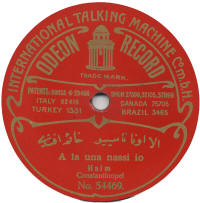
Sephardic 78 RPM recording If there ever was a labor of love in Jewish music, this is it. Joel Bresler's much anticipated website Sephardic Music: A Century of Recordings went live this week. As Bresler explains
"This website showcases over 100 years of recorded Sephardic music, from the 78 rpm era to the present. It first explores in detail the earliest Sephardic recordings, the artists that made them, and their repertory and performance practices. These early recordings tell a rich story of Sephardic musical life in the first half of the 20th century. The site next covers the second half-century of recorded Sephardic music, touching on the amazing outpouring of Sephardic recordings and the diverse performing styles used in these recordings. "
While the level of detail in the site already is amazing, where it's going is incredible. It already includes detailed information on performers, recordings, and music labels as well as a wealth of reference recordings and general information on Sephardic Jewry. In the future Bresler will be adding detailed analysis and histories of specific songs. He gives us a taste of this with an analysis of the song A La Una that includes information on over 125 recordings of the song, including over a dozen provided for online listening.

A la Una Naci Yo, recorded by Lazare Angel in 1948


A la Una Naci Yo, recorded by Sarah Gorby in late 1960's


A la Una Naci Yo, recorded by Adama in 1980


Go check out the SephardicMusic.Org, it will be well worth your time.

Wednesday, October 8, 2008

Neil Diamond - Kol Nidre

Gut yontiff, everyone.

I'm getting ready for the fast. May all of yours be easy and rewarding. This is, of couse, the inimitable Neil Diamond in The Jazz Singer singing (part of) Kol Nidre. Always a tear jerker.

Neil Diamond - The Jazz Singer

Friday, October 3, 2008

Adon Olam, Arnie Davidson style

It's hard to start thinking about Shabbat when I'm already starting to look to Yom Kippur, but Shabbat it is. It's a serious week, so I thought I'd lighten it up for a minute with Arnie Davidson and his Friday Night Music Project. Shabbat Shalom

Adon Olam - Arnie Davidson - FNMP


I've written about Arnie and his Project Ben David album before. Check it out.