Showing posts with label sephardic. Show all posts

Sunday, August 12, 2012

Ljuba Davis. Never forget that your family are Sephardim.

“Never forget that your family are Sephardim. That you came from Spain.”

I'm continually surprised and delighted by the strong resurgence in Sephardic music that's been happening for the last few years. Ljuba Davis, a mainstay of the West Coast Jewish music scene, has been performing for decades and has added to that resurgence by finally put out a recording of her own. One that Ari, of Klezmershack has referred to as "one of a small (but growing!) number of traditional Sephardic music CDs worth listening to."

That's high praise. And a good thing.

Here's a recording from Davis' record release party at Drom in NYC.


Here's a bit from her official bio:
"The words of Ljuba Davis’s feisty paternal grandmother always stuck with her, as did her father’s penchant to spit at any mention of the Jewish people's expulsion from Spain. The expulsion in the 15th century sent the Sephardim moving ever further east, to the Ottoman and Russian Empires.

A gifted singer and fluent Spanish speaker, Davis was fascinated by the morsels of Sephardic melodies—secular and liturgical—she encountered as a child, and later on recordings and in songbooks. She went to nursing school (where she sang in the hospital’s resonant stairwells), raised seven children, and gradually gathered dozens of prized Ladino traditional songs into her repertoire.

A veteran performer, Davis contributed to the fascinating intersection of Jewish music revival and the folk movement, performing on major stages and in small clubs from Chicago to her Bay Area home. Berkeley was a hotspot of Jewish music creativity in the 1960s, and Davis was a sought-after singer and cultural trailblazer in the community.

But it wasn’t until she went to Barcelona—and until her son David Davis (who produced the album and plays the radiant cello on “Durme”) began to encourage her to record—that Davis contemplated making an album of her uniquely heartfelt renditions and the stunning melodies of the Ladino tradition."

While I haven't had the opportunity to hear the full album, the reviews look stellar. Delarue, author of the review "Haunting Spanish-Jewish Sounds from Ljuba Davis" in the New York Music Daily, notes the album contains
"flamenco-tinged acoustic guitars, but the lead lines are carried just as often as by Avram Pengas’ spiky, incisive bouzouki or Rachid Halihal’s oud. The melodies refer to gypsy music, the Middle East or the Balkans just as often as they evoke their Spanish home turf. Davis sings in a nuanced voice that can be quiet and plaintive but also joyous, sailing up to the end of a phrase on the album’s second track with the kind of microtonal “whoop” that’s common in Bulgarian music."


For more information, check out Davis' website and CDBaby.

Sunday, February 19, 2012

Sefiroth, an electro-acoustic chamber ensemble

Sefiroth, based in London and led by saxophonist & composer Nick Roth, is an "electro-acoustic chamber ensemble" that performs dark and moody arrangements of classics of the Sephardic repertoire. They've recently released a "double EP" that they've made available for listening and download on BandCamp (Arboles lloran por lluvia, Abre tu puerta serrada).

Here's a representative example...

Sefiroth Ensemble - Arboles lloran por lluvia


I'm enjoying these recordings thoroughly, though I admit that some listener's might find the arrangements a bit pretentious / overwrought given the source material. I love Olesya Zdorovetskaya's atmospheric vocals and how the horns and electronics provide texture. For a counterpoint, check this more typical arrangement of this distant-love song by prominent Israeli vocalist Yehoram Gaon. Just a bit more melody and less drama. And, while we're at it, check out this funky Sarah Aroeste arrangement.

These counterpoints aren't a critique, just context. It's great to hear artists use these old chestnuts as launching off points for their own explorations and to draw out of them nuances that we may have not heard in a while. It's also good to remember that these familiar melodies have a lot of miles behind them, and that informs how we hear them.

The other recordings have a vary in feel, with some maintaining the same drama and atmospherics and others straying into jazz territory. Erotokritos, in particular, does the neat trick of mixing an 'early music' style vocal harmony with jazz reminding me of Jacqui McShee vocals in the British folk-rock-jazz group Pentangle. The result is more art-music that Pentangle's pop, but equally engaging.

Wednesday, April 13, 2011

Ezra Malakov's Bukhari Chad Gadya

Beth Gavriel Bukharian Congregation in Queens, NYC was founded in 1996 as home to the city's growing Bukharian and Russian Jewish community. Beth Gavriel's cantor, Ezra Malakov, has been central to an effort to preserve and transmit Bukharian Jewish music. In addition to his own albums, he's collected and produced "Musical Treasures of the Bukharian Jewish Community", a seven CD box-set with book of music and lyric that "represents the religious and folk music of the Bukharian Jewish Community, once based in Uzbekistan, Tajikistan, and elsewhere in Central Asia.""

Here's Malakov's performance of the Passover seder classic Chad Gadya.


Note that Malakov's recordings and the Musical Treasures collection have all been released independently and do not have any internet distribution that I'm aware of. Contact Cantor Malakov through Beth Gavriel for more information. The only recording that Malakov was involved with that has any internet distribution is "Eternal Music of Bukharian Jewish Hymns" which is available through the American Sephardi Federation online book & music store.

For more information about the Bukharian Jewish community, check out Beth Gavriel's "History of Bukharian Jews," the Australian radio program "Encounter: Shalom from the Silk Road: The Story of the Bukharians," and the article "Bukharian Jewish Music in Queens" by Evan Rappaport of New York's New School. If you happen to be NYC tonight (April 13, 2011) Rappaport will be giving a lecture on the topic. Rumor has it that the talk with be recorded and if it's made available, I'll post it.

Hat tip to the website Invitation to Piyut for uploading the video to YouTube. In addition to Malakov's Chad Gadya, Invitation to Piyut has a wide variety of Passover piyut from around the world.

Tuesday, April 5, 2011

Performing Piyyutim

Last Thursday, WNYC's NEXT New York Conversation series put on a fascinating lecture and concert titled "Performing Piyyutim: Sephardic Music, Poetry and Spirituality." I missed the webcast. I was at the Detroit JCC's Stephen Gottlieb Music Fest that night. Fortunately for me and the rest of us, WNYC put the webcast up for viewing. I knew that ethnographer Samuel Thomas and his group Asefa was performing (see my previous post) but forgot that Asefa included the amazing Yoshi Fructer, who graced the Gottlieb Music Fest stage the previous week with his amazing avant-garde jazz/rock group Pitom. In addition to Thomas and Fructer, the evening included the Moroccan born Rabbi Gad Bouskila of Congregation Netivot Israel, Brooklyn and Rabbi Joseph Dweck of Congregation Shaare Shalom, Brooklyn. This is a must listen, folks.

Here is WNYC's description of the event.
"Today in Brooklyn, where disparate Jewish groups from the Middle East are engaging one another in an unprecedented way, the piyyut – the Hebrew term for a sacred poem – serves as an expression of a specific type of Jewish identity. Spanning five centuries since the expulsion from Spain in 1492, these piyyutim express unique conceptions of the relationship between humanity and the Divine and serve as the backbone of the quasi-classical musical traditions of different Sephardic immigrant groups who now call New York home.

Following an introductory discussion, Thomas, accompanied by his ensemble Asefa and other traditional musicians, will present a lively musical performance of Sephardic piyyutim. Intertwining musical performance with discussion, Syrian Rabbi Joseph Dweck and Moroccan Rabbi Gad Bouskila will illuminate how the intersection of Kabbalistic and Sufist thought in Sephardic cultural history inspired piyyutim."


Finally, three last shout outs... First, Asefa just released their second album, Resonance. The samples from the website are gorgeous. Check it out.

Second, Pesach is coming. I recently ran across a wonderful CD of Sephardic Pesach music recorded by the folks at B'nai Jeshurn, NYC.

Third, during the performance / lecture Samuel Thomas talked about contrafactum music, where existing music is re-purposed with new lyrics. The always excellent "On the Mainline" blog recently wrote a post on this topic titled "The original Shlock Rock: R. Yisrael Najara's 16th century religious Hebrew poetry set to Middle Eastern rock music."

Sunday, March 13, 2011

Teruah in 1552

The excellent Jewish history blog "On the Main Line" focuses on showcasing and contextualizing interesting historical Jewish texts. A Jewish children's primer from 1827? He's got it. Earliest known print source of the Golem of Prauge? That too. The post, though, that near and dear to my heart is his discussion of a "page from Libro de Oracyones, the Ladino siddur published in Ferrara 1552 by Yom Tob Athias (the Spaniard formerly known as Jeronimo de Vargas)."

Not only does this text have an early description of the shofar calls, but it's an information graphic! Note the way the different calls are drawn. Tekiah are long swoopy lines bracketing the other calls. Shevarim is three short strokes. (note how much they look the shin used to abbreviate them) and Teruah is short hyper-kinetic wiggle. In my day job I'm a research scientist with a deep love for information graphics and visual notation. This hits me where I live, folks. I need to make a Teruah blog graphic out of this. Love it. love it. loveit.

Check out the full post for a great linguistic exploration of the different ways in which Teruah is translated in Spanish.

Hat tip to my buddy Daniel for pointing me to the post. Thanks!

Friday, December 31, 2010

Asefa: (noun, from Hebrew) A collective, assembly or gathering, with purpose.

AsefaI love meeting interesting folks, and there are no shortage of interesting folks in the Jewish music world. This week I got an email from Samuel Thomas, Ph.D candidate in Ethnomusicology at the City University of New York and the leader of the musical collective Asefa. Asefa plays a wonderfully exploratory fusion of Arabic Jewish music and jazz that includes Yoshie Fructer, guitarist and New York Jewish scene staple, bass player Noah Jarrett, and percussionists Eric Platz and Rich Stein. This is the kind of music, deeply rooted in tradition and wildly adventurous, that I could crawl inside and live in.

Here's their official blurb...
Drawing upon a plethora of musical traditions from North Africa, the music Asefa presents is a blend of North African grooves and song traditions with passionate and innovative composition and improvisation. This is Mitteleuropean proto-blues. This is music that honors both ritual and experimentation, reminding us of the vitality and variety within the Jewish tradition -- a tradition that reflects the world. Listen and trace your own roots, whatever they are.
They've got an album out. I haven't heard the whole thing yet, but the tracks on the website sound great. I'd link to them, but I'm a live show guy. I'd rather show off this clip from one of their concerts at New York's Blue Note Jazz Club


In addition to playing Asefa, Thomas conducts a variety of workshops

"Whether you want to discover more about Middle Eastern musical traditions, Sephardic poetry, or simply have an interactive experience touring different world musics, the educational programming and performance workshops add incredible value to any Asefa experience! "

To give you a sense of what he's about, here's a short talk by Thomas about his experience with Arab Jewish music given to the Brooklyn Historical Society - Roundtable: Arab Music Traditions and Their History in Brooklyn.

Monday, November 29, 2010

A White Goat Under the Bed. A night of Jewish lullabies.

I just got back from a fun night at my synagogue which included a talk on Mussar by one of the congregants and a talk (and concert and singalong) on Jewish lullabies by our Cantor Annie Rose. Mostly I enjoyed the lullabye part. Go figure. (The Mussar talk seemed to be well received by everyone but me. I found the speaker to approach it from a fuzzy faux-spiritualized self-help perspective that was sadly disconnected from any Jewish meaning. I'm just cranky I guess) The lullabies were great, though.

I know a bit about Yiddish and Ladino lullabies but Cantor Rose brought up a number of points that I didn't know including....

1. Lullabies typically express the yearnings of the mother, sometimes for the return of an absent father, sometimes for the future of the child, sometimes for love or peace

2. Lullabies typically tell a story, even if it's just the story of the day's activities and dilemmas

3. Yiddish and Ladino lullabies have a strong sense of Jewish culture and community, with common references to rabbis, prayers, and Torah study, Jewish superstitions (white goats are lucky), and Jewish experiences (the father conscripted into the army, merchant trades)

4. Did I say that white goats are lucky? Yep. Having one under your bed is a good thing. Really.

My favorite of the night was Unter Dem Kinds Vigele (Beneath the Baby's Cradle). The lyrics, which include a white goat, are:

1. Unter dem kinds vigeleBeneath the baby's cradle
Shteyt a vayse tsigele.Stands a white kid.
Di tsigele iz geforn handlenThe kid has gone away to trade
Rozhinkes mit mandlen;In raisins and almonds.

Rozhinkes mit mandlen iz zeyer zis,

Raisins and almonds are very sweet,
Mayn kind vet zayn gezunt un frish.My child will be healthy and alert.


Gezunt iz di beste skhoyre,Health is the best of goods,
Mayn kind vet lernen toyre,My child will study Torah;
Toyre vet er lernen,Torah is what he'll study,
Sforim vet er shraybn,He will write holy books.
A guter un a frumerA good and a pious person
Vet er im yirtse hashem blaybn.will he stay, God willing.

Unfortunately, I can't find a good version online to share. So here's Hannah Roth singing the lovely Yiddish lullabye "Shlof Mayn Kind (Rest my kid)," Lyrics by Shalom Aleichem.


Monday, June 7, 2010

Two from Sefarides: Juan Bau and "Por ke llorax"

Today I want to feature two great videos from Sefarides, a website and Facebook stream dedicated to "a la información sobre la cultura y la historia sefardí" (Which I'm assuming means "information about Sephardic history and culture" Gotta love cognates). I just got linked up withe Sefardies Facebook stream, which is now sending me lots of fascinating Sephardic videos.

Here's the first one...

Por ke llorax blanca ninya? Sephardic song on hurdy gurdy


I love this version of the song. I've got two different contemporary recordings of it, one by Psychedelic Sephardic rock band Deleon and one by Sephardic Indie-Pop band La mar Enfortuna (both tracks with the titled transliterated "Porke Yorach"). It's great to hear this more traditional version. That said, I'm not ready to go along with the videos notes that describe the song as "a sad Sephardic Jewish romance from pre-inquisition Spain." One thing I've learned about Sephardic music is that while the lyrics may be pre-inquisition there's no real evidence that the melody is that old. This shouldn't detract from my (or anyone else's) appeciation of the song or the recording. It's just that the mythos of Sephardic musical antiquity is a bit overblown.

This second video is a hoot.

Juan Bau - La estrella de David


When I close my eyes, I really love the vocals and imagine the singer in a suit on a theater stage. When I open my eyes I all I see is Bay City Rollers. But generational fashion quirks aside, Juan Bau is a seriously good vocalist working, at least in this recording, in a Sephardic context. And from looking at his website, Facebook page, and myspace page, Bau is a vocalist that is still performing and recording. My Spanish isn't good enough to get too far into these sources, but I get the impression that he's a popular Spanish singer who recorded one or two Sephardic recordings during a much longer recording career. If anyone knows more about him and can help fill in some details I'd appreciate it. I'm going to try to hunt down this album. Have to have it.

Hat tip to YouTube user flautadeorfeo for posting (and recording?) the hurdygurdy video and to mireyaesc for posting the Juan Bau video.

Sunday, June 6, 2010

Jewish Music Fest Shoutouts, Chicago, SF, Toronto, Atlanta, Washington DC

My own adventures with the Detroit JCC Stephen Gottlieb Jewish Music fest aside, there are a number of Jewish music fests going on this summer that are worth pointing out. This is just a quick list, not an exhaustive one. If I'd don't mention one in the area you live in, check my left-side panel for a larger list of annual fests. If you're in Europe..check Ruth Ellen Gruber's extensive list of European Jewish Music Festivals.


Chicago Jewish Festival. Next Sunday, June 13, is the Chicago Jewish Festival. It runs from from 11 to 5ish, with 4 concurrent stages as well as food, art, and local organizations. I think the music is free, but am not sure. And I get to go! If you see me say howdy! I'll be live tweeting the show. This year artists will include my buddies StereoSinai as well as
"Tzioni ‘R' Us/Weiner Experience, Moshe Skier Band, The Ruby Harris Band, David Broza, Kol Sasson, Rabbi Joe Black, Listen Up! A Capella, Community Sing, David Broza, Jazmer, Barbara Silverman, Lafayette Klezmorim, Tarkay, Tracy Friend, Maxwell Street Klezmer Band, Guy Mendilow, Shakshuka, Saul Kaye, Cantor Jeff Klepper, Tumbalalaika, Guy Mendilow, Kol Tikva, Lynn Hazan, Caryn Bark, Shining Lights, Jeff and Janis, Anna and Catherine Kazyansky, Mamaloshn Yiddush Song Group, Ed Holstein, Marilyn Price, Steve Justman, Shelechet Aviv Israeli Dance Troupe, Ballet Entre Nous, Aaron Freeman, Jessica Honor Carleton, Solomon Schecter Choir, Junior Klezmer Band, Guy Mendilow Band, Judy & David, Jessica Honor Carleton, Joel Frankel, Judy & David, Marilyn Price, Jewish Jammers, and Comedy Ventriloquist Chuck Field."
And rumor has it that Patrick A of Can Can and Punk Torah will be in town for festival as well, though not performing.

Whew. Looking at a list like this is humbling. As much as I think I know the list touring Jewish musicians, looking at the line of summer Jewish music fests makes me realize how much more action there is out there than I can track. Great fun.

San Francisco Jewish Music Festival. July 11. This year is the SF Music Fests 25th year. They had a big showcase in March and will be having another one in July.
"Artists include Eprhyme, Glenn Hartman and the Klezmer Playboys, Peter Jacques, Elana Jagoda, Kugelplex, Ira Levin, Joe Nguyen, Kat Parra, Red Hot Chachkas, Dror Sinai, Gerry Tenney and California Klezmer, Vocolot and Joshua Walters. Plus klezmer, maqamat (Middle Eastern modes) and Middle East percussion jam/ workshops, an Instant Chorus, and an Instrument Petting Zoo, in association with the Community Music Center and Zambaleta World Music Institute."
Ashkenaz Music Festival, Toronto. From Aug 31 to Sept 6. Headliner shows require $ tickets, but everything else is free. And considering most of the "everything else" would headliners at other festivals, this is amazing. I would love to go but don't think I'll be able to afford it. Anyone feel like sponsoring an itinerant blogger? No? Oh well. Maybe in two years.
"Abraham Inc., Adrienne Cooper & Marilyn Lerner, Andy Statman, Batsheva, Beyond the Pale, Canadian Cabaret hosted by SoCalled (including helly Posen, Brian Katz and Lenka Lichtenberg, Lache Cercel, Aviva Chernick, the Yiddish Swingtet, Mike Ankielwicz), Daddo, Daniel Kahn, Deep Minor, Di Fidl Kapelye, Flory Jagoda, Gypsophilia, Jaffa Road, Klezmer Kids, Konsonans Retro, Kosher Gospel w/ Joshua Nelson, David Wall, and Ken Whiteley, Kurt & Annette Bjorling with Di Fidl Kapelye, Lache Cercel and the Roma Swing, Marilyn Lerner, Mitch Smolkin, Nayekhovichi, Nayekhovichi, Sephardic Cabaret hosted by Aaron Bensoussan, Shtreiml, Sisters of Sheynville, The Flying Bulgars, The Huppah Project, The Klez Dispensers, The Lithuanian Empire, Theresa Tova, Toronto Jewish Folk Choir, Vira Lozinsky, Zully Goldfarb."
Atlanta Jewish Music Festival. Ok, it was last night and I missed it. But I wanted to give a shout out to one of the new Jewish music fests. First of all I love seeing some Jewish action down South. There's been a solid Jewish population down there for a long long time, but it doesn't get the attention that Jewish in northern east and west coast cities get. Secondly, the line up for their fest was pretty interesting. Yesterday's show included the Moshav Band, DeLeon, Girls in Trouble, and 4th Ward Afro-Klemzer Orchestra. What's interesting about this is that it was much more of a rock / pop concert than your typical fest. Most fests lean toward Jewish flavored folk / world music. As more Jewish rock, pop, and hip-hop bands are getting formed, I wonder how long it will be until more fests have stages like Atlanta's.

Washington DC Jewish Music Fest. It kicks off tonight and runs until June 13, with....
Screening of The Jazz Baroness, Danny Sanderson, Seth Rudetsky’s Deconstructing Broadway, Galeet Dardashti, Uri Gurvich Quartet, Saints & Tzadiks (Susan McKeown & Lorin Sklamberg), Golem with Girls In Trouble, The Macaroons Children's Concert, and Vagabond Opera.

Wednesday, May 19, 2010

More possible musicians for Detroit's JCC Stephen Gottlieb Music Fest: Sephardic / Mizrachi musicians

Here is a list of Sephardic / Mizrachi musicians that I passed along to the JCC Stephen Gottlieb Music Fest committee. For more of an explanation see yesterday's post about Yiddish singers.

Pharaoh's Daughter
Led by Basya Shecter, Pharaoh's Daughter plays neo-psychedelic Sephardic/Mizrachi folk rock. A friend described them as "a Jewish Jim Morrison getting lost in the desert." Something like that.
http://www.youtube.com/watch?v=sCVUDQrxFwQ
http://www.pharaohsdaughter.com/

Divhan
Led by Galeet Dardashti, Divhan plays Sephardic/Mizrachi folk music. A bit more mannered than Pharaoh's Daughter, but equally great.
http://www.youtube.com/watch?v=LdvHiRSpz2M
http://www.youtube.com/watch?v=-b8QQaRFMvQ
http://divahn.com/

Smadar Levi
Israeli singer of Morrocan descent
http://www.youtube.com/watch?v=YAw12T4PFFU
http://www.smadarlevi.com

Yasmin Levy
Wonderful Sephardic vocalist. A mainstay on the world music festival circuit.
http://www.youtube.com/watch?v=4kFhqS1yMu
http://www.yasminlevy.net/

Sara Aroeste
Sephardic Ladino rock band
http://www.youtube.com/watch?v=-LEf1QegfuA
http://www.youtube.com/watch?v=tO8Q6duj9U
http://www.saraharoeste.com/

Deleon
Sephardic psychedelic indie-rock band. Saw them live last fall and they were GREAT.
http://www.youtube.com/watch?v=fo7aXTCCdZA

Yair Dalal
Israeli "Ethnic Musician," which means something like Mizrachi folk music treated as art music without becoming theatrical. wonderful.
http://www.youtube.com/watch?v=_sYp5S-jkZo
http://www.youtube.com/watch?v=_sYp5S-jkZo&feature=related

Jaffa Road
Sephardic/Mizrachi group from Toronto.
http://www.youtube.com/watch?v=ozOMNiqu2Q0
http://jaffaroadmusic.squarespace.com/

Jaffa Road also just recorded a wonderful album of original Jewish
wedding music called The Hupah Project and sometimes performs under
that name
http://www.youtube.com/watch?v=feXOk8zwmQk
http://www.thehuppahproject.com/

Cantor Aaron Bensoussan
Moroccan born Aaron Bensoussan performs Cantorial, Yiddish, Ladino and
Moroccan Folk Music, as well as jazz w/Uri Caine
http://www.youtube.com/watch?v=2K3_AsC4KVc

Flory Jagoda
Grande Dame of Sephardic music, songwriter of Hanukkah classic "Ocho
Kandelikas" and NEA heritage award winner. In this video, she's
singing with Cantor Gaston (see below)
http://www.youtube.com/watch?v=PA6X3y8jS58
http://en.wikipedia.org/wiki/Flory_Jagoda

Cantor Gaston
Cantor in MA, originally from Argentina. Sephardic music with South American flair.
http://www.youtube.com/watch?v=46QmCFIIYbg
http://www.cantorgaston.com/

Wednesday, March 31, 2010

Flory Jagoda's "Pesah ala mano (Passover is at hand)"

My favorite Sephardic psychodelic rock band, Deleon, tipped me off to this Passover song by Flory Jagoda. Jagoda is Sephardic Jew from Bosnia, a winner of an NEA National Heritage fellowship, and composer of the Chanukah classic* "Ocho Kandelikas." It's the first Passover song I've heard that focuses on cleaning up after Purim. Which is exactly how I feel most years. My last hamentashen is just crumbs, and now I have to clean up the crumbs (chametz). Really. Already?

Click through to the YouTube page for the full Ladino lyrics and English translation.


* I've always hated the term 'classic.' It's like the word obvious, only used when something wasn't. But Jagoda earned it for Ocho Kandelikas. The song has been recorded a zillion times, to the point where I've seen it mis-labeled as "traditional."

Thursday, December 10, 2009

The Sephardic Hazzanut Project

Faraj Samra is well on his way to completing the very ambitious Sephardic Hazzanut Project. Samra, a Sephardic hazzan (cantor) from Damascus, Syria, had noticed that "that many people have trouble singing the taamim properly and reading the Torah correctly" and that "Sephardic music tapes ... and lessons with an experienced Hazzan" are very expensive options. Inspired by the Sephardic Pizmonim Project, he decided to help out by "record[ing] all the parashiot and Shahrit of Shabbat for all the main seven maqamot." That's a pretty large undertaking but he's off to a good start, having recording over a dozen parsha, the Shahrit, High Holidays chazzanut and daily tefilah, and a lot more.

Hat Tip to Eva Broman & the KlezmerShack mailing list for the link.

Wednesday, October 7, 2009

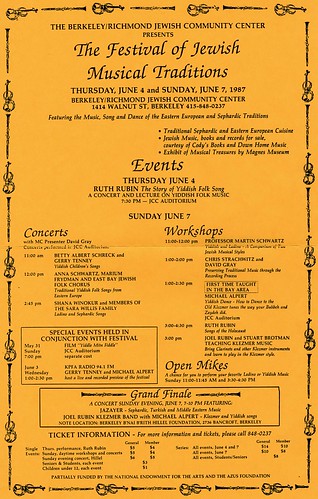
Jewish Music Festival (Berkeley, California) promotional materials, 1987-2009

The folks from Berkeley's Jewish Music Festival have recently uploaded a treasure trove of their historical documents to the web. I'm going to through these for weeks. If you want a crash course on the Klezmer Revival and on the emergence of Ladino music, this is it.

1987 Festival of Jewish Musical Traditions
"The Jewish Music Festival started in Berkeley, California, in 1986 as a one-day event produced and hosted by the Jewish Community Center of the East Bay (formerly the Berkeley-Richmond Jewish Community Center). Its programs have included performances, lectures and workshops devoted to instrumental music, song and dance inspired by the musical traditions of the global Jewish Diaspora. Initially called "The Festival of Musical Traditions," the initiative became the "Annual Jewish Music Festival" in 1989, and in 2009 reached its twenty-fourth edition. Over time, the Jewish Music Festival has developed a host of programs at venues in the greater San Francisco Bay Area as well as outside the United States. The Jewish Music Festival has been a steady vehicle for the development of the Jewish musical "revival" movements in North America, and specifically for Klezmer music, Yiddish and Ladino song; it has also provided a space for the presentation of the music of the Jews from the Islamic World and from Israel to north American audiences.

The collection includes digital copies of the promotional materials of the Jewish Music Festival collected and organized by its director, Ellie Shapiro. The materials document the history and development of the Jewish Music Festival from its second edition (1987) until 2009, and comprise program brochures, performance schedules, concert notes, flyers, mailers, postcards, anthological audio CDs, fundraising and survey documents and correspondence. These materials document the development of a community-sponsored public space in which a variety of musical genres inspired by the Jewish experience have been promoted."

Thursday, October 1, 2009

Toronoto's Jaffa Road & The Huppah Project

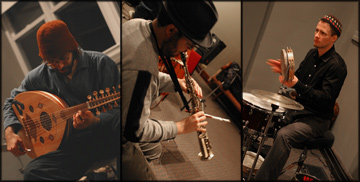
Jaffa RoadI got an email this morning from Toronto musician, Aaron Lightstone about his two groups, Jaffa Road and the Huppah Project. Both take a world music approach to Jewish music, mixing new and traditional melodies with "Classical Arabic and Indian music, modern jazz, rock, pop, and dub."

Jaffa Road, the full band, includes Lightstone on oud, and vocalist Avaiva Chernick , bass player Chris Gartner, percussionist Jeff Wilson and sax player, Sundar Viswanathan. Like many Jewish groups that have appeared in the last few years, they lean toward a Sephardic / Mizrachi sound. Unlike the DeLeon, the Sephardic indie-rock band I saw earlier this week, Jaffa Road has a warm open sound, gentle and passionate. I particularly enjoy the tracks where they introduce rougher, staticy, electronics squawks and buzzes. It's not quite on the level of DJ Olive's work with Uri Caine, but well done and convincing. (In fact, with cantor Aaron Bensoussan joining them as a guest vocalist, their recent album Sunplace, is very reminiscent of a lighter, warmer, version of Uri Caine's ZOHAR album.)

Here's Jaffa Road in concert.


As much as I enjoyed Jaffa Road (and will have to pick up their album), I'm even more taken with The Huppah Project. Centering around the interplay of Lightstone's oud and Aviva Chernick's vocals, The Huppah Project is a collection of music inspired by Lightstone's wedding and explores Jewish wedding music from a vantage that is intensely personal and at the same time open and inclusive. I love seeing artists take the traditions seriously, but at the same time using them as a jumping off point for their own exploration.

The Huppah Project


Check out Jaffa Road and the Huppah Project, and their albums Sunplace and Under the Canopy.

Tuesday, September 29, 2009

Sephardic indie-rockers Deleon hit the North Coast

Whew. I got the babysitter back home and now I'm flopped down to write about the great Deleon show I just saw. I've got their album quietly cranked. C'mon. It's midnight, you know what I mean.

I'm marveling at how natural and inevitable it felt to see a young band picking up the 500 year old Sephardic musical tradition, without irony or kitsch, and letting it shimmer and shake. The Sephardic music tradition is deeply passionate, religious and romantic, a passion that never gets old. And it's passion that's as well suited to Deleon's brand of indie-rock; frantic and bustling, spinning with layered bass and drum-beats and writhing under the evocative (yeah, I mean sexy) voices of Dan Saks and Amy Crawford. It's also well suited the stripped down acoustic of a jangly banjo and tambourine.

Deleon

And both versions of Deleon, electric and acoustic, were on stage tonight. You see, Deleon is normally a 5 piece. Opening for a large band like Os Mutantes on small stages like Detroit's Magic Stick, means that they were forced to strip down to the essentials and are traveling as a three piece: Saks on voice, electric guitar and banjo, Crawford on voice, tambourine, xylophone and melodica, and Kevin Snider on bass. That's the acoustic combo. For some of the songs, though, Snider kicked off a pre-recorded version of drummer Justin Riddle's complicated and off kilter drum tracks. Then the band, and the audience, jumped on board for a wild ride.

DeLeon - La Serena


Deleon is not the first contemporary band to take on Sephardic music. Bands including Galeet Dardashti's Divan, Basya Schechter's Pharaoh's Daughter and the Sarah Aroeste band, and Oren Bloedow and Jennifer Charles have all explored this space already. But Deleon's high-energy, high-passion, highly-intertwined pop mixed with their sly acoustic work are helping them carve out their own space. If you haven't seen 'em yet, get going.

You can check out their MySpace page for a tour schedule.

Wednesday, September 16, 2009

Kol Shira - World music from eastern Iowa

One of the interesting movements in American Jewish music at the moment, is the adoption and promotion of Sephardic music. Kol Shira is the latest group I've run across that happily mixes music (Jewish and otherwise) from around the world, but draws heavily Sephardic and Misrachi music for their basic sound and approach. This, in my opinion, is a good thing.

And they do it well. Not quite world stage, Galeet Dardashti, well, but definitely 'drive for an hour see them' well. Valerie Davine's got a lovely, passionate, voice, and the rest of the combo (Linda Wertz on bass, Debbie Singer on guitar, Julie Anolik-Cassell on percussion and cello, Karen Charney on flute and vocals, and Rita Offut on vocals) are tight and talented. I don't think they have any recordings out, but if you live in Iowa you should check their upcoming performances list.

Here's a video from a 2005 performance, for more videos see their video page.

Kol Shira: Mizmor L'David

Thursday, June 4, 2009

Oi Va Voi - Klezmer Electronica Refugees

Oi va Voi at Paradiso, AmsterdamHow embarrassing. I was chatting online last night with a fine fellow who was looking for klezmer electronica music. I made a few suggestions including my blog posts on Zohar, GhettoPlotz, Jewdyssee, Anakronic Electro Orkestra, Socalled, and Oi Va Voi. So where's the Oi Va Voi link?

No where. I've never blogged about Oi Va Voi. sigh. I've mentioned them a few times, but no link of their own.

So let's get to it.

According to their Wikipedia bio...
"Oi Va Voi is a British band that takes its name from a Yiddish-derived exclamation popular in modern Hebrew meaning, approximately "Oh, dear!" It is an experimental band from London, England, which formed in the late 1990s. Their sound draws on Jewish music from both the Ashkenazic and Sephardic traditions, including both klezmer and Ladino music, as well as Eastern European, especially Hungarian folk music, as well as contemporary electronic music."
Any wonder I love these guys? They've got four albums out, including the brand new "Travelling The Face of the Globe." I actually don't own any yet, mostly because they're not available on eMusic. Writing this post reminds me I going to need pickup them up soon.

Here's great video for Everytime, from their new album. The only disappointing thing about it is that it's two minutes shorter than the same track on their MySpace page. What's been trimmed out? Primarily a lovely klezmer influenced clarinet solo. Bah. The contrast of the pop vocals with the clarinet was part of what made the song for me. But it's still a good pop tune. Enjoy.

Everytime


Also very much worth checking out are their songs Ladino Song, Yuri, and Yesterday's Mistakes. Each has it's own take on including Jewish music elements. Great stuff.

For more info, check out their MySpace page, their Wikipedia page, and short video interview with them on Sarajevo TV. As a promo for their new album, their offering a track from the new album for the price of your email address.

Hat tip to funborn for posting the video.

Tuesday, March 3, 2009

Vashti's Revenge - Galeet Dardashti presents music from The Naming

Twitter's been bubbling. The blogosphere's been buzzing. Strange costumes and mask's are popping up in unlikely places. I've been invited to a dozen parties I'm too far away to attend. I declare it officially Purim.

If you're in the New York City area and want to kick off the Purim season in style, I recommend you check out Galeet Dardashti's show on Thursday, March 5 at Santos Party House in NYC. Dardashti, who specializes in Misrachi and Sephardic music, released the stellar Divahn album a few years back. This week she'll be debuting Vashti's Revenge and other music from her new album, The Naming. (Note: This is not the CD release party. The disc isn't out yet). Here's the official description of the album...
"The Queen of Sheba's shaven legs. A witch's bitter prophecy. The female superheroes who saved Moses. These stories make up The Naming, singer and composer Galeet Dardashti's exploration of the little-known lives of the Bible's phantom women."
I'd simply describe it as a passionate whirlwind. Enough said. Go to the show. For more information about, check out Dardashti's website or FaceBook page. Tickets to the show, you're going right?, can be had through TicketWeb.

Vashti's Revenge


Flyer for Vashti's Revenge concert

Monday, November 24, 2008

American Crypto-Jews and Consuelo Luz

A Crypto-Jewish SukkotI was taken aback this morning. I was sitting in a doctor's waiting room leafing through the October 2008 issue of Smithsonian Magazine and ran across an article titled "The 'Secret Jews' of San Luis Valley: In Colorado, the gene linked to a virulent form of breast cancer found mainly in Jewish women is discovered in Hispanic Catholics." The article discusses the possibility that a region of New Mexico and Colorodo were settled by "crypto-Jews," Jews who had been forced to hide there beliefs and heritage by the Spanish Inquisition. Here's Smithsonian's description of that settling process, which summaries research by Stanley M. Hordes presented in his 2005 book, To the End of the Earth: A History of the Crypto-Jews of New Mexico. Hordes is a professor at the University of New Mexico and was New Mexico's official state historian during the 1980's.
" Following the Jews' expulsion from Spain, crypto-Jews were among the early settlers of Mexico. The Spanish in Mexico periodically tried to root out the "Judaizers," but it is clear from the records of trials that Jewish practices endured, even in the face of executions. According to Hordes' research, settlers who were crypto-Jews or descended from Jews ventured up the Rio Grande to frontier outposts in New Mexico. For 300 years, as the territory passed from Spanish to Mexican to United States hands, there was almost nothing in the historical record about crypto-Jews. Then, because of probing by younger relatives, the stories trickled out. "It was only when their suspicions were aroused decades later," Hordes writes, "that they asked their elders, who reluctantly answered, 'Eramos judíos' ('We were Jews')."
So, this is another chance for me to demonstrate my ignorance in public. I had heard the term crypto-Jew a number of times before, but always in the context of the Jewish expulsion from Spain in the 1490's. The story, in the versions I'd been aware of, always trailed off pretty soon after that. One block of Jews, who became the Sephardic community were able to flee to the northern and southern Medeteranian. The other group, for some by choice and for many by lack of choice, officially converted to Catholocism and were absorbed into Spanish culture, holding on to some remenants of Jewish tradition but largely forgotten by history. Guess I'm way off on that last part. It turns out that there are self-aware communities, and many not-so-self-aware communities, of crypto-Jews scattered around the globe.

As someone mildly obsessed with Jewish music, I sprang into action. From an academic perspective, the primary work on Crypto-Jewish music seems to have been conducted by Dr. Judith Cohen though I could not find much useful information on line. Dr. Cohen notes that, speaking of the Crypto-Jews of Portugal, that "They have very, very few songs which are not common to everyone else in the areas they live in." I'll keep digging. I'm sure there is better information out there and I'll report in as I find it.

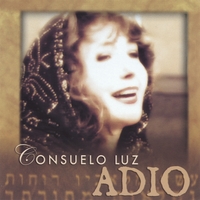
Adio album coverIn terms of contemporary music, I found a lovely recording by Consuelo Luz, a "Cuban-Chilean singer-songwriter." Her new album, Adio, deals with the Crypto-Jewish experience. The official album description notes that "Crypto Jews" is a term used to describe those "hidden" Jews, who, for survival's sake, needed to hide their heritage. Today a movement is emerging of Crypto Jews, especially in the US Southwest, wanting to explore their Sephardic Jewish background and sometimes integrate it with their Indo-American heritage. This CD "Adio" is a musical reflection of this desire for integration, combining Latin, Middle Eastern, Flamenco and Indigenous elements to evoke a historic journey, a fusion of traditions and the Sephardic soul's survival and path of transcendence." And, it's quite lovely. You can listen to it at CD Baby.

Thursday, November 20, 2008

The Power of a Niggun

Here's a fun video about the power of a niggun to bring Jews together.

Oorah CD - Sfashkanaz Video


The video was put together to promote Oorah, an organization that supports traditional Jewish education opportunities in the United States.

Hat tip to YouTube user AhavsY for posting the video and to Yosef for pointing met to the video.