Showing posts with label history. Show all posts

Sunday, August 8, 2010

Teruah on TV (with a face for podcasts)

Jack at Ignite Ann ArborThat's right, I was on local access television recently. And someone actually watch the show. In fact, I only know I was on because a friend happened to stumble across the show, recognize me, and watch it, and then sent me an email about it. Yep. The joys of local access TV.

You may remember that I gave a talk at the wonderful Ann Arbor District Library a few months back. The video of the talk is finally up on the AADL website. Check it out! I only sounded like an idiot two or three times. For me that's not too bad. It turns out the library tossed the video over to the local access TV station. And yes..clearly I have a face for podcasts.

Here's a link to the library video page. You can watch the video or download it as an audio file. So far it's been viewed 63 times. Pretty cool.

Here's the description of the Ann Arbor library talk...
"Ignite Second Stage: The Silver Age of American Jewish Music is Happening Now! And You're Missing It!

Jewish music is exploding. Bands and labels and venues are multiplying. Rock. Hip Hop. Reggae. Punk. Klezmer. Sephardic. Choral. Jazz. Chassidic-Pop. Bible-gum. Beat Box. House. Socialist Yiddish Gothic. Indie. A revolution is happening but we're scattered across a big nation with no common media to connect us....except the net. Will it be enough? Jack Zaientz, an Ann Arbor area research scientist who blogs about contemporary Jewish Music, will introduce you to some of the most amazing new Jewish music that you've never heard.

This Extended Play version of Jack's recent 5 minute Ignite Ann Arbor talk will be loaded with more music, a road-map of the contemporary Jewish Music scene, a case study in social-networking Jewish Music, and the greatest Jewish song you've never heard."

My next speaking gig is going to be October 25th at Temple Beth Emeth in Ann Arbor. I'll be part of an adult education evening. You don't have to be a member to attend. All are welcome. Here's the topic:
The Music of the Diaspora
Description: In this meeting we'll talk about and listen to examples of secular and religious music from around the Jewish world including Ashkenazi, Sepharidic, Morrano/Converso, Ethiopian, Israeli, Mountain Jews, and Mizrachi Jews.
Discussion questions: How much of our view of being of Jewish comes from our immediate surroundings and culture? Now that the internet has made unexpected corners the world immediately available, how might that change our sense of Jewish culture? How will that change our sense of being Jewish?


I'm hoping this will be the beginning of a series of Jewish music talks at TBE. I'd also like to ones on the music of prayer, music in the home, and current popular music (Radical Jewish Culture and Shiny Shoe Music). We'll see how the first one goes.

Friday, May 21, 2010

Mixed Marriage: Jazz and the Post-Klezmer Revolution in NYC

Greg WallI'm up late working on a list of currently active Jewish jazz musicians (e.g. musicians who mix Jewish music and jazz music) for the music fest and ran across this gem, "Mixed Marriage: Jazz and the Post-Klezmer Revolution in NYC." It's an hour and a half music performance and discussion with Lewis Porter and Greg Wall, sponsored by NYC's Philoctetes Center for the Multidisciplinary Study of the Imagination. Greg Wall is a great sax player who's played in a number of Jewish jazz fusion bands including Hasidic New Wave, the Greg Wall Trio, and The Later Prophets. He's also an ordained Rabbi. Lewis Porter is jazz pianist, author and Professor of Music at Rutgers University.

I wasn't able to embed the video, but you can watch it on YouTube. And you should....

Friday, April 30, 2010

The Geneology of Jewish Rock

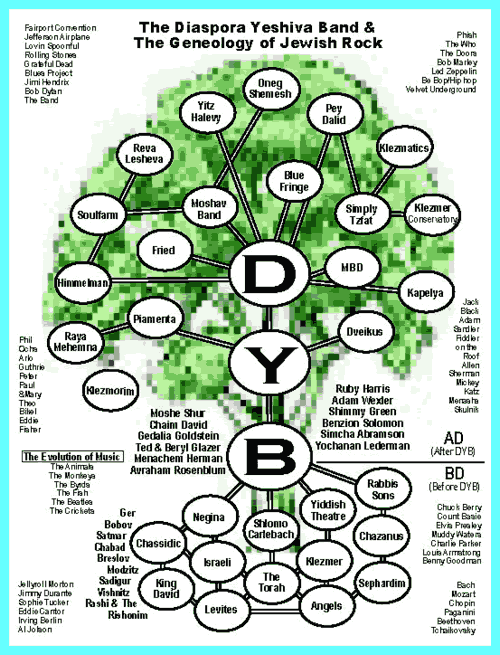
The Diaspora Yeshiva Band is one of the legendary bands of the Jewish music scene. Founded in the early 1970's by Avraham Rosenblum and Ruby Harris, it was, arguably, the first Jewish rock band. This afternoon, while looking for something else, I ran across an article by Ruby Harris about DYB.
"Almost parallel to the first Rock’n Roll stars and their society, the union of Rock with Jews didn’t come so smoothly, it was a rocky road at first, particularly in the years roughly from 1973-1982. Jewish music didn’t catch up with the rest of the world so fast. I remember one time we were doing a concert at the Jerusalem Theater and after the show someone comes up to us and emotionally expressed his disapproval of the Holy words being fused with rock sounds (Elvis and Ray Charles got the same reaction)."
In addition to his version of the history of DYB (which is a bit different than Roensblum's version) it includes this fantastic "Genealogy of Jewish Rock."

Genealogy of Jewish Rock
It's a bit idosyncratic, but hey...it's good fun none-the-less. I haven't been able to find a video of DYB playing, and Ruby Harris's videos focus on his other music interests. But here's Avraham Rosenblum, father of Jewish rock, in action.

Avraham Rosenblum. Tzadik

Wednesday, October 7, 2009

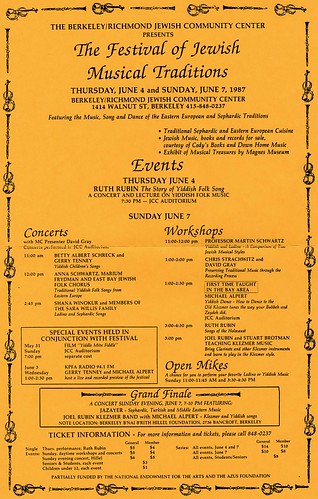
Jewish Music Festival (Berkeley, California) promotional materials, 1987-2009

The folks from Berkeley's Jewish Music Festival have recently uploaded a treasure trove of their historical documents to the web. I'm going to through these for weeks. If you want a crash course on the Klezmer Revival and on the emergence of Ladino music, this is it.

1987 Festival of Jewish Musical Traditions
"The Jewish Music Festival started in Berkeley, California, in 1986 as a one-day event produced and hosted by the Jewish Community Center of the East Bay (formerly the Berkeley-Richmond Jewish Community Center). Its programs have included performances, lectures and workshops devoted to instrumental music, song and dance inspired by the musical traditions of the global Jewish Diaspora. Initially called "The Festival of Musical Traditions," the initiative became the "Annual Jewish Music Festival" in 1989, and in 2009 reached its twenty-fourth edition. Over time, the Jewish Music Festival has developed a host of programs at venues in the greater San Francisco Bay Area as well as outside the United States. The Jewish Music Festival has been a steady vehicle for the development of the Jewish musical "revival" movements in North America, and specifically for Klezmer music, Yiddish and Ladino song; it has also provided a space for the presentation of the music of the Jews from the Islamic World and from Israel to north American audiences.

The collection includes digital copies of the promotional materials of the Jewish Music Festival collected and organized by its director, Ellie Shapiro. The materials document the history and development of the Jewish Music Festival from its second edition (1987) until 2009, and comprise program brochures, performance schedules, concert notes, flyers, mailers, postcards, anthological audio CDs, fundraising and survey documents and correspondence. These materials document the development of a community-sponsored public space in which a variety of musical genres inspired by the Jewish experience have been promoted."

Thursday, July 30, 2009

Ronald Robboy's In Our Own Way: Yiddish Theater Music

As a Jew in the Midwest, I get unduly excited about Jewish events in the Midwest. So How come I didn't know about the University of Wisconsin's Conney Project for Jewish Arts? Always more to discover, I guess. Anyway, I was tipped off this morning by Twitter user Geoffery Keezer (who just released a fine album of "folkloric Afro-Peruvian and Argentinian music mixed with jazz"). Keezer was excited about Ronald Robboy's recent Conney Conference lecture on Yiddish theater.

Now I am too. The Conney Project has graciously put up a video of Robboy's talk, as well as over twenty others. I'm particularly looking forward to listening to Lee Williams' "When Crooks (and Gumshoes) talk Yiddish: On Babel, Singer and Chabon" and Sherry Mayrent's "A Shidukh Fun Himl: 78RPM Yiddish Recordings in the Digital Age"

Thanks folks!

Tuesday, March 3, 2009

Chunky Chocolate Bars & Raisins and Almonds: Henry Sapoznik talks Yiddish Theater and Radio

Living on the North Coast (aka Michigan) has many perks. One of them is that between the University of Michigan and Michigan State we have a steady stream of exciting Jewish music related visitors. Yesterday Henry Sapoznik came to MSU to talk about Klezmer, Yiddish Radio and Theater, and give a Klezmer performance master class. I was only able to attend the Yiddish Radio and Theater lecture, but am so glad I did. Sapoznik is not only incredibly knowledgeable, but he is one of the people personally responsible for rescuing and chronicling a lot of Yiddish theatre and radio shows from being discarded or lost. He's also a fabulous story teller.

I don't think that last night's lecture was recorded, but here's a snippet of Sapoznik giving a similar lecture at last year's Paper Bridge Summer Arts Festival at the National Yiddish Book Center in Amherst, MA.

Hank Sapoznik on the Forward Hour


I had great intentions of taking notes through his lecture but a) got so caught up in his story telling that I forgot and b) realized that he's written a fabulous book on Klezmer and co-produced a 10 part radio show on Yiddish Theater. Reading and listening to those would be way better than my notes.

I do want to share one great story from the lecture. According to Sapoznik, one of the cellars that some unique Yiddish radio shows were rescued from belonged to the family that owned Chunky Chocolate Bars. It turned out that at the heyday of Yiddish radio, between the two world wars, the owner of Chunky Chocolate was a big supporter of Yiddish radio. He both advertised heavily on Yiddish programs and funded and recorded Yiddish theater to be performed on the air. Why? The answer (maybe) comes from the signature song of a Abraham Goldfaden opera that Sapoznik found on an aluminum master disc in his cellar. The theme song of this opera...Royzhinkes mit Mandlen (Raisins and Almonds). Sapoznik happily speculates that this man so loved Goldfaden and his song that he dedicated a candy company to producing chocolate bars that with ingredients drawn from an opera song, and then years later supporting revivals of opera the song came from. Royzhinkes mit Mandlen is a classic of the Yiddish theater and has been recorded so many times that it's often considered a folk song. In case you haven't heard it, here's a lovely presentation of it that includes the Yiddish and English lyrics.

Judy Albert singing Royzhinkes mit mandle


Hat tip to David Marc Klein of the Heartland Klezmorim for inviting me to the show, to the MSU Jewish Studies Program for hosting the lecture, and to YouTube user schnuffibossi for posting the Judy Albert video. Thanks folks.

Friday, February 27, 2009

Camp Rock -The Music of Reform Youth

Photograph of Cantor WallyI was recently pointed to a great article on the history of Reform Jewish youth camp music. According to the author, Cantor Wally Schachet-Briskin, the Reform youth camps movement "began with the founding of the National Federation of Temple Youth in 1939 ... to foster and maintain a network of temple youth groups, which stresses both religious and educational programming." Hitting it's stride in the early 1950's Reform camp music incorporated a blend of American popular folk (Weavers, Kingston Trio) and protest songs, Yiddish folk songs, Israeli "hialutznik" songs, along with "some hymns from the old Union Songster." The music was embedded in the daily life of the camps and was structured around singalongs led by older youth, often with guitar or banjo accompaniment.

According to Cantor Wally, from this start the music evolved to follow the style of the day, often with a bit of a time lag. In the 1960's it embraced protest music in the style of Bob Dylan, Tom Paxton, and Woody Guthrie. In the 1970's it engaged the electrified pop-rock of Dylan, Simon and Garfunkle, and Joan Baez. The 70's also brought to the forefront the first serious professional camp songleaders and composers, including familiar names like Debbie Friedman, Jeff Klepper, and Michael Isaacson. As Cantor Wally notes, "Echoing the rise in Jewish ethnic pride, camp music nationwide saw a strong shift in the early ‘70s from what had been 80% brotherhood songs to 95% Hebrew (with "Sabbath Prayer", from the musical "Fiddler on the Roof", thrown in on Friday night)." The 1980's saw a decline in songleading and camp music, as the camps struggled with out-of-date songbooks and a generation of campers that were more used to rock concerts than folk music singalongs. This decline was addressed by the end of the decade and through the 1990's by a series of songleading workshops, new songbooks, and a new generation of professional songleaders such as Craig Taubman who could incorporate electric guitar, keyboards, and drums into their music.


Debbie Friedman - Lechi Lach

This Debbie Friedman video exemplifies the contemporary songleader approach, mixing participatory singing with rock instrumentation, Hebrew with English lyrics, and a stage presence that facilitates and instructs.


In addition to tracing the history of the camps in isolation Cantor Wally connects their development to that of the Reform synagogue liturgy, noting "the tremendous impact the participatory style of the camping movement." He quotes that "Synagogues tend to be "10-15 years behind the camps as far as change. Whatever was a trend in the camps, it takes a generation to find its way into the synagogue." That said, Cantor Wally is quick to point out that the contemporary Reform synagogue is not last decade's camp. In addition to the integration of camp melodies and styles, it also incorporates a mix a traditional Reform Hebrew hymns, Chazzanut, and art song. But "[t]he 'gap' between the worship style of camps and synagogues is shrinking."

My one frustration with the article, and this is a "great stuff, give me more" kind of frustration, is that it presents a picture of Reform camp music evolution as being disconnected with the similar evolutions in the other Jewish movements. For example, the camp service songlist that Cantor Wally provides includes a number of Chassidic songs from Reb Shlomo Carlebach. There is no discussion of however, of how Carlebach's music represented a parallel evolution in Chassidic music that had a similar impact on Chassidic and Orthodox liturgy. While completely chronicling the evolution in Jewish liturgical music across the wide spectrum of Jewish movement over the last century is clearly a much larger task than Cantor Wally was attempting to take on, it would have been illuminating to see where Cantor Wally felt these evolutions actually influenced each other.

As a quick final note, like the article "American Yiddish Instrumental Fusion Music in the 1950s and 1960s" I mentioned in my post "Recovering the Yiddish Cha Cha," "The Music of Reform Youth" represents an academic masters thesis and has, at times, a slightly academic tone. But that tone never gets in the way, making this a highly informative and highly engaging article.

Update: A blog reader just informed me that "The Complete NFTY Recordings: 1972-1989 (5 CD Set)" is available from URJ Books & Music. NFTY is the National Federation of Temple Youth mentioned above and at the core of the Reform camp movement. Here's the URJ blurb...
"The long-awaited collection of the seven original NFTY recordings is finally here! All original record albums have been digitized and remastered for superior sound in this 5CD set. Includes 28-page full-color booklet with complete album histories, a historical essay from NFTY-ite Elyssa Mosbacher and track/songwriter information. Discover the rich history of NFTY and URJ camp music - a little bit of Jewish liturgy, a little Israeli folk and some American folk music all mixed into one."
Hat tip to Jewish musician and educator Adrian Durlester for pointing me to the article.

Thursday, February 19, 2009

Recovering the Yiddish Cha-Cha

I'm currently reading Matt Temkin's fabulous masters thesis, "American Yiddish Instrumental Fusion Music in the 1950s and 1960s." In the thesis, Temkin takes on the much maligned (then and now) period of Jewish American music between WWII, after the heyday of Yiddish theater music, big synagogue Chazzanut, imported old-world klezmer and it's off-shoot Yiddish swing, to the 1970's with the advent of the klezmer revival and the rise of Jewish folk liturgical music, including Debbie Friedman in the Reform community and Reb Shlomo Carlebach in the Chassidic). What filled that 30 year void? According to Temkin, it's fusion - Yiddish with Cuban dance rhythms, klezmer with jazz, which he describes as "serious art and important landmarks of the 20th century cultural fluidity." Temkin explores this period through detailed analyses of five representative albums, Sammy Musiker & Dave Tarras; Tanz!, Mickey Katz; Mickey Katz Plays Music for Weddings, Bar Mitzvahs and Brisses, Irving Fields; Bagels and Bongos, Terry Gibbs; Jewish Melodies in Jazztime, and Shelly Manne; My Son The Jazz Drummer!

While it lacks the visual appeal of Roger Bennett and Josh Kun's "And You Shall Know Us by the Trail of Our Vinyl: The Jewish Past as Told by the Records We Have Loved and Lost," it may well be the better read. Temkin is a good writer, with a gentle even prose style that compensates for the academic orientation of the thesis. Tune out the foot-notes and squint through chapter titles like "New Fusions of Yiddish and American Musical Forms, 1945-1970" and you'll find passages such as
"Today the counter-culture has turned into the old guard and one of the standard-bearers of the community. We know them as the Hasidim. While they are still concerned with the separation of the holy and profane, they understand the impact that music can have on people, and were willing to bring instrumental (and vocal) music into their community as long as it was used for holy purposes.[20]

Silence is Better than Speech

But Song is Better than Silence

—Hasidic Saying[21]"

and
"Irving Fields could play every style and tune that the consumer wanted. The Latin music was just the ritornello of his ventures that is remembered. Bagels and Bongos came out of a idea Fields had while working in Boston, and a couple different versions of the story are told. In one version, after hearing a Jewish radio program on the air the day before, he tells his drummer to play a rumba, and over this he played “Raisins and Almonds.”[2] It worked: the Jewish tam (feeling) was still there and at the same time it was danceable. The second story is that someone in the audience starting dancing a rumba to a Jewish tune that Fields was playing as a fox trot.[3] Fields changed the tune to a rumba and more people got up and danced."
All in all, it's one of the best histories of American Jewish music I've read, with a focus on secular instrumental music. And it echos a point made by other cultural historians who note that while we remember the cultural peaks of our societies for their heights, it's the chaotic periods between the great peaks where the real adventures take place. Like the adventures we're having right now in Jewish music. The heights of the klezmer revival have been reached, the folk liturgical vein has been well mined, the Orthodox shiny shoe simcha music territory has been well mapped. And what's happening...an explosion in fusion forms - Jewish hip-hop, reggae, rock, punk, ambient, heavy-metal, chamber music. All what Temkin describes as "co-territorial" (in the same geographic territory) fusions. What will be the great heights that come out of this burst of creativity...don't know. But it'll be fun to listen to.

Wednesday, November 19, 2008

Life Magazine Photo Archive

Folks, another treasure trove has been opened up. Google has made the entire photo archive of Life Magazine available on the internet. (We loves the internets). Here's a description from Ewen MacAskill writing for the Guardian (UK).

"One of the biggest photo collections in the world that ranges from the 1880s through to the seminal moments of the 20th century and on into the present day was made available to the public online from today. The bulk of the archive is from Life magazine, the premier platform for photojournalists in the 20th century. About 10m images will be available, from Marilyn Monroe and JFK to Barack Obama and Hillary Clinton. About 97% of the pictures have never been seen before. Google announced today it had done a deal with Life to put their pictures online. Also available is work from other archives, much of it collected by the former Time publisher, Henry Luce."

Here are a few fabulous photo's that I found on a quick skim the through the collection. But don't stop here, do your own searches.
A scene showing the cast from the light comic opera, A scene showing the cast from the light comic opera, "La Belle Helene", as produced by Jewish group. Photograph by John Phillips, 1943, Israel.


Ceremony of a Jewish Hasidic wedding.Ceremony of a Jewish Hasidic wedding. Photograph by Yale Joel, 1959, US.


Israeli pilgrims
Israeli pilgrims to shrine on Mt. Meron of 2nd century Jewish mystics, celebrate Lag B'Omer day with music. Photograph by Paul Schutzer, 1960, Israel.

Wednesday, September 10, 2008

Jailhouse Rock & The Puple Gang

Ok, so this one's a stretch even for me. But I can't resist.

A couple of weeks ago I caught the Red Sea Pedestrians in concert and picked up their album "A Lesson in Cartography". During the intro to the Pedestrian's great song "One Mile Wide," band leader Ian Gorman taught us a great bit of local Detroit Jewish history. "One Mile Wide" is about the notorius Purple Gang, a group of particularly vicious, mostly Jewish, gangsters that were bootleggers during Prohibition. According to Wikipedia..

"The Purple Gang was a mob of bootleggers and hijackers in the 1920s. Under the leadership of Abe Bernstein, the gang operated out of Detroit, Michigan, in the United States, which was a major port for running cached alcohol products across during Prohibition, since it is on the border with Canada. The gang supposedly received their name during a conversation between two Detroit market owners, each of them gang victims. One owner made the comment: "They're rotten, purple like the color of bad meat."

The Purple Gang has shown up in pop culture prior to the Pedestrians song (which can be heard on their MySpace page). In fact, it shows up in a highly unlikely place...Elvis. Specifically the song "Jailhouse Rock," in which Elvis describes his band saying "the whole rhythm section is the Purple Gang."

So in honor of the Purple Gang, here's Jail House Rock. I've substituted the classic Blues Brothers performance instead of Elvis's performance because, well, I enjoy it more. If you want to see the King himself, check out this YouTube video.

Blues Brothers - Jail House Rock


You can read more about the Purple Gang at My Jewish Learning.com.

Thursday, July 10, 2008

A Jumping Night at the Garden of Eden

Can you tell I'm staying up late in another hotel cruising YouTube instead of going to bed? Anyway, here's another must see video...

"A Jumpin' Night in the Garden of Eden was the first film to document the klezmer revival, tracing the efforts of two founding groups, Kapelye and Boston's Klezmer Conservatory Band, to recover the lost history of klezmer music. A Michal Goldman film"

A Jumpin' Night in the Garden of Eden


This YouTube video is only a short clip of the film. You can watch a longer version (26 minutes) on the FolkStreams website or order a copy of the full thing through First Run Films.

Hat Tip to YouTube user Folkstreamer for posting the video.
"Folkstreamer" is the youtube channel for previews from www.Folkstreams.net --- A National Preserve of Documentary Films about American Roots Cultures streamed with essays about the traditions and filmmaking. The site includes transcriptions, study and teaching guides, suggested readings, and links to related websites. We are a group of people who are passionate about documentary films about folklife and roots culture centered around Folkstreams.net a website streaming documentary films on American folklife. Credit most of our Youtube previews to Zach Nicholls, a student at Highland School in Warrenton, VA "

Sunday, January 13, 2008

The history of frum popular Jewish music and other misc.

I've got a ton of things to blog about tonight, but after painting my living room twice (don't ask) I'm beat. Instead of trying to be clever and interesting, I'll get by with pointing to recent cleverness and interestingness out there in weboland.

First, Chaim at Life of Rubin wrote an interesting piece on the recent history of frum popular music. (By frum, I'm mostly referring to Chassidim & Modern Orthodox.) It generated a lot of comments and a great followup piece by YK of 'YK's Jewish Music Form' speculating on the impact of Chassidim in general and Chabad in particular on frum popular music.

The Forward applauds as Conservative "Synagogues become rock concerts" and laments the death (or at least dearth) of Jewish parody music.

Haaretz writes about the rock concert thing also.

JVibe Music AwardsYou can go vote in JVibe's third annual JVibe Music Awards competition. I'm always interested in who makes the cut in competitions like this one. This year has lots of interesting choices and lots of missed opportunities, go check it out.

Monday, December 3, 2007

Saleh Al Kuwaiti

A treasure trove of Jewish-Iraqui music was posted to YouTube recently.

show Saleh Al Kuwaiti iraqi song in israel סאלח אל כוויתי


Here are links to some additional videos:

Here's a short bio of Saleh Al Kuwaiti, from Haaretz
"Brothers Salah and Daoud al Kuwaiti were born in Kuwait to a family of Iraqi origin. When Salah was 10 years old and his brother was eight, they received a violin and an oud from their uncle, who had returned from a business trip to India, and began studying music. Their talent was soon discovered, and they quickly became the prodigies of Kuwaiti music. Salah began to compose, Daoud excelled in playing, and the two began to perform at events hosted by Kuwaiti high society. The first song that they wrote and performed there, "I Swear I Loved Your Beauty," is still played today on radio stations in the Persian Gulf.

"The lightning success brought the family back to Iraq, where the music market was much larger," says Shlomo al Kuwaiti. "At first the brothers returned to Basra, where they performed and recorded with great success, and later they went on to Baghdad, the major musical capital of the period, and there they became real stars. In essence, as a composer, my father founded modern Iraqi music. After years of a frozen tradition, he introduced Western elements into it, and developed the new music on the basis of the traditional makamas (a traditional form of Arabic poetry). The songs he wrote were performed by the greatest Iraqi singers, including Salima Murad and Sultana Yusuf, and were played all over the Arab world and the Persian Gulf
...

His glorious career was cut short by the brothers' decision to immigrate to Israel during the major wave of aliyah (immigration) in the early 1950s. From the moment they left Iraq, attitudes toward them changed, as they did toward the Jews altogether. "The process of erasing them from Iraqi history was gradual," says Shlomo al Kuwaiti. "During the first years, local artists, Muslims, began to appropriate some of their songs. Slowly but surely, their names disappeared from the radio programs, although the songs themselves were still played. The process came to a climax after Saddam Hussein came to power. In 1972 he established a committee in the broadcasting authority, and one of its orders was to erase the names of the Al Kuwaiti brothers from every official publication and from the curricula in the academy of music. From then on, the songs that they wrote were labeled 'of folk origin.' Incidentally, the director of the broadcasting authority during that period was Mohammed al Sahaf, who was the Iraqi minister of information during the period of the second American invasion of Iraq, and is remembered for his grotesque television appearances."

The Kuwaiti brothers were not treated properly in Israel, either. After undergoing a difficult absorption process, they performed on the Voice of Israel radio broadcasts in Arabic, but felt they were being forcefully pushed into a marginal ghetto of Oriental music, which the establishment treated with hostility. "They had a weekly program on the Voice of Israel in Arabic, the broadcast of a live performance that was very popular both among native Iraqis in Israel and in the neighboring countries," says Shlomo al Kuwaiti, "but they lived with an unpleasant sense of humiliation. In Iraq they had left behind a fortune, and were at home in the king's palace, and here they were treated with suspicion and arrogance."


See Haaretz "From the king's palace to a 'ghetto' of Oriental music" for the full biography.


hat tip to Eva Broman, for posting the link on the Jewish Music mailing list, and to motifun07 for posting the video to YouTube, and to the Point of No Return blog, for pointing me to the Haaretz article.

Thursday, November 22, 2007

Thanksgiving & Jewish Music

One of the fun things about writing this blog is that I get emails from all sorts of interesting people. I had an great exchange recently with a music teacher who was looking for ideas for a Thanksgiving program for a Jewish day school. It was a great question. Every year there are active discussions about how or whether American Jews should participate in Thanksgiving celebrations. (See Life of Rubin's recent post for an example of this ambivalence). Personally, I just hosted a big Thanksgiving dinner that started with a heartfelt 'Shehecheyanu' that a large portion of my family, including a contingent of Christians, was sitting around my table.

Back to the music....as far as I'm aware (and my awareness is notoriously limited) there isn't any specific Jewish customs or music for Thanksgiving. I came up with two possible ideas for the day school program; Sukkot and Israeli kibbutz music.

Sukkot seems an appropriate connection for two reasons. First it's a Jewish harvest festival and has songs that are thematically similar to Thanksgiving, and second, I've read at least one historian who connects the Pilgrims conception/motivation for Thanksgiving with the verses in the Torah that enjoin the Hebrews to celebrate Sukkot. (You can read more about this at http://www.jewfaq.org/holiday5.htm). One Sukkot song that might be used is Vesamachta Bechagecha, a Biblical text that commands our rejoicing during the Sukkot festival (see this link for the Hebrew words, English translation an mdi and mp3 recordings -
http://www.greatjewishmusic.com/Midifiles/Sukkot/Vesamachta-Bechagecha.html).

The other idea is Israeli pioneer / kibbutznik songs. There are a number with harvest, or at least pioneer spirit, themes. There's a famous, and very kid friendly one called Zum Gali Gali. You can read the lyrics here: http://everything2.com/index.pl?node_id=695650 and hear a midi file here: http://songs-with-music.freeservers.com/zumgali.html and get a score here: http://www.mtrs.co.uk/zum%20gali.pdf and a see youth choir sing it here: http://www.youtube.com/watch?v=SguRfMtXW4E. There's a wonderful recording of it on the first OyBaby album, too. (http://www.oybaby.com)

I meant to post this two months ago, but forgot. It's too late to help out my correspondent with her Thanksgiving program (which I hope went well) but I'd be interested to hear what other folks think. What do you all think?

Friday, October 19, 2007

German Goldenshteyn and Bessarabian Klezmer

German Goldenshteyn: Bessarabian KlezmerI was catching up on the Jewish music mailing list yesterday and ran across a term I didn't recognize: Bessarabian Klezmer. The cool kids in the room already know all about it, but for the benefit of the rest of us I hit Google and here's what I found....

First of all, Bessarabia is "is a historical term for the geographic entity in Eastern Europe bounded by the Dniester River on the East and the Prut River on the West," and is now referred to as Moldovia. Like most of Eastern Europe, pogroms, the Holocaust, and emigration significantly reduced the Bessarabian Jewish population.

One significant emigree was German Goldenshteyn (A"h, 6/9/2006), who "arrived with nearly a thousand klezmer tunes (many previously unknown) that he had transcribed over the years." This legacy, now published in the three volume series "German Goldenshteyn: 'Shpilt Klezmorimlach, Klingen zoln di Gesalach,'" forms the basis for the Bessarabian Klezmer repertoire in the US. Goldenshteyn has one available album, published posthumously and available through CDBaby. Klezmershack has a wonderful 1999 interview.

Bessarabian Klezmer, itself, is a border music strongly associated with Balkan and Roma (gypsy) music, and you hear that influence clearly in the quick rhythm and horn bass line in Goldenshteyn's "Medley of Moldavian ... (MySpace clip)". While I couldn't find any video of Goldenshteyn, there is no shortage of musicians who play in the Bessarabian style. Here are a couple examples:

The first is Alicia Svigals, Iliya Magalnyk and Marilyn Lerner playing at The Stone, New York, April 27, 2007. (Recorded by Misha.)

Bessarabian Medley (Klezmer)


The second is the Lansdorp String Trio. I was amazed to see the "violin with a horn (trumpet- violin or Stroh Viol."
"It's an early 20th century invention of John Matthias Augustus Stroh. These violins were made between 1904-42, and during the era of the Bessarabian klezmorim (the 1920's and 30's) widely used by dance band leaders. In modern folk music they may still be found in the Rumanian Bihor district."
I can't embed this one, so go see the Lansdorp String Trio video on YouTube. They also have a recording, "Bessarabian Groove" available through CDBaby.

Thursday, September 20, 2007

Jewish Music in the New York Times Archive

As of midnight, September 18th, the New York Times stopped charging for access to its archive. Specifically, the NYT now allows anyone to search the entire archive, which goes back to 1851, for article titles and first paragraphs. The NYT has also allowed free full text access for two portions of its archive, from 1851 to 1922 and from 1987 to the present. They expect to earn more from ad revenue than they are currently earning from subscriptions and article fees. (The NYT explains itself in this article)

Across the web, the race for buried treasure is on. Blogs (such as Kottke.org and Deeplinking.net) are digging through the archives looking for articles with historical or cultural significance. I thought I'd join in the fun.

July 16, 1959, Thursday ERNEST BLOCH, 78, COMPOSER, IS DEAD; Creator of 'Schelomo' Wrote in Terms of Jewish Spirit -- Used Bible Themes

April 26, 1908, Sunday CHAMPION CYMBALIST IS PLAYING HERE NOW; Folk Who Know Only Uptown Music May Find Him Down in East Houston Street. THE BARDS POPULAR THERE And the Subjects They Sing -- A New Note Heard in Jewish Minstrelsy

September 15, 1952, Monday TWO SCHOOLS DEDICATED; Cantors Institute and College of Jewish Music Formally Set Up

February 3, 1952, Sunday THE CASE FOR BELIEF THAT JEWISH MUSIC EXISTS Jewish music is as difficult to define as the Jewish people itself. There are those who deny the reality of a Jewish music. They say that what is called Jewish music is really Slavic or Balkan, Babylonian or Egyptian.

December 31, 1935, Tuesday CURBS JEWS IN MUSIC.; Reich Bars Them From Teaching -- Jewish Veterans Evicted.

April 12, 1903, Sunday "COON" SONGS IN YIDDISH AT EAST SIDE MUSIC HALLS; Where the Families of the Crowded Ghetto Find Amusement in the Highland Fling Transformed Into a Yiddish Dance and in the Strains of "Upidee."

If you want to do your own digging, go to the NYT home page, enter your query in the search box, and set the dropdown to "NYT Archive 1851 to 1987"

Monday, September 10, 2007

Leonard Cohen singing WWII French Resistance song "The Partisan"

Haveil Havalim #133 is up at the Rubicon3 blog. Check it out. The best music related post was this one...

"Jeramayakovka has unearthed a phenomenal video of Leonard Cohen performing "The Partisan," a song about survival behind nazi lines. He includes information on the background musicians and the lyrics."

Here's the video, but definitely check out Jeremayakovka for the background info.

Leonard Cohen The Partisan

Sunday, September 2, 2007

The Moonshiner's Dance: A klezmerized, French-Canadian, red-hot Scanda-jazzian, beer-garden polka

"Too jazzy for Brian Rust's American Dance Band Discography, too ethnic for his Jazz Records, and too ambivalent for Dick Spottswood's Ethnic Music on Records, "The Moonshiner's Dance" is both too full and too empty to be made sense of in an ordinary way."

1n 1997, Harry Smith released the "Anthology of American Folk Music" on Smithsonian Folkways. The literal, and for many also the figurative, centerpiece of which is the 1927 recording "The Moonshiner's Dance, Part One." When musician and science journal editor Kurt Gegenhuber first heard Moonshiner's he thought it sounded like like some kind of klezmerized, French-Canadian, red-hot Scanda-jazzian, beer-garden polka. All the Anthology's liner notes said about the tune is that it was recorded by Frank Cloutier and The Victoria Cafe Orchestra and that "The Victoria Cafe Orchestra ... does not appear in any jazz or dance band discography, but is assumed to have been from the Minnesota area." After 9 years obsessing over the anthology and 18 months dedicated to research the history of Moonshiners, Gegenhuber's written a fine essay for Zeek, a A Jewish Journal of Thought and Culture, detailing the history of the song complete with Prohibition gin-joints, Jewish gangsters, and ethnic novelty orchestras. You can check out Gegenhuber's essay at Zeek and listen to a sound clip on the Smithsonian Folkways site.

Friday, August 10, 2007

The Israeli Folk Music Archive: The Place Where Out-Of-Print Israeli Folk Music is...Alive! Alive!

Israeli Folk Music ArchiveMost LP records never made it to CD, much as most 78's never made it to LP. Every time there's a switch to a new format, a new generation of music fans turn into archaeologists and archivists. Once such archaeologist/archivist loves old Israeli folk music and wants to share the love. The Israeli Folk Music Archive specializes in out-of-print 1950's and 1960's Israeli folk recordings and has a smattering of other genre's including Folk Dance, Youth Groups, Spoken,Comedy, Documentary, Orchestral, Liturgical, Choral, Chassidic, Holiday, Compilations, Festivals, and Soundtracks. The goal of the archive is to preserve the memory of these recordings, both by providing listings of their holdings and by transferring the LPs to CD to the enjoyment of us all.

Bezalel and the Sabras Album CoverThe LP to CD thing has gotten me pretty excited because I found the archive while researching the band Bezalel and the Sabras. I ran across the Sabras on the PCLLinkDump blog, which covers odd audio/visual finds. PCL referenced the Acid Archives of Underground Sound 1965-1982. According to Acid the Sabras are a "Jewish garage band featuring melodic guitar folk instros and reverb rockers, some fuzz. One track from the "Jerusalem" LP (released as by the Sabras only) appears on the "Riot City" compilation." So how cool is that?

And The Israeli Folk Music Archive is going to sell me copies? What a great start to the day. (And it's a great day for a little perk. An elderly family member is very sick. My wife's already flown back East to visit and I may need to fly myself and the kids in for a funeral soon.) I'm going to order one and will let you know how it goes. I may even try to post a few sound samples once I get the disc. Greatness like this should be shared.

Anyway, go check out their listings. Lots of great stuff and maybe just the album you need to perk up your day.

By the way, there's a real question about the legality of an 'out-of-print' LP to CD service. You can read their explanation here along with prices and other policies.

Saturday, August 4, 2007

Beyond Recall - Recordings from Berlin 1933 to 1936

Beyond Recall Album CoverHere's a box-set I'd love to add to my collection. It's called Beyond Recall and includes 11 CDs and 1 DVD capturing the tail end of pre-war German Jewish music. It's available through Bear Family Records and Amazon.com. Unfortunately neither Bear Family nor Amazon offer sound clips, but ere's the Bear Family Records description of it.

"After Hitler's seizure of power in 1933, anti-Semitism became a state doctrine. The National Socialists' aim was the physical destruction of the Jews. Every memory of the sound and voice of Jewish artists was to be consigned to oblivion in the same way as the Yiddish language. On being liberated from Theresienstadt concentration camp, the Berlin Rabbi, Leo Baeck, stated his conviction that the 1,000 year history of the Jews in Germany had come to an irrevocable end. This documentation is proof of the victory of life over death - priceless sound documents have been rescued, then restored with a great expenditure of technological effort and, after sixty years, made available once more for all time.Under constant surveillance by the Gestapo, the members of a Jewish Cultural League [Juedischer Kulturbund] in Berlin were able to pursue their artistic activities and make and distribute records. Some of the titles recorded in Berlin were released in Palestine from 1934 to 1936 - forming part of the early history of Israel's record industry. These records that are scattered throughout the world for the most part exist only as single copies or test pressings. The repertoire is wide and includes classical music, Yiddish comedians, German cabaret, Palestinian folk songs and, above all, cantorial singing of enormous eloquence."
Both Bear Family and Amazon offer full listings of the tracks. If you're interested in knowing what musicians and what kinds of music were happening in Berlin in the early 1930's, this list may be invaluable. The box set is a bit pricey, but not unreasonably so considering the size of the collection. It still out of my price range for the moment. Ah well, it's good to have a wish list.