Showing posts with label art. Show all posts

Monday, March 19, 2012

Back in the Day: Alon Braier's Mizrachi Musician Cards

Zohar ArgovAlon Braier is a freelance graphic artist and illustrator based in Tel Aviv. I recently ran across his fantastic project "Back in the Day (בזכרי ימים ימימה)" which consists of a boxed set of cards that pay "tribute to the great Israeli mizrachi music pioneers of the 60's and 70's." Looking to get a bit more information, and hopefully score a set of the cards, I contacted Braier about the project.

Teruah: What was origin of the Mizrachi musician card project? Was this something you did as a freelancer for a customer? A personal project? Are you personally a fan Mizrachi music?

Braier: I started working on the Mizrachi musician card project, or "back in the day" as it translates from its Hebrew name, about two years ago. It was my final project before achieving a bachelor's degree at the Bezalel Academy of Art and Design in Jerusalem. On my junior year I spent one semester as an exchange student at the Maryland Institute College of Art in Baltimore, and while visiting New York City on spring break, I stumbled upon a beautiful, illustrated trading card deck named "Legends of Rap". I was blown away by the whole idea of illustrated music related trading cards, It was then that I decided to make my own deck as a final project when I'll get back to Israel.

Mizrachi music was never exactly my cup of tea (at least not before the project). I chose to focus on that specific genre because I wasn’t familiar with it. Back then, it occurred to me that by digging into a subject I know very little about my interest will stay high throughout the process.

I also wanted my project to deal with social matters and I knew Mizrahi music always carried a big social and political baggage. Mizrahi music was created by migrating Jews from the Arab countries of the Middle East and North Africa who created a unique musical style that combines elements of Arabic, Greek, and Turkish music. At the early days of Israeli radio this type of music was excluded from the airwaves, basically because the people who owned the media and the main cultural institutions in those years where of Ashkenazi heritage and preferred a more European taste. At the beginning of the 80's Mizrahi music suddenly got in to the playlists and became very popular until this very day. The sad thing is that in order to reach this state the genre lost most of its authenticity and unique musical roots. Today it's basically all about simple pop songs on an Arabic scale with some occasional oriental instrument thrown in the mix. My project is focusing on the early days, the 60's and 70's, when Mizrahi music was a special fusion of east and west, a one of a kind blend of rock soul and middle eastern music.

Teruah: Who is included?

Braier: The deck has all the great pioneers of the genre, people who became legends like Zohar Argov (pictured above) – the king of Mizrahi music (5) and Aviu Medina (1) the composer who wrote many mizrahi classics like "Haperach Begani" http://www.youtube.com/watch?v=vcpgpEUlKfk which was Zohar's first international hit. I also included the main producers and representatives of Mizrahi artists, "The Reuveni Brothers" (12) and the most essential Mizrahi bands- Tzlilei haoud (3) http://www.youtube.com/watch?v=f9_hY8bhuzc&feature=related and Tzlilei hakerem (11 ) http://www.youtube.com/watch?v=JynC5hxfSZM&feature=related.

Among the well known artists I illustrated some truly underrated ones, like Aris San (10)http://www.youtube.com/watch?v=d-LCj-wGAQI - Filfel al Masri (19) http://www.youtube.com/watch?v=zM-vE9ngljg - The Gang (15) http://www.youtube.com/watch?v=eU301lExnO4 - Jo Amar (17) http://www.youtube.com/watch?v=xclyyCzMM0Q (my personal favorite). And some surprising rarities like Shechunat Hatikva workshop Theater (8, pictured) http://www.youtube.com/watch?v=O2xNTzlFSk0which includes the very young and talented Ofra Haza.

I really wanted to include Yosef Ben Israel, the first DJ who actually played Mizrahi music on the radio, but I couldn't find any pictures of him.


Teruah: Are these cards available for purchase?

Braier: I'm afraid not, I did have a few of them in a handmade box with a poster in every pack but they were sold out pretty quickly (I have only one complete pack left, which I carry with me to job interviews) but I'm planning to re-print them sometime during this year.

Teruah: Have you done any additional music related projects? Do you plan any?

Braier: Since the Mizrahi project came out I did some editorial illustrations for local papers that had article about Mizrahi culture. I also did the cover art for Lo dubim's debut album http://www.youtube.com/watch?v=6ADtnkFUV-U&feature=related lately, I began working on another card deck about the Israeli new wave scene of the 80's but I'm still in the research stage.

-----

Jo Amar
So no cards for me. At least not yet. But go check out the full set on Braier's website.

As a final treat, here's Braier's favorite, the great Jo Amar, singing Great My Cousin. Amar, who passed away in 2009, was a widely popular Moroccan born vocalist whose 1971 "Shalom le-ben dodi" was one of the first big Mizrachi hits.

Jo Amar Greet my cousin ג'ו עמר שלום לבן דודי

Thursday, March 25, 2010

Baruch Dayan Emet - Norman Liveten

Today I attended the funeral of my uncle Norman Liveten. He'll be missed.

Among his many other loves, he loved trains. So I thought I'd share this video that mixes Mourners Kaddish and trains.


The video was posted, and I assume created, by YouTube users freimasaurus. Performance In Video Space, Mass. College of Art, 2010.

Saturday, October 17, 2009

Notes on my "Silver Age of Jewish Music" talk

I normally don't post on Shabbat, but I'm up at 3 in the morning and my brain is buzzing about my upcoming Ignite Ann Arbor talk "The Silver Age of American Jewish Music is Happening Now! And Why We're Missing It." I posted earlier this week about the talk, so I won't repeat the details here. Other than to say giving a 5 minute talk is not easy and I'm more than a little bit stressed. I can't convey a real nuanced story in 5 minutes. Anything I say will be fundamentally wrong or misleading in some major way. I just have to deal with it.

I've spent the last 2 hours working out a rough storyboard of my 20 slides. I get 15 seconds for each one. Whew. Here's a pretty close approximation of what I sketched out. Sorry the formatting's crummy, but it's 3 am. Comments anyone?


#DesignNotes
1?Fast intro: I write a blog on Jewish Music. Not a musican
or expert. Just a rookie fan.
2Words/album covers 'klezmer/Dave Tarras', Cantorial/Jan Peerce', 'theater/fiddler', 'folk/hava nagila'I knew a few random bits that had come through what passed for a national Jewish musical culture in the 1970's.
3Avant-garde / Kelka Red & Frum-Pop / LipaI found this. (play 7 second music clips)
4Jazz / David Chevan & Reggae / Matisyahu(play 7 second music clips)
5House / Ghettoplotz & Misrachi Chamber / Davka(play 7 second music clips
6Sephardic Indie / DeLeon & Pop Liturgical / Sam Glaser(play 7 second music clips)
7Hip Hop / Y-Love & Yiddish Blues / Wolf Karakowski(play 7 second music clips)
8fill screen with album coversAnd lots more. Art music. Bible-gum. Yiddish Gothic. Boy Choirs. Niggunim. All happening now. But how come I didn't know about this?
9Pictures of 1930's Jewish NYC
Because I don't live here. I'm not living in a predominately Jewish are w/ defining a Jewish culture & media
10Picture of 1940's Catskill resort
The Golden Age of Jewish Music was in the 20's through 40's, right along with the big wave of Jewish immigrants from Europe
11Picture of Jewish big band / swing albums?
Who like most immigrant groups clung to culture & community while at the same time radically assimilating and reinventing themselves
12pics of a yiddish radio station, theater, newspaper and the Eldridge Street Synagogue. Their media, and cultural lives, were tied up the local Yiddish radio station, theater, and newspapers and shuls with a superstar cantors.
13?I, and most Jews in the US, are products of that assimilation. We don't have that community & media because it's largely vanished.
14pics of Orthodox & Chassidic media (e.g. JM in the AM, a Big Event type poster, the Jewish Jukebox logo, a current frum-pop album cover.Though it still exists in pockets, predominately in the small but vibrant Orthodox and Chassidic communities
15pics of 1950's through 1980's JM albums. Bagles & Bongos. 'Hear O Israel: Service in Jazz.' 'Brothers Zim' 'Jan Peerce' 'Israeli Kibbutz Singers'Jewish music didn't die but it lost relevance and focus. It became marginalized, attenuated, and self-referential.
16kapelye album cover, Sholomo Carlebach cover, Jeff Klepper or Debbie Friedman cover. Flory Jagoda album coverNow it's exploding again. Kicked off in the 1970's by the klezmer revival and by Reform camp music & Chassidic folk-niggunim entering the liturgy, and in the 1980's by a world music scene that pushed local ethnic diversity as a marketing gimick.
17map of Jewish population centers in the US with a television in the middle of it.But I live here. We American Jews get our media awareness through mainstream American channels. Unless you're visible to the mainstream media (eg. Matisyahu) most American Jews don't know to look. We're in a silver age of Jewish Music, but most American Jews don't know it.
18images of YouTube, MySpace, CD Baby, Teruah blog, Jewish Music Report The Internet is making a difference. It makes everything more accessible, but you still need to know to look and now what to look for.
19image of a social media graph. maybe with facebook or twitter logos.Without a central media, we are only exposed to it through word of mouth. This is a classic social network problem. And the new social media tools might be part of the answer. There is a rich community of transnational & transdemonational Jews self-organizing on facebook & twitter .
20overlay faces taken from twitter & facebook feeds I follow. So if Jewish music is interesting, go to synagogue, go to concerts, buy mp3s and CDs, watch videos & read blogs. But talk about it, tweet or status update about it, and let people know. Culture only happens in a vibrant community. It's time to rebuild one.


I think I need to shrink the Golden Age section by one slide and expand the social media section by one slide at least and give a really concrete example maybe use Patrick A from Can Can / Punk Torah as my poster boy of musician use. (you cool with that Patrick?) Also should think about a good example of non-musician/publisher/blogger usage. Maybe a page of interesting recent twitter comments.

* note, I'm thinking about using a light gold background on slides relating to the Golden Age and a light silver background on current slides. I'm not sure if that will work or not.

Wednesday, November 19, 2008

Life Magazine Photo Archive

Folks, another treasure trove has been opened up. Google has made the entire photo archive of Life Magazine available on the internet. (We loves the internets). Here's a description from Ewen MacAskill writing for the Guardian (UK).

"One of the biggest photo collections in the world that ranges from the 1880s through to the seminal moments of the 20th century and on into the present day was made available to the public online from today. The bulk of the archive is from Life magazine, the premier platform for photojournalists in the 20th century. About 10m images will be available, from Marilyn Monroe and JFK to Barack Obama and Hillary Clinton. About 97% of the pictures have never been seen before. Google announced today it had done a deal with Life to put their pictures online. Also available is work from other archives, much of it collected by the former Time publisher, Henry Luce."

Here are a few fabulous photo's that I found on a quick skim the through the collection. But don't stop here, do your own searches.
A scene showing the cast from the light comic opera, A scene showing the cast from the light comic opera, "La Belle Helene", as produced by Jewish group. Photograph by John Phillips, 1943, Israel.


Ceremony of a Jewish Hasidic wedding.Ceremony of a Jewish Hasidic wedding. Photograph by Yale Joel, 1959, US.


Israeli pilgrims
Israeli pilgrims to shrine on Mt. Meron of 2nd century Jewish mystics, celebrate Lag B'Omer day with music. Photograph by Paul Schutzer, 1960, Israel.

Tuesday, September 23, 2008

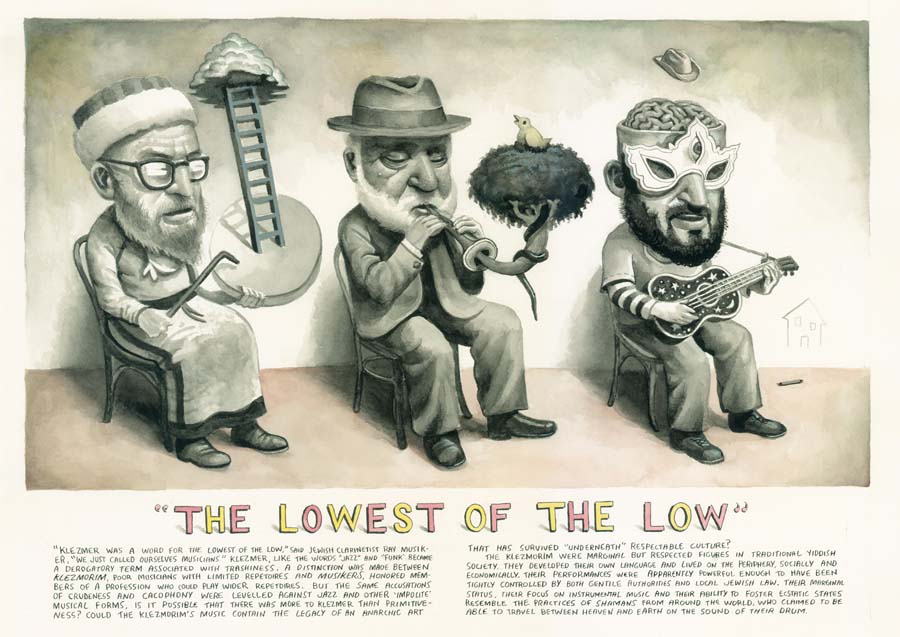
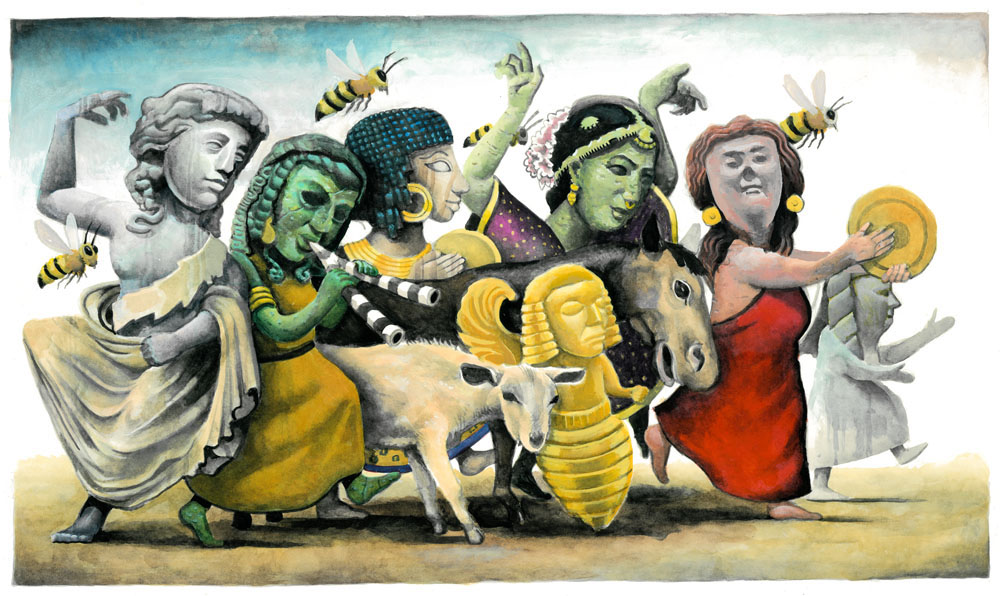
Phil Blank: The Lowest of the Low and Jewish Deborah/Bee Goddesses

I got chatting with Phil Blank, the accordion player of the Wednesday Night Klezmer Collective. Fascinating guy. He is now officially added to "The List of People Jack Would Invite Over For Beer and Conversation If Jack Didn't Live 1000 Miles From Them." In addition to squeezing out the Odessa Bulgar on Wednesdays, Phil is an professional artist with an eye (and an ear) for esoteric musicology. Here are two paintings from his recent Philadelphia Museum of Jewish Art show.

As he says "The Lowest of the Low is my anthropological musings on the role of the klezmer and their perhaps misunderstood "status" and the second is an illustration of the Jewish Deborah/Bee Goddesses, a possibly ecstatic group of women who played drums and were related to a bee cult that stretched from Egypt to Greece to India in the olden days."

Phil Blanks: The Lowest of the Low

Underlying Lowest of the Low is a wonderful sense of the Klezmer as both marginal outsider (barely tolerated for living according to other rules) and critical insider (provides spiritual and secular functions not available otherwise). Jewish Deborah/Bee Goddesses picks up a similar theme, but is even more esoteric. It contemplates mystic, ecstatic, musical, religious traditions connected to, in this case, bees. According to Phil, this tradition was widespread across the Mediterranean and Asia Minor and may have included the Israelites via the prophetess Deborah (who's name, in Hebrew, is Bee).

Phil Banks - Jewish Deborah / Bee Goddesses

Now, whether or not his art connects for you the way it does for me and whether or not you buy the connections he makes, this is important stuff to think about. We tell ourselves simple stories of the past that make the present seem inevitable and benign. It's neither. History is filled with traditions, ideas, and people who were excised from what would become the dominant story. But that doesn't mean they weren't there and that they didn't have an influence. Is it a stretch to look at klezmorim as remnants of a shamanistic mystical musical tradition that stretches back in time to Deborah (and further back to Miriam)? Probably. But the tension between Rabbinic Judaism and mystic, spiritual, strains of Judaism goes back at least that far. So why not?

Anyway, Phil and the Philedephia Museum of Jewish Art are selling prints of these and other of his paintings. Channukah's coming up.... Checkout Phil's website or write to him at phil at philblank dot net. Tell him I sent you.

Wednesday, June 11, 2008

Rohan Kriwaczek, Klezmer, Art Music, and the Guild of Funerary Violinists

Rohan KriwaczekThere are some pretty odd and interesting corners to be explored in the Jewish music world. And in one of them you'll find Rohan Kriwaczek perched, violin in hand and bowler had jammed down over his eyes, sitting on a barrel. Kriswaczek is most famously known (and profiled on NPR) for his book "An Incomplete History of the Art of Funerary Violin." The book, which I understand to be a wonderfully spun, but completely fictitious, tale chronicles the history of the guild...
"From its origins in the Elizabethan Protestant Reformation, to its final extinction amidst the guns of the First World War, the Art of Funerary Violin was characterised by many unique and frequently misunderstood qualities that set it quite apart from all other forms of music. Indeed it is these distinctive characteristics that make it a truly unique genre, with its own specific concerns, aesthetic and function. Throughout the many changes in culture and society between the foundation of the Guild of Funerary Violinists in 1580 and the death of Niklaus Friedhaber (the last of the practicing official Funerary Violinists) in 1915, it retained a trueness to its origins and function, and a commitment to purity of form and mode, unparalleled in any other Western European musical tradition: due, in part, to the exclusive social role it played in relating the greatness of the higher classes directly to the ears of the lower classes."
(I haven't read the book yet, but it's on my wishlist.)

Wandering Jew album coverKriwaczek, himself, is a composer and performer. He has a series of darkly theatrical recordings that draw on "Eastern European, Middle Eastern and Jewish folk music," has scored TV, radio and theater and performed under a variety of names including Infamous Reverend Rohan K., "Dr. Asperger's Klezmer Tonic", and The Guild of Funerary Violinists. I'd love get my hands on some of his recordings but he's not on eMusic and I've used up my music budget for June already. He's top on the list for July.

The Keening, from The Wandering Jew


A Fistful of Klezmer, from Looking Back


The Hall of Magic Words and God’s Great Flood, from Ritual Dark Music

Tuesday, May 27, 2008

Beyle Schaechter-Gottesman: Song of Autumn

Beyle Schaechter-GottesmanFolks, here's an interesting press release I thought I'd pass along. For those not familiar with Beyle Schaechter-Gottesman (me, for instance), she has been an important figure in the American Yiddish music scene. According to Wikipedia, "Schaechter-Gottesman’s songs have been performed by Theodore Bikel, Adrienne Cooper, Theresa Tova, Lucette van den Berg, Michael Alpert, Lorin Sklamberg, Sharon Jan Bernstein, Fabian Schnedler, Massel-Tov and others. A song written for her nephew, "Binyumele’s Bar Mitsve", was adapted by Adrienne Cooper for her daughter as "Sorele’s Bas Mitsve" and was recorded on the CD Mikveh ....Schaechter-Gottesman continues to serve as a resource for researchers of both Yiddish folk and art music. She has been recorded and interviewed numerous times and participated in such cultural events as KlezKamp, KlezKanada, Buffalo on the Roof, Ashkenaz, and Weimar KlezmerWochen...In 1998 Schaechter-Gottesman was inducted into the People's Hall of Fame at City Lore in New York; and in 2005 she received a National Endowment for the Arts Heritage Fellowship, one of the highest cultural honors given by a United States government agency"
Yiddish Film Project
Worlds within a World: Conversations with Yiddish Writers
Beyle Schaechter-Gottesman: Song of Autumn

A VELT MIT VELTELEKH: SHMUESN MIT YIDISHE SHRAYBERS
BEYLE SHEKHTER-GOTESMAN: HARBSTLID

The League for Yiddish is pleased to announce that the film Beyle
Schaechter-Gottesman: Song of Autumn (BEYLE SHEKHTER-GOTESMAN: Harbstlid), the second film in our series Worlds within a World: Conversations with Yiddish Writers (A velt mit veltelekh: shmuesn mit yidishe shraybers) is ready and available for viewing and purchase.

THE FILM
Beyle Schaechter Gottesman: Song of Autumn is an edited interview conducted with this remarkable Yiddish poet, songwriter, and singer by her son folklorist/journalist Itsik Gottesman and enhanced by photo stills and Schaechter-Gottesman's music. The film is 72 minutes long. The interview is entirely in Yiddish WITH VERY ACCURATE AND COMPLETE ENGLISH SUBTITLES. In it, BEYLE, whose name has become synonymous with modern Yiddish song and who has played a central role in revivng and inspiring interest in Yiddish song and poetry among a whole new generation of artists, discusses her life and creative path: her upbringing in the Yiddish cultural milieu of Tshernevits (then Rumania) as the daughter of a remarkable traditional folk singer and a passionate Yiddishist, the war years in Rumania, her development as a modern Yiddish poet and songwriter in New York, and her views on Yiddish literature and creativity. What emerges is a rich picture of the world of a woman who recited poetry to the great Yiddish fabulist Eliezer Shteynbarg as a child, was part of a vibrant Yiddish enclave in the Bronx, and is the only Yiddish poet ever to be awarded a National Heritage Fellowship from the National Endowment for the Arts, the nation's top honor for folk arts.

DIRECTOR
The film is directed and edited by Josh Waletzky, director and editor of Image before My Eyes and Partisans of Vilna, and editor of Emmy Award-winning "Itzhak Perlman: In the Fiddler's House." Among other awards, Josh is the recipient of the Silver Ducat at the Mannheim International Film Festival for Image and First Prize at the Anthropos International Film Festival for Partisans.

PURCHASE
Both films make the perfect program for a Yiddish circle, class, or eveny our local Jewish or documentary film festival. The film is available in VHS or DVD format. TO ORDER, SEND $30 PLUS $5 POSTAGE (IN THE US) OR YOUR CREDIT CARD INFORMATION to LEAGUE FOR YIDDISH 64 FULTON ST. SUITE 1101, NEW YORK, NEW YORK 10038. Postage for Canada – $6.00 for either VHS or DVD. International postage other than Canada – $5 for the DVD and $12 for the VHS. You may also order at our website www.leagueforyiddish.org with a credit card or paypal. For inquires, please contact us at info@leagueforyiddish.org or call 212 889-0380.

Tuesday, March 11, 2008

Marc Сhagall Passion / Strasty po Shagalu

As I've noted before, I'm a big fan of animation and love the chance to showcase it here. I don't speak Russian, so I can't comment on the narration, but the visuals are quite good. This appears to be a nice mix of stop motion animation (my favorite) with some computer generated effects. The music is described as being "Folk Jewish Music" by the Kristall-Balalayka Folk Band. I went to their English language website, but couldn't find any more information.

Marc Сhagall Passion / Strasty po Shagalu (Part 1)

If you like this, check out "Strasty po Shagalu / Marc Сhagall Passion - 2007 - (Part 2)".

Thursday, February 28, 2008

Responding to the charge of Jewish cultural narcissim

The Jewish Rider (1985), oil on canvas by R.B. Kitaj – Marlborough Gallery, New YorkRoaming the blogosphere this morning, I ran into an interesting post on the blog "Dyneslines" about the author's perception (as a non-Jewish New Yorker) of the Jewish communities cultural narcissism. The post is too long to quote verbatim but here are a couple of short posts, so you can get the flavor of the argument (if you're interested, please read the whole post)...

"As an intellectual, naturally I feel indebted to such creative figures as Popper, Koestler, Panofsky, Einstein, Schoenberg and so many others. All the teachers who influenced me in grad school were Jewish. I used to think that if I could figure out their secret, I could really go places. Alas, the secret was not being Jewish but having the advantage of superb education in Weimar Germany, an option that ceased to be available after 1933."

"Here in New York City we are bombarded with celebrations of Jewish films and books. Countless articles and book reviews appear in the New York Times and other quality media. It is all interesting--up to a point....Today, the new sentimentalization of ghetto life. Fiddler-in-the-Roofism, obscures these realities."

"Yet in key ways the collective narcissism of American Jews is unique among ethnic groups."

Anyway, I should make it clear, I don't take this post to be anti-semitic and hope that no one else does either. While I disagree with it, I think it is a legitimate response by a thoughtful person. I just think the author is wrong.


Here is my response. Sorry it's long too...

Hi. Interesting post, though I strongly disagree with your premise and conclusion I resonate with some of the connections between them. For the record, I'm both a Jew (not secular, though not Orthodox either) and one who lived as "an enlightened heterosexual in San Francisco."

To be specific.
1. I do generally "support gay rights, and enjoy cabaret, theater, and films featuring camp and gay wit."

2. I don't "long for a moratorium on the perpetual festival of gaydom"

3. I acknowledge that in "New York City [you] are bombarded with celebrations of Jewish films and books. Countless articles and book reviews appear in the New York Times and other quality media"

4. I don't accept that it's due to "a kind of salmagundii of ethnic exhibitionism" or "the collective narcissism of American Jews" (or African-american's, Hispanic/Latino's, Greek-Americans, Irish-Americans...)

Let me suggest a couple of another interpretations.

One thing that is similar in your two strawmen (gay culture in SF and Jewish culture in NY) is that both groups have significant and recent histories of victimhood they are trying to overcome and/or recover from. Significant portions of the world hold unreasoning, unrelenting, and often murderous hatred for both groups. For the Jews, not only was genocide attempted in the last century, but, in the sense of destroying centuries old Jewish communities and cultural histories, it was largely successful. For the gays, there are few places or groups in the world that do not condemn and persecute them for merely existing.

It is no wonder then, that each group takes moments of opportunity (SF and NY at the end of the last century) to attempt to preserve and establish their history and culture. If not for these moments, there is a very real chance of them not being able to perpetuate these cultures.

So, where you see this as outwardly directed self-congratulatory narcissism (and truthfully, there may be some of that too), I see it as inwardly directed reinforcement.

Let me offer you an analogy..

I once went to a funeral of a Christian with a friend who was an atheist. The friend was annoyed and offended by her perception of the Christian's priest's proslytizing. The thing is, the priest wasn't talking to her. He was preaching to a Christian family and other members of their Christian congregation. He was answering their needs, using his Christian-centered, language for grief and recovery.

At the time I took my friend to task for her solopsitic view that the priests words were directed at her. Now, I'll take this post to task in the same way...while you're invited and welcome to the gay culture and Jewish culture events, no one's really talking to you.


Please join the conversation and post a comment either here or at Dyneslines.

Tuesday, October 16, 2007

Alexander Vaisman: drawings and paintings

When looking for one thing I found another. This time I found the artist Alexander Vaisman. Vaisman, born in 1967 in Chernovtsy, draws and paints "illuminate the experience of being Jewish under the different and often very difficult circumstances." There's a lot of life in these images. Check them out on his web site.

This drawing is titled "Tum balalaika, shpil balalaika" I wonder if he'd let me use it on a T-shirt?

Wednesday, October 3, 2007

Feinsmith Quartet: Modern Jewish Music

Another genre of Jewish music that I've had a hard time tracking is Jewish classical / art music. Despite there being a long tradition of Jewish composers and performers, I've had a hard time getting oriented to the scene. Part of it is not knowing the proper terminology, part of it is just not knowing which websites track the scene. But I think I'm getting there, and hope to showcase lots more as the days go by...

Here's a great example. The Feinsmith Quartet is "... modern music at its most melodious -- full of tension but with thrilling rhythm" (Kaija Pepper, The Dance Current) The quartet will be playing in San Francisco this weekend at the SF Jewish Community Center. You can get more information on the quartet and the show at their website and their myspace page. They have an album coming out any day now. Hopefully I'll get to announce it in my next Recent and Upcoming Albums list.

Feinsmith Quartet: NAME from Feinsmith's ELOHIM

More Shofar Madness

Sid Yiddish is back in action. I wrote about Sid's experimental shofar music video ("Suite For Furby On Shofar In D Minor)" back in July. While the Furby video was pretty unwatchable (bad audio recording + bad lighting = headache) it was pretty engaging conceptually. Sid just sent me an update, called "Beano". I enjoyed the effect that Sid was going for, the drone guitar vs. sharp shofar contrast, but wish the audio recording was better. The recording
doesn't pickup the individual guitars well and they come off a bit mulchy.
"This was one of the better and more funnier highlights from an August 1st Sid Yiddish (on shofar) performance at The Mutiny, an ugly, nasty dive bar in the Bucktown neighboorhood of Chicago. Sid Yiddish was backed by his performance art band $2 Cockroach, consisting of members Lew Brickhate (electric guitar) & Rat Niptik (bowed electric bass)."

Beano


If you happen to be in the Chicago area this weekend, Sid will be performing a 20-minute version of "Suite For Furby On Shofar In D Minor" at MusicCircus2007. The performance will be at Sunday, Oct 7, at 2:55 pm at the Chicago Cultural Center, see the MusicCircus website for more details. You can also check out Sid's myspace page.

Monday, July 30, 2007

Don't watch this video

It's dark, hard to follow and very odd.

But...it's the only documented collaboration of man (Sid Yiddish) and Furby "Your Emoto-tronic Friend"that I'm aware of, and certainly the only one featuring a shofar.

I bravely watched the video all the way through and can report this: the shofar toots, the Furb(ies?) beep and boop, and occasionally someone seems to be doing something with a guitar (a something that shouldn't be described as playing).

I pass this video along in my efforts to capture the spirit and adventure of Jewish music. But please don't watch it.

Suite For Furby On Shofar In D Minor (Art Bootleg Version)

Wednesday, March 21, 2007

Asparagus: A Horticultural Ballet

I've already written three posts in the last 24 hours, so I figure I deserve a break. I'll just wander over to BoingBoing, home of all things wacky and wonderful. I mean, what are the odds I'd run into something wacky, wonderful, and Jewish music related? Really, what are the odds. Darn good, it seems. This is only barely on-topic, but I had to share it.

Asparagus: A Horticulture Ballet Promo Poster
From the SHOWSTudio blub:
"Asparagus: A Horticultural Ballet

Pil and Galia Kollectiv, Conway Hall Humanist Centre, London, Tuesday, 6th March, 2007

The Israeli duo who refer to themselves as the Pil and Galia Kollectiv, in particularly reverential Modernist mood, presented 'Asparagus: A Horticultural Ballet' on stage at the Conway Hall Humanist Centre, in Holborn last week. Well attended, the programme was a three act, asparagus costumed dance that moved methodically through a series of moves for different numbers of the vegetable cast. The programme makes claim to the ballets basis on 'Marx's Das Capital (as Lali Chetwynd did recently in her vegatable performances - something in the zeitgeist?)".

You can see video's of the the show at the SHOWStudio site and a trailer at the SHOWROOM. The SHOWROOM blurb gives a little extra historical information. Not that it makes anymore sense, now that I've read it though.
"Asparagus: A Horticultural Ballet is a live performance piece inspired by rumour and myth. In the late 1970s, while still a student, Waw Pierogi, later of an obscure New Jersey minimal synth band Xex, composed the interdisciplinary Asparagus: A Horticultural Ballet. No documentation of the piece exists, but Pil and Galia Kollectiv have become fascinated by this work, alongside another lost work, Oskar Schlemmer's Triadic Ballet. Pil and Galia Kollectivs' desire is not to recreate either, but rather they are intrigued by the possibilities of making a new work through the collision of ideas left behind by former art movements and other cultural phenomena. For them unrealised, forgotten and failed revolutions are as much a legacy of modernism as the utopian belief in progress that we have inherited."
There's a longer related article at the YourLocalGuardian newspaper site.

There seems to be a category of art out there defined by pieces that exist only to enable the artists to write clever essays. This is clearly part of that category.

Monday, January 22, 2007

Album Art as Social History (sort of)

I attended a lecture on Jewish music recently given by a respected university researcher. In this lecture, he equated Jewish music with klezmer. He then spent an hour using klezmer as a lens to inspect Jewish and African-American relations vis a vis the relationship of klezmer and jazz. A big part of his discussion was using klezmer as a metaphor for Jewish culture and religious life. You know how this goes, klezmer fizzled as American Jews assimilated in the first decades of the 20th century only to be revived in the late 1970's as the children (or grandchildren) of assimilated Jews tried to find meaning in their religion (or at least, in there cultural history). So the story goes.

But that story misses the point that music was still being made by Jews for a Jewish audience. And I'm not talking about Chassidic music, though there was rich vein of that happening too. I mean a whole world of Jewish artists interacting with American pop culture including swing bands, the Barry Sisters, the Irving Fields Trio and all of the other artists working then and now to write songs, play music, and celebrate their Jewish identity.

The folks at "You Will Know Us By The Trail of Our Vinyl..." get it. Here's there motto:
"the history of the Jews in America has been spelled out in books and dramatized on the big screen. But it has never been told through LP covers. Until now."
They've got a blog that discusses Jewish music and Jewish culture, by presenting and analyzing Jewish album art. And what a culture it is...


Now, I'm not claiming that these albums and the others that have been so lovingly presented by the "Trail of our Vinyl" guys represent our finest musical moments. But they're more reflective of our cultural history than the klezmer to klezmer myth.

Tuesday, January 16, 2007

Israeli Albums on Ebay

The Dreidel Day mix reminded me of how little I know about Israeli music other a passing familiarity with Ofra Haza (meaning I ran into her name two days ago and bought one album yesterday). So, I did what all reasonable people do. I went to eBay. Most of what I found were Israeli pressings of American or European albums. But there was a smattering of Israeli albums. There was a bunch of interesting cantorial albums, but what really caught my eye was a small cluster of rock and pop albums. Now, I haven't heard of (or heard) these groups so I can't comment on the music. The album covers, though, were lovely. I'm a big fan of album cover art and poster art. I'm be tempted to pick these up just to frame them. But I won't. Someday I'll have a record player again and will probably regret not grabbing these.