Thursday, July 26, 2012
Zion80: Carlebach Afropop
Check it out.
Zion80 - Carlebach Fela Project - Ein K'elokeinu
This recording, from a December 2011 concert at the Sixth Street Synagogue includes a who's who of the NYC Jewish music scene including Frank London, Greg Wall, and Yoshi Fructer.
You can get more info at the Zion80 website, which has a few tracks up for download. Rumor has it an album is coming soon on John Zorn's Tzadik label.
Hat tip to Sarah V who tipped me off about Zion80 this morning.
Sunday, February 19, 2012
Sefiroth, an electro-acoustic chamber ensemble
Sefiroth, based in London and led by saxophonist & composer Nick Roth, is an "electro-acoustic chamber ensemble" that performs dark and moody arrangements of classics of the Sephardic repertoire. They've recently released a "double EP" that they've made available for listening and download on BandCamp (Arboles lloran por lluvia, Abre tu puerta serrada).Here's a representative example...
Sefiroth Ensemble - Arboles lloran por lluvia
I'm enjoying these recordings thoroughly, though I admit that some listener's might find the arrangements a bit pretentious / overwrought given the source material. I love Olesya Zdorovetskaya's atmospheric vocals and how the horns and electronics provide texture. For a counterpoint, check this more typical arrangement of this distant-love song by prominent Israeli vocalist Yehoram Gaon. Just a bit more melody and less drama. And, while we're at it, check out this funky Sarah Aroeste arrangement.
These counterpoints aren't a critique, just context. It's great to hear artists use these old chestnuts as launching off points for their own explorations and to draw out of them nuances that we may have not heard in a while. It's also good to remember that these familiar melodies have a lot of miles behind them, and that informs how we hear them.
The other recordings have a vary in feel, with some maintaining the same drama and atmospherics and others straying into jazz territory. Erotokritos, in particular, does the neat trick of mixing an 'early music' style vocal harmony with jazz reminding me of Jacqui McShee vocals in the British folk-rock-jazz group Pentangle. The result is more art-music that Pentangle's pop, but equally engaging.
Monday, November 7, 2011
Tikkun Olam in Brazil, Talat's Jewish jazz
I got an email recently from a Jewish jazz group that I hadn't heard about before. The band is called Talat and is led by composer and piano player Alon Nechushtan. Talat's debut album, Growl, on Tzadik Radical Jewish Culture has garnered praise from both the jazz and Jewish communities. I haven't heard the album yet, but I dig the Vimeo videos I've heard. To my ears, their sound, particularly the video below, is very much in keeping with other Tzadik acts, which is a fine thing. I'm a big fan of that sound. (Though I'm also a fan of non-Tzadik Jewish jazz groups including the Afro-Semitic Experience and Enrico Fink). That sound is typically based around jazz improvisation using klezmer modes. Talat's press material talk about also mixing in middle-eastern sounds, though I haven't heard that in any of the videos I've seen. What I have seen though is a nice blending in of Israeli pop music sounds, which is lovely.For more info, check out their website.
Alon Nechushtan and TALAT perform 'tikkun Olam'
Wednesday, August 10, 2011
Serge Gainsbourg. A Heroic Life
A new film about Gainsbourg was just released. The film, called "Gainsbourg: A Heroic Life" was directed by Joann Sfar, one of my favorite comic book artists. Sfar, himself, is also French, Jewish and known for incorporating Jewish themes and ideas into his work (see The Rabbi's Cat, The Rabbi's Cat 2, and Klezmer: Tales of the Wild East.)
I can't wait to see this. It looks great.
Here's the official blurb and trailer.
Taking the best from LA VIE EN ROSE and AMÉLIE, renowned comic book artist Joann Sfar’s GAINSBOURG: A HEROIC LIFE is a completely original take on one of France’s greatest mavericks, the illustrious and infamous Jewish singer-songwriter, Serge Gainsbourg (Eric Elmosnino). Born Lucien Ginsburg to Russian-Jewish parents, Sfar follows him from his precocious childhood in Nazi-occupied Paris, to his beginnings as small time jazz musician and finally pop superstar. Along the way he romances many of the era’s most beautiful women, including Juliette Greco (Anna Mouglalis), Brigitte Bardot (Laetitia Casta) and Jane Birkin (Lucy Gordon). Employing a witty surrealistic style and a soundtrack that includes many of the musician’s greatest hits, GAINSBOURG: A HEROIC LIFE is a quintessential time capsule to ‘60’s Paris.
For more info on the film and a listing of theaters, check out the Music Box Films website.
I'm currently bouncing back and forth between cranking up some Gainsbourg tunes and some covers from the "Great Jewish Music: Serge Gainsbourg" album put out by John Zorn's Tzadik: Radical Jewish Culture label. The album includes covers by John Zorn, Fred Firth, Marc Ribot, Cibo Matto, Elysian Fields, Kramer, Franz Treichler (of the Young Gods), Blonde Redhead and others. I don't have a copy of Rock around the Bunker but I'm hot on it's trail.
Tuesday, August 2, 2011
Black Ox Orkestar
Nisht Azoy
Nisht Azoy - BLACK OX ORKESTAR by Constellation Records
Here's the Orkestar's official blurb. Gotta love the phrase "Anchored to tradition without being suffocated by it." Exactly. We need more of that.
"The second record by Montreal’s Black Ox Orkestar placed the group at the forefront of a ‘new Jewish music’ that rejected contemporary fusion and musty nostalgia in equal measure. With backgrounds in folk, punk-rock and free jazz, the group’s four musicians distilled Balkan, Central Asian, Arabic and Slavic sources into a coherent, impassioned sound that gave teeth to old Jewish songs. Never relying on museum-piece reverence or an obvious, forced collision of musical forms, Black Ox rewrote a Yiddish songbook in ways that sound organically anchored to tradition without being suffocated by it."
Thursday, April 7, 2011
Divine Sparks Judicial Review: Critical reviews of Jewish music
Go. Read it. Now.
http://artsfuse.org/?p=27943
Ok. A couple of my favorite points.
- Hankus Netsky's introduction to cantorial music, Chassidic Niggunim and Sephardic Moroccan music is excellent and I was completely cracking up when I read his comment about the cantorial performance of these songs being "tainted by Conservative and Reform cantors trained to perform them with Contemporary Ivrit (standardized Israeli) Hebrew accents—imagine, if you will, the Delta blues as sung by Ted Koppel or Dan Rather." Absolutely.
- I found critic John Bradshaw to be gratingly unable to get past his own musical experiences. In a review of a Jewish music event I'm uninterested in his flawed comparisons to the Christian music he is used to singing. His complaint about over-abundant ornamentation and lack of melody characterizes his ignorance of the music. That's the way its supposed to sound, dude. Though, to be fair, the exuberant ornamentation of chazzanut has been a subject of debate in the Jewish world as well and has may detractors.
- I was also stunned by critic Steve Elman's ignorance. He writes "The only examples of true crossover music in the jazz tradition that I can recall quickly, Ziggy Elman’s freilach trumpet solos for Benny Goodman in the 1930s, were a sort of burlesque, a novelty rather than a genuine cultural bridge." There was and has been a significant interaction between jazz and Jewish musicians which include plenty of examples of cross-over music. I refer him to David Katznelson's recent collection "‘Black Sabbath’: ‘The secret musical history of black-Jewish relations" for a schooling. Though, here too, his basic point is correct. While the number of crossovers between Jewish music and American music is larger than he credits, it is not large.
Finally, without quoting it because I would need to quote the entire thing, I found Frank London's artistic response to be and eloquent and persuasive. I have been to a number of "cantorial concerts." While they have their value as entertainments, they have offered me far little in terms of spiritual content. Experiencing these cantors in true liturgical contexts is a different story, as is hearing a spiritually minded musician of any type. I remember fondly seeing the Afro-Semitic Experience (a jazz group) play the Michigan Sacred Music Festival two years ago and found their music to be deeply moving.
Ok. I hate writing blog posts that don't have play buttons. Unfortunately, as of the writing of this piece, no video of the Divine Sparks show has been put on line. So here's a clip of Cantor Aaron Benssoussan & the group OktoEcho performing at the Montreal Jewish Music Festival in September of 2010.
Saturday, February 19, 2011
More on Math Rosen, Yiddish Laser Bass and the Panorama Jazz Band
"The instrument is a Monome 256, from a mom-and-pop company called Monome. It's a totally open-source digital controller, meaning that it can be programmed to do virtually anything. Lots of people use it like I do, essentially a loop-slicing sequencer tool. But there are dozens of applications out there, everything from self-generating music to a wicked game of tetris. The units are all hand made by the creator and his partner, and all the software is designed by the users and shared on the forums. It's a pretty amazing community.
As for the Yiddish tune... It came from a few places. For one thing, there was Sunday Simcha -- the klezmer radio show my dad used to listen to every Sunday morning. That definitely got into my subconscious at an early age... I grew up pretty secular, but my parents always encouraged a curiosity about music and its connection to heritage across cultures.
The other place that tune came from is a bit of a story... The main hook is sampled from a group called the Panorama Jazz Band, who make a really eclectic mix of Dixieland, Klezmer, Baltic folk tunes... you name it. I saw them perform while I was staying in New Orleans about a year after Katrina. I was down there volunteering, gutting damaged houses mostly. And I found my heart in that town. It's hard to explain what that place does to a person... It's that thing about music connecting across cultures -- there's nowhere in the world where you can see that more than you see it in New Orleans.
So you can thank my parents and a Louisiana jazz-fusion band for that tune.
I'm working on a record right now, and I think the yiddish folklore influence might sneak in a few more times. I'm trying to find the sounds from my childhood that built who I am, before I was thinking about who I am. Those sounds are way down deep and you can't explain them or extract them. For me, it's a whole lot of rap, some jazz, and maybe a bit of klezmer."
I do love trad jazz (particularly ragtime music) and I couldn't resist looking into the Rosen's fav's "The Panorama Jazz Band." They've been working New Orleans since 1995, blending their flavor of traditional jazz with a blend of "folkloric* music from around the world – especially Eastern Europe, the Caribbean and Latin America." I dig it. I'll have to grab one of their recordings. Here's the PJB playing one of their Eastern European bits....the Yiddish classic "Baym Rebn in Palestina."
Baym Rebn in Palestina.Panorama Jazz Band from mel zimmer on Vimeo.
*I have often, tongue in check, defined "world music" as any group with an accordion. I will now define "folkloric" as any band with an accordion and without a power cord.
Friday, December 31, 2010
Asefa: (noun, from Hebrew) A collective, assembly or gathering, with purpose.
I love meeting interesting folks, and there are no shortage of interesting folks in the Jewish music world. This week I got an email from Samuel Thomas, Ph.D candidate in Ethnomusicology at the City University of New York and the leader of the musical collective Asefa. Asefa plays a wonderfully exploratory fusion of Arabic Jewish music and jazz that includes Yoshie Fructer, guitarist and New York Jewish scene staple, bass player Noah Jarrett, and percussionists Eric Platz and Rich Stein. This is the kind of music, deeply rooted in tradition and wildly adventurous, that I could crawl inside and live in.Here's their official blurb...
Drawing upon a plethora of musical traditions from North Africa, the music Asefa presents is a blend of North African grooves and song traditions with passionate and innovative composition and improvisation. This is Mitteleuropean proto-blues. This is music that honors both ritual and experimentation, reminding us of the vitality and variety within the Jewish tradition -- a tradition that reflects the world. Listen and trace your own roots, whatever they are.They've got an album out. I haven't heard the whole thing yet, but the tracks on the website sound great. I'd link to them, but I'm a live show guy. I'd rather show off this clip from one of their concerts at New York's Blue Note Jazz Club
In addition to playing Asefa, Thomas conducts a variety of workshops
"Whether you want to discover more about Middle Eastern musical traditions, Sephardic poetry, or simply have an interactive experience touring different world musics, the educational programming and performance workshops add incredible value to any Asefa experience! "
To give you a sense of what he's about, here's a short talk by Thomas about his experience with Arab Jewish music given to the Brooklyn Historical Society - Roundtable: Arab Music Traditions and Their History in Brooklyn.
Wednesday, November 17, 2010
Getting smart about Jewish art music
Let me start by explaining what I mean by art music. Here's a pretty reasonable starting point, from Wikipedia. * (There is also a Wikipedia article on Jewish art music but I find it way too narrow.)
"Art music (or serious music or erudite music) is an umbrella term used to refer to musical traditions implying advanced structural and theoretical considerations and a written musical tradition. The notion of art music is a frequent and well defined musicological distinction, e.g. referred to by musicologist Philip Tagg as an "axiomatic triangle consisting of 'folk', 'art' and 'popular' musics." He explains that each of these three is distinguishable from the others according to certain criteria. In this regard, it is frequently used as a contrasting term to popular music and traditional or folk music."In this sense, according to Tagg, Art music (as opposed to folk and popular music) is characterized by professional musicians, written scores, limited distribution, an agrarian or industrial culture, written musical theories and non-anonymous composers. It's a mouthful but you get the idea. This is fancy stuff, not the anonymous and ubiquitous oral folk tradition or mass-produced & distributed recorded pop stuff. A variety of different musics fit under this heading including orchestral and chamber music, opera, choral, and arguably more challenging versions of (sometimes) jazz and (rarely) rock music.
Thinking about Jewish art music raises a question that exists, but is less interesting, for Jewish folk and pop musics. Why make it at all? There are Jewish folk, who make music, so you get Jewish folk music. There is a Jewish populous and bands that play for them, so you get Jewish pop music. But in the theory-rich and abstracted compositional space of art music..how and why do you end up with Jewish art music?
There seem to be a couple of answers.
First, you don't. There is a long history of extremely talented and famous Jewish musicians, composers, and conductors that have been central to the Art music tradition but did not typically or ever produce recognizably Jewish art music. Some famous examples include Giacomo Meyerbeer, Gustav Mahler and Felix Mendelssohn, minimalist composers Philip Glass and Steve Reich, Leonard Bernstein, and 12-tone composer Arnold Schoenberg. Professionally, it was often not advantageous to advertise their Judaism and musically it was often irrelevant. (Note I said typically, my buddy Daniel just pointed out that both Reich and Schoenberg have composed Jewish works as well as non-Jewish works. That's also true for Meyerbeer and Bernstein.)
Second, you do if the composer is interested in liturgical compositions. Western art music (classical music) traces its history back to Gregorian chants which trace their history back to Jewish liturgical music. Art music and liturgical music have been influencing each other ever since. While there is a sense in traditional Judaism that our liturgical melodies go back to Sinai (and are referred to as "Mi Sinai" melodies), in truth these melodies have evolved and changed over time. In the 19th century, Samuel Naumbourg, Solomon Sulzer and Louis Lewandowski documented Ashkenazi liturgical music and added their own, now ubiquitous compositions. New liturgical works are constantly being developed. Some, such as the works of Hugo Chaim Adler and Samuel Adler and Aaron Blumenfeld fit well into the mainstream of Jewish liturgical works as well as art song. Some are quite idiosyncratic. I'm personally a fan of the
Third, you do if, as a composer, you're interested in the development of national music or cultural identify. There was a fascination in the 19th century, and to a lesser degree the 20th century, in developing cultural and nationalistic identities through the development of identifying cultural art, including music. For example, the "New Jewish School*" of music, represented by the St. Petersburg Society for Jewish Folk Music,
"can be compared to other national currents, forming the European musical landscape since the middle of the 19th century. While Russian, Czech, Spanish or Norwegian national music was able to unfold and establish itself in the cultural conscience, the development of the Jewish school was violently terminated by the Stalinist and national-socialist policy after only three decades.In the 20th century, outside of Israel, diaspora composers have often substituted the idea of Jewish identity for Jewish nationality but followed the same compositional lines... developing non-liturgical compositions inspired by Jewish religious practice, Jewish events (often the Holocaust), or themes from Jewish folk and/or popular music. Dmitri Shostakovich's Symphony No. 13, for example, was inspired by the poem Babi Yar, by Yevgeni Yevtushenko, which tells the story of a massacre of Jews in Kiev by the Nazi's but is also the story of Russian pogroms and of callous hate. (You can read the poem at Remember.org, and hear a performance of the poem and the symphony at the Museum of Jewish Heritage website. Avant-garde Jazz saxophonist and composer John Zorn developed the Masada Songbook of over 200 individual compositions based on a set of composition rules derived, largely, from his analysis of Jewish liturgical and klezmer modes. You can listen to an NPR spot on the Masada project on the NPR website. To develop an American Jewish identify, the Milken Archive of Jewish Music has produce well over 50 CDs of American Jewish art music ranging from Yiddish Theater music to contemporary symphonies. My personal favorite so far is Ofer Ben-Amots' etherial "Celestial Dialogues / Hashkivenu / Shtetl Songs"The history of the New Jewish School started in the first decade of the 20th century. In 1908 the Society for Jewish folk music was founded in St. Petersburg - the first Jewish musical institution in Russia. Important composers, such as Joseph Achron, Michail Gnesin, Alexander Krejn , Moshe Milner, Solomon Rosowsky, Lazare Saminsky and others joined it. In contrast to Jewish composers from Western Europe these young artists did not lose their connection to the Jewish community. The more than five million Jews in Russia (at that time about half of the Jews in the world) lived in old traditions, which remained a nurturing soil and a source of inspiration for musicians. [Musica Judaica website]
By the way...what comes around goes around. Two of my favorite albums are pianist Uri Caine (and his ensemble) exploring Gustav Mahler from both an improvisational jazz perspective as well as a Jewish music perspective, including klezmer styled horns and vocals by the extraordinary Cantor Aaron Bensoussan. The studio album, Primal Light, and the live album "I Went Out This Morning Over the Countryside: Gustav Mahler in Toblach" don't necessary show that Mahler had Jewish themes, which is questionable, instead they show how good a vehicle Mahler is for improvisation, Jewish themed or otherwise. But the irony, as well as the music, is delightful.
As I noted earlier, keeping up with Jewish art music is difficult. Here are some of my favorite resources, but all have frustratingly narrow focus areas.
1. The Milken Archive of Jewish Music: The American Experience
2. John Zorn's Tzadik label (look for the Radical Jewish Culture sub-label)
3. Jewish-Theatre.com - "The Global Website to promote Jewish Theatre and Performing Arts"
4. The Jewish Music WebCenter - an online forum for academic, organizational, and individual activities in Jewish music.
5. American Society for Jewish Music - which "serves as a broad canopy for all who are interested in Jewish music. Its members include cantors, composers, educators, musicologists, ethnologists, historians, performers and interested lay members - as well as libraries, universities, synagogues and other institutions."
6. The Klezmershack, Hava Nashira, and Jewish Shul Music mailing lists. While no one list focuses on Jewish art music, each occasionally has something interesting in this area.
* The Wikipedia article has lots of useful and cluttering footnotes and citations. Check 'em out if you want further edification. The Tagg article "Analysing popular music: theory, method and practice" is particularly fascinating.
Sunday, August 15, 2010
Lenka Lichtenberg - Avinu Malkeinu
The performance is from the 2010 Boskovice Festival, at the Boskovice Synagogue. Lichtenberg and her band will be performing at the Ashkenaz festival in Toronto in a few weeks. It should be a wonderful show. Wish I could go...
Wednesday, August 11, 2010
Pioneers for a Cure: The Israel Sessions Volume 1
Pioneers for a cure is a charity compilation that trading up and coming musicians exposure for an opportunity to raise money for cancer research. The Israel Sessions is the second phase of the project. The first phase, produced by one of my favorite musicians Rabbi Greg Wall (of Hasidic New Wave and the Later Prophets) featured a wonderful cross section of contemporary Jewish music. This phase focuses on Israel music and other than an inclusion Greg Wall's Later Prophets is full of artists I don't know. Great fun and great music, gentle pop and driving rock, Israeli folk and art music. I think the Later Prophets and the Uri Miles tracks are my favorites, but there's not a dull track in the set.
Here's Greg Wall's Later Prophets Featuring Shai Bachar and Rabbi Itzchak Marmorstein, playing Sobu Tzion live in Beit Avi Chai, Jerusalem, August 24, 2009. A studio version is part of the Israeli Sessions.
To get in on Pioneers, check out tracks yourself. Donate and download the tracks you like. Only the first 5 tracks of the collection are up on the site, but the rest are coming soon. And while you're there, check out the songs from the first phase. They're all still available and just as great. They include tracks by Teruah favorites David Broza, Y-Love, Stereo Sinai, Sway Machinery, and Adrienne Cooper, just to name a few.
Here's a short video article on Pioneers for a Cure. It was made at the time of the first set of songs, not the current set, but it will give you the right idea.
Friday, July 9, 2010
Klezmer / Jazz from Argentina .... The Lerner-Moguilevsky Duo
Hi folks. Today's great Jewish music find is César Lerner and Marcelo Moguilevsky, the Lerner-Moguilevsky Duo. Woodwind player Lerner and piano/accordion player Moguilevsky are based in Buenos Aires, Argentina and play a lovely, arty, klezmer-influenced jazz. While new to me, they're not a new combo. They've been playing together for 15 years and have just released their fifth klezmer/jazz recording, Aleph Beth. I haven't found a good import source for their recordings yet, but you can order directly from them or download their 2003 recording Sobreviviente from eMusic. (Which I'll be doing shortly)."In Argentina, though, and despite having the largest Jewish community in South America, klezmer remained rather relegated, downgraded to intimate expressions in the private life of the community members, most of all as the music played in festive occasions such as weddings and bar-mitzvahs. "
"This is why the oeuvre of Lerner and Moguilevsky, sustained in time and in an impeccable discography, is so important. Both grandsons of Eastern Europe and Russian Jewish immigrants, they have rescued those traditions that were just there, anesthetized in the memory of a whole community, waiting to come to life and flourish again not just as something from a time already gone, but as a present cultural expression with strong links with the present and the past at the same time."That's my kind of florid prose. I could say that with a straight face. Here's the Lerner Moguivsky Duo playing during Yiddish Summer Weimar, July 2007. There are a lot more videos available on YouTube, so check 'em out.
Hat tip to YouTube user, failsworthpole for posting the video.
Sunday, June 27, 2010
Australian Jewish Music Ensemble
"Jewish music tells an incredible story of a journey; both into the soul of man and throughout the physical world. This journey has given birth to a remarkably diverse and beautiful tradition that encompasses all of the cultures that have hosted Jewish people. The AJME was formed around the idea that, in its breathtaking diversity, Jewish music can be revitalised through fusions with other genres of music, different compositional forms and the inclusion of improvisation, which is the lifeblood of musical creativity. By funnelling Jewish migratory paths through a contemporary musical prism, the AJME hopes both to create for itself a repertoire that will make a lasting contribution to the body of Jewish music, and to encourage more people to engage with this tradition."That "Jewish music can be revitalised through fusions with other genres of music" is a fine idea, though I like seeing it revitalized as is too. The video below is a fun deconstruction of the seder classic Echad mi Yodea. They do a nice job of exploring the melodic and rhythmic possibilities in the song without making the song unrecognizable. On their myspace page you can hear a number of their other pieces, including Adam Starr's new composition "Meditations on a Judeo-Babylonian Ritual Song." I'm going to need to get a copy of that one. Very cool.
Wednesday, June 9, 2010
Gene Marlow's Heritage Ensemble
I love getting email. I've said that before, right? In particular I love the "have you heard" emails, because usually I haven't but now I will. Last week I got a nice email from a reader named Vivian who wanted me to know about "a composer named Eugene Marlow, and his group called The Heritage Ensemble. He writes both jazz and classical music, as well as interpretations of Hebraic liturgical music, which he performs with his excellent Heritage Ensemble....I hope you can find time to listen to some of the wonderful selections. It took me a week, but I did listen.Gene Marlow, according to his website, is a jazz and classical composer with compositions for solo instruments, chamber groups and big bands. He's also a working musician, playing parties with his Heritage Ensemble which specializes in "Jewish liturgical pieces and Israeli folksongs arranged in various jazz and neo-classical styles". With the Heritage Ensemble he's recorded a new album, "Making Music of our Own." Honestly, from the samples I hear on the website, I don't love Marlows arrangements as much as Vivian did. Marlow's clearly a pro, but his compositions and playing are a bit mannered for my taste. I've heard enough jazz takes on traditional melodies to not find the idea novel and Marlow's jazz explorations don't push nearly as far past the originals as I'd like to go. That said, I completely understand why Marlow's audience loves this music. There is a gentleness and depth of feeling to the music that is quite engaging. If you enjoy the sound of a classic jazz combo of piano, bass and trap then you should check out Marlow. If you're in New York or the environs, you should consider booking him.
Here's my favorite sample from Marlow's website:
Bilbililos ("Rock from whose store we have eaten. . .")
Sunday, June 6, 2010
Jewish Music Fest Shoutouts, Chicago, SF, Toronto, Atlanta, Washington DC
Chicago Jewish Festival. Next Sunday, June 13, is the Chicago Jewish Festival. It runs from from 11 to 5ish, with 4 concurrent stages as well as food, art, and local organizations. I think the music is free, but am not sure. And I get to go! If you see me say howdy! I'll be live tweeting the show. This year artists will include my buddies StereoSinai as well as
"Tzioni ‘R' Us/Weiner Experience, Moshe Skier Band, The Ruby Harris Band, David Broza, Kol Sasson, Rabbi Joe Black, Listen Up! A Capella, Community Sing, David Broza, Jazmer, Barbara Silverman, Lafayette Klezmorim, Tarkay, Tracy Friend, Maxwell Street Klezmer Band, Guy Mendilow, Shakshuka, Saul Kaye, Cantor Jeff Klepper, Tumbalalaika, Guy Mendilow, Kol Tikva, Lynn Hazan, Caryn Bark, Shining Lights, Jeff and Janis, Anna and Catherine Kazyansky, Mamaloshn Yiddush Song Group, Ed Holstein, Marilyn Price, Steve Justman, Shelechet Aviv Israeli Dance Troupe, Ballet Entre Nous, Aaron Freeman, Jessica Honor Carleton, Solomon Schecter Choir, Junior Klezmer Band, Guy Mendilow Band, Judy & David, Jessica Honor Carleton, Joel Frankel, Judy & David, Marilyn Price, Jewish Jammers, and Comedy Ventriloquist Chuck Field."And rumor has it that Patrick A of Can Can and Punk Torah will be in town for festival as well, though not performing.
Whew. Looking at a list like this is humbling. As much as I think I know the list touring Jewish musicians, looking at the line of summer Jewish music fests makes me realize how much more action there is out there than I can track. Great fun.
San Francisco Jewish Music Festival. July 11. This year is the SF Music Fests 25th year. They had a big showcase in March and will be having another one in July.
"Artists include Eprhyme, Glenn Hartman and the Klezmer Playboys, Peter Jacques, Elana Jagoda, Kugelplex, Ira Levin, Joe Nguyen, Kat Parra, Red Hot Chachkas, Dror Sinai, Gerry Tenney and California Klezmer, Vocolot and Joshua Walters. Plus klezmer, maqamat (Middle Eastern modes) and Middle East percussion jam/ workshops, an Instant Chorus, and an Instrument Petting Zoo, in association with the Community Music Center and Zambaleta World Music Institute."Ashkenaz Music Festival, Toronto. From Aug 31 to Sept 6. Headliner shows require $ tickets, but everything else is free. And considering most of the "everything else" would headliners at other festivals, this is amazing. I would love to go but don't think I'll be able to afford it. Anyone feel like sponsoring an itinerant blogger? No? Oh well. Maybe in two years.
"Abraham Inc., Adrienne Cooper & Marilyn Lerner, Andy Statman, Batsheva, Beyond the Pale, Canadian Cabaret hosted by SoCalled (including helly Posen, Brian Katz and Lenka Lichtenberg, Lache Cercel, Aviva Chernick, the Yiddish Swingtet, Mike Ankielwicz), Daddo, Daniel Kahn, Deep Minor, Di Fidl Kapelye, Flory Jagoda, Gypsophilia, Jaffa Road, Klezmer Kids, Konsonans Retro, Kosher Gospel w/ Joshua Nelson, David Wall, and Ken Whiteley, Kurt & Annette Bjorling with Di Fidl Kapelye, Lache Cercel and the Roma Swing, Marilyn Lerner, Mitch Smolkin, Nayekhovichi, Nayekhovichi, Sephardic Cabaret hosted by Aaron Bensoussan, Shtreiml, Sisters of Sheynville, The Flying Bulgars, The Huppah Project, The Klez Dispensers, The Lithuanian Empire, Theresa Tova, Toronto Jewish Folk Choir, Vira Lozinsky, Zully Goldfarb."Atlanta Jewish Music Festival. Ok, it was last night and I missed it. But I wanted to give a shout out to one of the new Jewish music fests. First of all I love seeing some Jewish action down South. There's been a solid Jewish population down there for a long long time, but it doesn't get the attention that Jewish in northern east and west coast cities get. Secondly, the line up for their fest was pretty interesting. Yesterday's show included the Moshav Band, DeLeon, Girls in Trouble, and 4th Ward Afro-Klemzer Orchestra. What's interesting about this is that it was much more of a rock / pop concert than your typical fest. Most fests lean toward Jewish flavored folk / world music. As more Jewish rock, pop, and hip-hop bands are getting formed, I wonder how long it will be until more fests have stages like Atlanta's.
Washington DC Jewish Music Fest. It kicks off tonight and runs until June 13, with....
Screening of The Jazz Baroness, Danny Sanderson, Seth Rudetsky’s Deconstructing Broadway, Galeet Dardashti, Uri Gurvich Quartet, Saints & Tzadiks (Susan McKeown & Lorin Sklamberg), Golem with Girls In Trouble, The Macaroons Children's Concert, and Vagabond Opera.
Friday, May 21, 2010
Mixed Marriage: Jazz and the Post-Klezmer Revolution in NYC
I'm up late working on a list of currently active Jewish jazz musicians (e.g. musicians who mix Jewish music and jazz music) for the music fest and ran across this gem, "Mixed Marriage: Jazz and the Post-Klezmer Revolution in NYC." It's an hour and a half music performance and discussion with Lewis Porter and Greg Wall, sponsored by NYC's Philoctetes Center for the Multidisciplinary Study of the Imagination. Greg Wall is a great sax player who's played in a number of Jewish jazz fusion bands including Hasidic New Wave, the Greg Wall Trio, and The Later Prophets. He's also an ordained Rabbi. Lewis Porter is jazz pianist, author and Professor of Music at Rutgers University.I wasn't able to embed the video, but you can watch it on YouTube. And you should....
Friday, April 30, 2010
Mark Bloom's Jazz Shabbat Suite
Shabbat Shalom, everyone.Whew. I'm looking forward to Shabbat. It's been a long week. I was a bit of a gadfly at the Music Fest meeting, but they kindly didn't run me out on a rail. (Afterwords I was referred to as "Perchik". I was assured it was a compliment. I'm not quite assured. Ah well.)
I haven't had a 'get into to the Shabbat groove' video in a while. But in that spirit, here's a SoundCloud player loaded up with Mark Bloom's Jazz Shabbat Suite. Bloom is a musican and bandleader, as well as a cantorial soloist and liturgical music writer. This is pretty easy listening for me, but well done and just what I needed this afternoon.
Jazz Shabbat Suite by MochaJuden
By the way, Bloom's based in Plymouth, MN, and is a working musician. Give him a yell if you've got a private party, religious program, or educational workshop.
Hat tip to my buddy, MochaJuden, for uploading the track and tweeting about it.
Tuesday, March 9, 2010
Like a happy rabbi eating tacos in Guadalajara at 3am- The Sherele Jazz Band Innovators
- The shtetl band, wanting to perfectly recreate the sound of pre-war Eastern Europe. (e.g. Budowitz and Adrienne Greenbaum)
- The revival band, honoring their American golden age klezmer progenitors and Yiddish theater favorites, and so very (sometime depressingly) serious about making new Jewish culture (e.g. Klezmatics and the Shirm Klezmer Orchestra).
- The bongo band, klezmer by way of the 1940's pop Yiddish and 1950's Jewish Latin music crazes (e.g. Yiddishe Cup and the Klezmer Company Orchestra).
- And of course, the hard-working local simcha band (we play weddings, bar mitzvahs and brisses), actually expecting the audience to dance to songs with 'hora' in their name (e.g. Michigan's Heartland Klezmorim and New England's Wholesale Klezmer Band).
- And then there's the jazz-klezmer band, where violins become horns, accordions become upright basses, and Minsk becomes Manhattan (Frank London, Enrico Fink).
- The post-klezmer (or prog-klezmer) band, where klezmer is a point of departure not a destination (or something profound like that). (e.g. Klezmer Madness, Klezmafour)
- The Pop-klezmer, where pop music has an illicit love affair with klezmer (e.g. Oi Va Voi, Golem)
- And finally, the Roots / World music klezmer, where klezmer is whipped up with most any other rootsy music around to prove that every indigenous music form in the world loves accordion (Red Sea Pedestrians, JUF, Beyond the Pale)
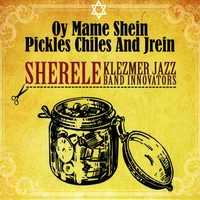
The Sherele Jazz Band Innovators is one of my favorite contemporary klezmer bands, well grounded in the tradition but also well planted in their place (Mexico) and time (now). A fine woody clarinet over tockity drums, acoustic and electric guitars, and bass. Wailing and soulful, jangly and full of life. Their recent album, "Oy Mame Shein -Pickles, Chiles and Jrein" is great fun. And, of course, my categories both help and hurt my ability to describe them. Definately not a shtetle band. They've got the jazz feel of a late-revival band but happily weave in elements of (Mexican) roots and post-klezmer. The guitar playing was particularly fascinating, sometimes a Spanish, almost flamenco, style acoustic guitar sometimes a cutting electric guitar. All in all a lovely blend.Here...give'em a listen.
Sherele has gotten a bump in popularity late through their inclusion on the new Putumayo sampler cd "Jazz around the World."For a band who's self description is "Like a happy Rabi waking up in a Moldavian shtetl, dancing love letters in Buenos Aires, eating tacos in Guadalajara (3 a.m. after mariachi and tequila) and head banging to your grandmother’s music in 50 plus minutes of Latin American Klezmer extravaganza" a world music album is natural home.You can get more info on Sherele at the Myspace page, their CD Baby page, and their Facebook fan page.
Monday, March 1, 2010
Hal Linden headlines Detroit's JCC Stephen Gottlieb Music Fest
I don't remember if I mentioned this before, but I recently joined the executive committee of the JCC Stephen Gottlieb Music Fest. The music fest brings all sorts of interesting Jewish music acts to the North Coast (aka Michigan) every spring. I'm going to spend this week writing about a number of the acts playing the fest, both as a shameless plug and as a chance to think aloud about how different types of music collide in a Jewish music fest and what that says about American Jews.The headliner of this year's music fest is Hal Linden, who will be playing on March 6. If you know who he is, you're doing better than I did when I first saw the event schedule. What if I said "Barney Miller?" Did that do it? It did for me. I'm old enough. Hal Linden is the Tony and Emmy award winning actor who played Barney Miller on the hit 1970's tv show of the same name. He's also a fine singer and musician and is Jewish, "Hal Linden" being a stage name for a Mr. Harold Lipshitz.
Here's the official fest blurb...
"Actor/singer/musician Hal Linden has earned three Emmys and Broadway’s highest accolade, the Tony, for his lead in “The Rothschilds.” Best known as the star of the popular series “Barney Miller,” Linden began his show business career as a clarinet player and later toured as a singer with the Sammy Kaye, Bobby Sherwood and Boyd Raeburn bands. Join us for an evening of outstanding music and song; Hal Linden is a riveting entertainer not to be missed!"
Here's a fun video of Linden goofing around on the 1970's show Captain and Tennille (which I don't remember.)
I'll be honest. I'm going to miss this one. I'm a fan of traditional jazz and I'm sure that Linden puts on a great show. But babysitting is expensive, going out without my wife isn't much fun, and with a Jewish music fest kicking off...this one just isn't compelling enough for me. It isn't, well, Jewish enough for me.
If the opportunity were to come my way, I might see Linden at a jazz fest. Or at a celebrity showcase of some kind. But I don't get the idea of him playing at a Jewish music fest. Other than banal fact that he's Jewish, his music says little to me about my religious life or cultural history. All it does is remind me that fairly regularly Jews make good TV shows.
What's interesting to me is how much my perspective isn't shared. This is a hot ticket, don't make any mistake about it. The show is selling well and people are excited. He's gotten rave reviews from other JCC's. Partially this is a demographic thing...his primary audience is my parents age, not mine. People who were in their 30's or 40's when Barney Miller was on the air. Not 7. People who are in their 70's now. Not 39.
Partially, it's an expectation thing. Going out to listen to a Jewish musician with a hall full of other Jews is more than sufficient for many Jews. It's not sufficient for me, for a Jewish music fest I expect more Jewish content. The JCC Stephen Gottlieb Music fest has plenty to offer for me, though, and I'll talk more about that starting tomorrow.
Friday, December 4, 2009
Anim Zimros, Breslov Niggun
Shabbat shalom. I've had a long week couple of week. I was in upstate NY yesterday on a work trip, then got up at 4am this morning finishing up some work. Also got grumpy at my daughter for no really good reason. sigh. Hopefully the candy buttons I bought her, along with a good hug, will make up for it.
Anyway, I'm really looking forward to shabbat. Here's a good 'get in the shabbat groove video. According to the YouTube notes, it's Yisroel Gottlieb singing an old Breslov niggunim for Anim Zmiriot. I really love niggunim and could listen to them all day. I really need to find some better recordings than I have, though. I keep finding accompanied choral arrangements. What I really want is disks of niggunim like this. A few voices, unaccompanied. I'd like to finding them for as many of the Chassidic groups as I can. Sounds like yet another project...
For another take on Anim Zimros, check out this jazz performance by Jeremy Siskind, Miles Brown, Yonatan Rosen at the Knitting Factory in NYC. I could get lost in this too, though maybe not all day.
Update: I've gotten a couple of great recommendations for Niggunim albums. My friend Binyomin Ginzberg, of JewishMusician.com and the Breslov Bar Band, suggested "The Hasidic Niggun as Sung by the Hasidim", which is a set of field recordings put out by The Jewish Music Research Centre in 2004. Avishai suggested Yehuda Solomon's Beyond Words albums. They are available from JewishJukebox.com and Mostly Music. All of the web sites have clips. Check 'em out.
Hat tip to YouTubeUsers GotToBeNanach for the Breslov version and Seinav for the jazz version.