Earlier this week I blogged about NuRootz musician Alison Westerman. Today I've got the latest video from her fellow NuRootz collective musician Mikey Pauker. I got a chance to see Pauker perform at the URJ Biennial and was impressed. He's part of a really select club of people that includes Matisyahu, Y-love, the Moshav band that are equally comfortable in religious Jewish settings and in very secular rock club settings and doesn't change his set list much between the two.
Here's his latest video, Constellations. It's not one of his more explicitly Jewish pieces, but I dig it.
Pauker's a California guy, but is current living and attending a Yeshiva in Nahalot, Israel and soaking it all in. Here's an excerpt from his blog
"I have fully immersed myself in a super natural, complex, beautiful, mystical culture filled with life!!! I have been living in Nahloat which is a Silverlake/East Village/ Mission District type of community in Jerusalem. The people here are artists/hippies the create sort from all over the world. This is a spiritual community right across from the Shuk which is an open market similar to what you see in movies where people bargain for fresh produce, like in the Disney classic Aladin. Every day I eat fresh barakas, produce, and drink fresh juice. I am still keeping up with my daily yoga and meditation. During the week days I wake up early head to the yeshiva to study Tania. From Tania, I walk over to the Mikveh, (a spiritual bath house), where I cleanse my soul and physical body. From there I walk up stairs where I pray and wrap tefilin on my body. Every morning I pray during the entire Shachrit morning service and then I continue with Shemona Esrei. On the days they have torah service I am finally able to follow along with the hebrew text without using any vowels. I am able to understand the prayers and the intentions behind all of them. Every morning I am able to get VERY present with the universe through morning prayer and I am falling in love with this practice."
Wish I was there buddy. Seriously.
To get more info on Pauker's recordings, tours, and his spiritual adventures in Israel, check out his website.
Hi folks. I'm at the Union for Reform Judaism Biennial. I'm serving on the board of trustees for my synagogue Temple Beth Emeth in Ann Arbor. It's been pretty interesting for a guy with a Conservative upbringing and Orthodox leanings to settle in a Reform temple, but it's been really great. TBE is just about the most wonderful congregation I can imagine. Any quibbles I have with theology or liturgy are very much secondary to that. The Biennial is the bi-annual conference for the the URJ, the Reform communities organizing body. This year over 6000 people have piled into Washington DC for the event. There will be lots of URJ committee meetings, lectures, hallway discussions, big speakers, and, of course music. I'm going to do my best to see as much music as possible and report in.
First a quick note....the URJ has put a lot of information about the musicians up on their Stage Page including schedules (for attendees), musician info and some videos. If you've ever wanted to get a real sense of what's going on in the Reform music community this is the page to visit.
Day 1
12:00 Noon The “URJ Books and Music” stage is kicking off with Beth Schafer, Julie Silver,Doug Cotler, and Rabbi Joe Black.They’re singing a funky, folky version of “Driedel, Dreidel.”Schafer, Silver, and Cotler are on guitar and Colter is playing keys. It's fun to see them live but I'm really hoping this isn't setting the tone for the week. They're playing into all my stereotypes of liberal Jewish pop-liturgical musicians (I have different stereotypes for Orthodox community musicians). One of the big challenges for me is that while I really appreciate what these folks are doing, I don’t love a lot of the music. I find a lot of it to be pretty shallow both lyrically and musically. I also find a lot of it very dated. I don’t know if this is me pointing out that the emperor’s got pretty shabby clothes or that I’m just a jerk. Probably both.
Before anyone takes me task, let me say..... I know. Lots of it is “family music” aka kids music. And I know… lots of it is intended for easy camp and congressional sing-alongs. And, I know… these folks are talented musicians.But most of what I hear is mediocre and forgettable, a baby-boomer pastiche of 1970’s folk pop with a few Hebrew (sometimes Torah) phrases wrapped in fuzzy good feelings. Like an oldie’s radio station in a Jewish twilight zone. Yawn.
I’m hoping to find a few gems, though. I want to hear some new voices and sounds. I want my world rocked like it when I first heard Girls In Trouble sing feminist midrash over an indie-pop electric guitar and looped violin. I want to hear songs with depth and substance that really speak deeply to Jewish beliefs and dreams.
Is Colter really asking us to sing “take a potato pat pat pat.” Sigh. At 41 I'm the youngest guy in the room at the moment. Why is he singing this?
Ok, now we’re into Rock of Ages. Classic, and a nice arrangement.I think this is Silver’s arrangement. I love her soft descant. Nice. (I really appreciate Silver's work, much more than Shafer’s which for me is vapid fuzzy good feelings and fairly uninteresting song structures). Joe Black is now singing his ‘hit’ “Judah Macabee.” He's got a wonderful voice and this is a well-written song, though I wish it didn’t sound like it was written 30 years ago.
12:30, Jay Rappaport.
I don’t know Rappaport. Let’s see what he’s got. The announcer is crediting him for being a Berklee College of Music grad and a Billie Joel sound-alike.Ok. A little light R&B piano action. He sings well, plays well, works the audience well and sounds like 1970’s R&B oldie radio station instead of a 70’s folk-pop station. Lyrics…. Hebrew chorus? Check. Explanatory English lyrics? Check. Yep. He sounds like a elementary Hebrew school class. So, would my kids dig it? My 9 year-old who’s crank’s Matisyahu on her nano probably would find it really boring. My 7 year old? Maybe, if it was presented in a class situation but not on her own. (She digs Lady Gaga. Let me tell you…she was “born this way” all right). We are Jews. Why? Our people are connected around the world? That’s it? We should do push-ups with Judaism on our back? Sigh. We’re definitely aiming for the 7 year old in all of us. So Rappaport’s a lot of fun. I could see a gang of really young kids really having fun with him, but his songs don’t measure up for me.
Opps. I just got scolded for poaching a power outlet in a dangerous spot. My bad. But they offered me a spot at a table that will later be home to Jewish Rock Radio. Thanks folks! I’ve promised to put in a plug for the convention’s Stage Page (www.urjbam.com/stagepage). I’m not on wireless yet but will check it out as soon as I am. Maybe I can get press credentials and access to the press wireless connection tomorrow?
12: 55 Lisa Levine.(Cantor from Chevy Chase, MD)
Levine is a cantor from here in Maryland and is touted as having a lot of albums and her own song-book and visiting and performing for Jews in Cuba. She’s performing with members of her “inter-generational choir and band.” Yep. More 1970’s folk rock, complete with flute and cello this time. She’s got a good voice, though, and her music, while playing to all the songleader cliché’s, is more varied and better written than much of what I’ve heard from the community. I really dig her V’shamru. It’s up-tempo, but has a dark glimmer that gives it depth. I could easily see the kids’ choir at my synagogue nailing this one. Her “We will sing” is a powerhouse anthem. Listening to it reminds of a Gordon Lightfoot anthem (which is a pretty dated but still high praise, for those of you who don’t the guy.)All in all, Cantor Levine fits into all my preconceptions about songleader music, but there’s some real music here. I hope the folks listening are paying attention and take her songs back to their communities.
It’s frustrating that they’ve programmed music through the main conference lecture/panel sessions. The audience completely clears out. Only a few of us die-hards left. Lots of musicians I recognize wandering around. I see Todd Herzog, Jeff Klepper and Saul Kaye. I’ve got lots of folks to say howdy to.
1: 20 Sababa is next up. This show is getting better and better. In case you’re wondering…yes. more 1970’s liturgical folk-pop, this time with two guitars and a mandolin. Their sound is simple but tight, bright and glittery songleader rock with a bit of a country twang. Sababa’s lovely harmonizing and great control of their dynamics results in a very strong and engaging sound I could easily see on a main stage somewhere (hint hint Detroit JCC Stephen Gottlieb Music Festival). I really want to hear them with a drummer and maybe a horn section. I might just have to get their album. Yep that’s me clapping along. Funny, they’re closing with a anthem with the chorus “God made it and it’s all good.” Very apropos of my Lady Gaga reference earlier. (She’s Jewish, after all).
Yikes. The audience is getting really thin. This is almost as bad as when I gave a Jewish music talk to 4 people at the Detroit JCC recently. Being in the wrong time slot is a real drag.
1:45 Larry Midler. Oops. I missed Rabbi Midler’s intro and will have to look him up later. He’s playing some goofy, happy-clappy, tune and not impressing me yet. Hang on. He’s busting out some serious country flat-picking guitar lines. That’s better. He’s got some action after all. I’m digging this tune about Noah. I wonder if he’s got a video of it I can post? Oy. He’s singing his “hit” “Where I go there’s someone Jewish” which rhymes Jewish and Newish. Cute but oy. At least the remaining audience members are singing along. I guess this is a hit after all. I’d rather hear the flat-picking. Now he’s singing about bar mitzvah’s. I really don’t love songs about Jewish set pieces (bar mitzvah's, dreidles, candles, Torah scrolls, matzoh....). Not that they’re not important, they’re just easy to write and easy to forget.It’s really hard to make them wonderful. Ok, he’s doing more flat-picking, this time a song about Sampson…I love this just like I loved his Noah song. Do more of this and skip the goofy stuff.
One thing that’s clear to me is that I really don’t know this community very well. I’ll need to check in with my friend David, who’s been a part of this community for years. He’ll know Midler’s story.
In case your curious.... Here’s the Teruah guide to music for URJ musicians. (this is tongue in cheek folks.)
1.Play 1970’s folk pop (or R&B) because the history of music ended then.
2.Make sure you have one, and only one, Hebrew phrase in your chorus. Reform Jews like to spice things up. But only so much.
a.If you’re a performer, not a song-leader feel free to replace the one line of Hebrew with Yiddish, Ladino, Russian or whatever comes to mind.
3.Draw your lyrics inspiration from a Shabbat prayer with additional English lyrics that may or may not relate to the prayer. Non-Shabbat prayers are discouraged because no one remembers them and Lenoard Cohen’s already done theUnetanneh Tokef.
4.Skip the English lyrics and just sing the prayer lyrics in a new, uptempo, folk-pop arrangement because no one has done that yet.
5.Write something silly about one of the great Jewish set pieces (e.g. driedles, bar-mitzvah’s)
6. Make sure you write kids songs and then sing them to adults. Because they're cute. And maybe we won't notice there are no kids in the room.
Will I come up with new rules as the Biennial progresses? Inquiring minds want to know.
2:15 Todd Herzog. I’ve blogged about Herzog before. He’s a really strong singer/songwriter with a lot implicit and explicit Jewish themes in his lyrics. (and yes, he sometimes does the one line of Hebrew thing). Definitely a performer and not a songleader, though he got some nice call and response from the audience at times. And not stuck in a formulaic 1970’s folk pop vibe, though his warm voice and guitar playing is very accessible to the Biennial audience. The great thing about Herzog is that doesn’t fall into a lot of the cliché’s of Jewish pop music (see Teruah’s Rules above). He’s a storyteller with a lot of spiritual depth. His song Tree of Live, which he’s playing right now, is wonderful and deserves a lot more attention than it’s gotten. (Ok. It does have the ‘one Hebrew phrase” cliché). I had Herzog’s previous album in heavy rotation when it came out and seeing him play live reminds me why.(Hmm. Bring Herzog to Detroit? What a good idea)
Great. I just ran into Miriam from the Biblepop band Stereo Sinai. They rocked the house last year at the Detroit JCC Stephen Gottlieb Music Festival. They’re huge crowd pleasers. Miriam is here representing the non-profit DarimOnline and the URJ funded social media bootcamp for URJ synagogues. (http://on.fb.me/urjbootcamp)
2:30 The Levins. I’m not familiar with The Levins. They’re a duo (keys and guitar, both on vocals), with some lovely warm harmonies. And yes, they’re following Teruah’s Rules. But like Herzog, they’re performers not songleaders, and play with a lot of style and much more interesting songs. (Bring The Levin’s to Detroit? They played the SF Jewish Festival Family Stage). Wow I’m digging these folks. Their song “Let me see you as myself” is pretty awesome. Ok. Now not digging them so much. Now they're getting goofy. Are they seriously singing The Who in Yiddish. Yes. Yes they are. They don’t have Herzog’s deep spirituality and probably won’t end in heavy rotation but are a lot of fun. I’d go see them live again.
3:00 Noah Aronson.Aronson hit the stage with four guys… two acoustic guitars, a six-string bass, a keyboard and a percussionist. Clearly a performer not a songleader, though it appears Teruah’s Rules are being followed to the letter. The songs happily alternate between English and liturgical Hebrew in a uptempo strummy arrangements. Credit should be given…Aronson’s music draws as much on mid 90’s alterna-pop guitar as from 1970’s folk-pop.Whew. Aronson’s a young guy with a solid, driving voice. This song rocks and I could see high-school NIFTY kids who normally groove on Rick Recht and Dan Nichols loving him. (Another possible for Detroit… perfect for the Progressive Jewish Music Showcase?).Yum. Love the Spanish rhythms and the spacey keys under the second song. The percussionist needs a full kit but is doing his best with the drum box he’s got. Ha! He just pulled a bunch of NFTY Leadership Program kids up on stage with him to sing harmonies and just said “I’m going to break it down Dan Nichols style.” And then did. And here comes a closing pop version of the Shehikanu. grin. nice work. Jewish rawk.
Speaking of which, the Jewish Rock Radio gang including Rick Recht is setting up shop behind me. And the conference session must be over because the audience is filling up again.
3:25 Max Jared Einsohn. Whew. Quick stage swap. Max was playing rhythm guitar for Noah and now Noah is playing keys for Max. (And Noah is killing the keys). Max is also a Jewish rawk performer but with a softer and funkier sound. Finally, someone’s ignoring Teruah’s Rules entirely. About time. And of course, since he’s not taking the easy road the Jewish content of the music becomes harder to hear. With songs with titles like “We’re all connected” I get the positive messages that he’s interested in, but are these Jewish positive messages or American progressive pluralistic positive messages? (There is a difference, people.) That aside, this is a fun set. I’m going to need to talk to Einsohn and get more of his story.
3:45 Mikey Pauker. Ok, so clearly there’s Jewish Rock cabal here. Pauker’s got Aronson on piano and Einsohn on guitar.But Teruah’s Rules are back in play, at least to a degree. He’s leading off with arrangements of Sim Shalom and Hinea Matov, but there’s no 70’s folk-pop in sight.Strummy, but with more of a 90’s acoustic rock bite and a languid jam-band presentation. Hinei Matov? How great it is for brothers and sister to hang out on this day? Pretty great. Thanks for asking. Pauker’s is playing a song he wrote at Hava Nashira that’s been picked up for a reality TV show on OWN. It’s a great tune, I see why they picked it up. Let it rain! Strong, dreamy, impressionist lyrics but with a surprising Jewish liturgical hook in the middle. Avhat v’simcha v’shalom! At the end of his set, he talked about how he’s influenced by going to Hava Nashira and playing at camps. Clearly Pauker, Aronson, and Einsohn are the story of the day. It’s great to see that a younger generation is defying Teruah’s Rules. Note. I talked with Pauker after the set and he plays gigs at camps, Jewish festivals, and rock clubs and is building a career in all these places. He's opened for Matisyahu and the Moshav band, but also for a lot of prominent LA area bands.
4:15 Mark Bloom. This is my second time seeing Bloom. He played last year at the Detroit JCC Stephen Gottlieb Music Festival. He’s a jazzy piano player guy who plays some originals and lots of Jewish standards. He’s a fine musician but I find his set tedious…. a Jewish lounge nostalgia fest. Very much not my thing. Not much to say here.
Ok…the URJ saved the best for last.
4:40 Saul Kaye. Ok, I’ve been waiting for this show all day. I’ve seen Kaye on YouTube but not live and his music has been in heavy rotation lately. He plays a mean blues guitar and has a strong bluesy voice. “Let my people go!” “Some one please call my brother!” Metal slide grinding …. giving me chills. His song “Two Wolves,” which was based a concept from the Tanya regarding on the ideas of Yetzer Tov and Yetzer Hara, was Dan Akroyd’s “Blues Breaker of the Work” on the House of Blues radio show last October. It’s a fantastic song. And yes…it has the terms Yetzer Tov and Hara in it. This is, in my opinion, what we need. Musicians who deeply understand the Jewish tradition making new music that picks up those ideas and makes seriously good new music out of them.
Saul Kaye is married to Elana Jagoda? Jagoda is a fine family music performer (and up next.) How cool.
Yikes. I may not get talk to Saul and Elana…I have to get to evening T’filah (in the Cherry Blossom Ballroom. Just in case you were wondering.)
5:15 Elana Jagoda. Ok. Teruah's Rules are reinstated, Jagoda is leading off with her own Sim Shalom.And that’s followed by a classic Jewish music set piece… the Hanukkah candles. But I dig her contemporary folk sound and where she goes with her lyrics. Go check out her Hanukkah track on the Craig and Co Hanukkah sampler on Amazon. Double yikes. Jagoda just explained that the version on the sampler was uploaded at the wrong speed and she sounds like a man. Ouch. It’s being fixed today. Ok. I've got to run and didn't get to hear all of Jagoda's set. Bummer.
10:30 Colter, Black, Silver, and Schafer. It's late and the late show is starting. The openers Julie Silver, Rabbi Joe Black, Doug Colter, and Beth Schafer are back on for a full set. I'm watching the show with Saul Kaye and comparing notes. Once again I'm struck with how this music seems dislocated in time...it all sounds like a baby boomer nostalgia fest. Which, considering the audience, it pretty much is. And don't get me wrong... they're all fine musicians. I particularly love Julie Silver. I'm just bored. I think what bugs me isn't that the music style is dated. I love 1800's klezmer music right? It's that there's no acknowledgement that the music is a period piece. It's being presented throughout the community as if this was the best of current music. Which it's not. My other bug became clear to me when we were celebrating Debbie Freedman earlier in the evening. Freedman deeply knew her Judaism, the texts, the ideas, the liturgy and her music and lyrics resonated with it. The musicians that follow after her? Not so much. Too much of it is empty of any real Jewish depth. So I'm at a late night, very average, folk-pop concert.
By the way..I'm well aware that these folks are mainstays of the community, have been loved for years and that this show is as much about the community enjoy itself as it is about anything else. And I haven't been part of the community so I just don't get it. Yep. Pretty much.
I recently gave a talk on Jewish art music. While prepping for the talk I realized that I couldn't find recording's of two fascinating piece. Here's the story of the first.
In the 1830's and 1840's, Giacomo Meyerbeer owned grand opera in Europe. His opera's Robert le Diable (1831), Les Huguenots (1836), Le prophète (1849), and L'Africaine, (which was produced posthumously in 1865) were immensely popular and critically acclaimed.
Unlike Felix Mendelssohn, and many other Jewish artists of the time, who either converted to Christianity, or attempted to downplay their Judaism, Meyerbeer was a committed Jew. While Meyerber never directly included references to Judaism in his operas, he was known at the time for his inclusion of religious, as well as religious tolerance, themes.
Born in Tasdorf, near Berlin, Meyerbeer's given name was Jacob Liebmann Beer. He was the son of Jacob Judah Herz Beer and Amalia Liebmann Meyer Wulff, both from wealthy Jewish elite families and active in the Jewish community in Berlin...a community that was busily contributing to what would become the Reform movement and contributing to a renaissance in both traditional and modern Jewish liturgical music.
The renaissance was being driven by Louis Lewandowski (Berlin), Salomon Sulzer (Vienna), and Samuel Naumbourg (Paris). These great cantors and composers were creating a new Jewish liturgical music that took in equal parts traditional nusach and Western classical music. The result was both the basis of modern chazzanut (cantorial singing) and controversial innovations such as the inclusion of the organ into Jewish liturgy.
In this atmosphere Meyerbeer, the reigning king of the grand opera, received a commission that he didn't like but couldn't say no to. His father, who had started an early Reform temple in his home, commissioned Meyerbeer to compose a piece for choir and organ. Meyerbeer was firmly against the use of organ in Jewish music, thinking it a shallow apeing of Christian music and an interference with man's direct communion with God through prayer. Yet he composed the Hallelujah anyway.
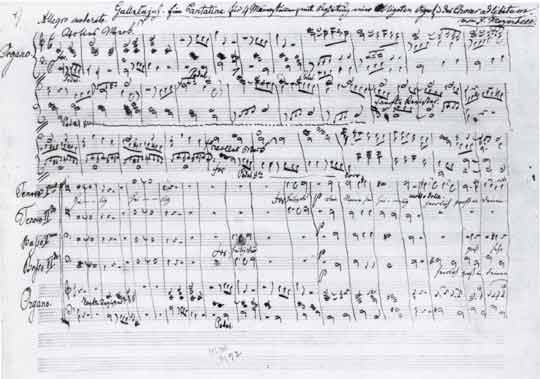
The manuscript for Meyerbeer's Hallelujah exists, and is held by the US Library of Congress. But I haven't been able to find any recording, or even evidence of public performance in the last few decades. I have no idea why not.
Manuscript score for Meyerbeer's Hallelujah, from the Library of Congress (via the Jewish Virtual Library)
Another great Meyerbeer story....why are Meyerbeer's operas not performed often any more? Two main reasons. First, they're huge performances requiring large numbers of expensive lead and secondary performers. Second, after his death Meyerber's music was denounced by his most notable musical protege, the next king of opera and raging anti-semite, Richard Wagner.
The word went out last night, Debbie Friedman is dead. Dead at age 59 of pneumonia. And we are all grieving. Friedman was singer, musician and a songwriter who made an indelible imprint on liberal, particularly Reform, Jewish liturgy.
In the year 2011, with her revolution well won and her signature sound anchored so deeply in a time past (1970's and 80's folk pop), it's easy to forget how radical a presence she was. She's possibly overshadowed only by Shlomo Carlebach as the most important Jewish liturgical composer of the 20th century. She was pivotal in the translation of the Reform camp liturgy into a synagogue form and in the defining of the 'songleader' cantorial style. She carved out a space not just for a woman's participation in Jewish prayer, but created a body of work that placed woman's experience, in both Torah and contemporary life, as central to the prayer experience.
This past Shabbat, my synagogue and countless others sang Friedman's "Mi Shebeirach," hoping for her healing. This Shabbat we'll sing kaddish for her. She'll be missed.
I'd thought to share a favorite Friedman video but I'll skip that. You can find a zillion on YouTube. Instead, here's a much more fitting testimony, from YouTube user sweetandsourgal3.
I'm pretty tired of knee-slapper "Jew on Christmas" posts, so let's just skip that. I'm looking forward to Shabbat and that's more than enough. For this week's get into the Shabbat groove post, I'd like to share a video and an announcement... the Third Annual South Florida Cantorial Concert is coming up on Jan 15. If you're in the area, hit their website for details, including a full list of performers. If you're into the Reform cantorial style (Nusach Ashkenaz with acoustic guitars!) it looks like a great event. I love hearing cantors of any movement cutting loose, and 20 cantors in large 700 person hall sounds magical.
Normally I don't showcase a lot of individual events. I thought posting this one would be fun partly because they thoughtfully sent me a link to last year's concert to share (see below) and partly because they're planning on webcasting the show. That's something that I'm strongly supportive of. There are a lot of Jews who don't live close enough events like this or, in this tough economy, can't afford the ticket price. (That said, this particular event is VERY reasonably priced at $18. That's half what I paid for a similar concert in Detroit recently, and I was only buying a cheap seat!) Webcasting is a wonderful way to share the good stuff with the whole community.
I don't see the webcasting info on their site yet, but will email them and ask about it. If you're excited about that option...email them and let them know. It's important that they have a reasonable estimate of who's going to watch so that they can make sure their gear is up to the load.
There's a new Jewish internet streaming radio station in town. Helmed by Rabbi Micah Greenstein, Ron Hoffman, and musician Rick Recht, Jewish Rock Radio is a slick and glossy website and iphone app that's now streaming slick and glossy Jewish rock music 24/7. To give you a sense of their playlist, in the last 20 minutes or so I've heard Orthodox rapper Eprhyme, and Orthodox college pop band Blue Fringe, Israeli world-beat rockers the Idan Rachel Project, singer-songwriter Todd Herzog, and Reform camp rock superstar Rick Recht (hey..it's his station, right?). It's is a really nice pop-radio mix with a liberal Jewish orientation but drawing some great frum-pop and secular Israeli pop. Good for them.
And yeah.. I said slick and glossy twice. I can't help it. I'm so not a slick and glossy guy. I like my pop indie and my rock punk. I want them to play The Shondes and Girls in Trouble. I dislike Rich Recht's music so much it makes my eyes cross. But that's my deal. I honestly hope and expect JRR to take off and finds it's audience.
Debbie Friedman is a seminal figure in American Jewish music, with a huge influence on Reform liturgy and camp music. She's inspired song books, movies, and now...the cover band Not By Might.
Ok. Not really. The guys in the video, Jason Mesches and Jacob Perlin are actually the musical comedy duo Mesch and Cod. But their mockumentary is brilliant and absolutely spot-on. If you've spent any time around Reform songleaders, you'll be in stitches.
Sam Kay is a high school student up in West Bloomfield, MI and is studying to be a Reform cantor with Temple Israel cantor Michael Smolash. Kay has stepped in to cover for Temple Israel soloist Neil Michaels and plays with the temple's Yom Sheini band. And now he's cut a music video. (Oh, and there's rumor of record label interest). Not too shabby.
Sam Kay - Raise Your Voice, of Temple Israel, West Bloomfield
I'll be honest that Kay's style is way too smooth pop for me. Not my speed. But he does it well and I could see him building a real fan base in the Rick Recht and Dan Nichols crowd. Or in the secular pop community, if he goes in that direction. I don't have any contact information on Kay yet, so if you loved the video let me know and I'll get you in touch with him once I get the info. Or, you can go check out this article on him written by Mitchell Barnett for Teen2Teen.
Shabbat Shalom and Chag Sameach everyone. I hope everyone has a great Simchat Torah.
For a get in the mood video this week, I thought I'd share a song and a story. Here's the story, last week I was at Shabbat services with my gang and the cantor led us in a version of Etz Chaim Hi that left me a bit befuddled. I was sure I'd heard the melody before, was sure that I'd never sung it, and was sure I hadn't heard it in the context of a service. So where did I hear it?
A little sleuthing later I think I've got it. The melody, composed by Tanchum Portnoy, is also used by the group Blue Fringe on their album "The Whole World Lit Up." I should say, they use a very different arrangement of a very very similar melody. I don't have the liner notes to WWLU handy. I'll dig them out or email Dov and see if I'm right.
Anyway, here's Portnoy's Etz Chaim Hi, sung by the choir at Rodef Shalom Congregation in Pittsburg, PA.
I haven't found a video or embedable player for Blue Fringe's Etz Chaim, but you can listen to it over at Last.Fm.
Hat tip to YouTube user Castodivo for posting the video.
I got an note on Facebook recently from a fellow named Steve Cohen....
"I'm a classically trained composer, and I attend a Reform congregation in Larchmont, NY. The former cantor there, Lori Corrsin, now sings at Temple Emanu-El in New York City. I sang bass in the Zamir Chorale, under the direction of Matthew Lazar for about 7 seasons, and I've had my choral pieces performed at the North American Jewish Choral Festival, by zamir and also by the Kol Zimrah choir of Chicago, IL. I'm about to release a CD of solo vocal music, psalm settings and liturgical pieces...."
While the CD isn't out yet, here's a tasted of what Steve's got in store for us. There's some serious happy clappy going on here...
Kol Ha-amim Tiku Kaf
According to Steve, Kol Ha-amim Tiku Kaf is
"A piece for children's choir, based on Psalm 47, Verses 2-3. Music by Steve Cohen. Performed at the SAR Academy, in Riverdale, NY, by the SAR Combined Choirs, Naomi Katz Cohen, music director."
By the way, "happy clappy" is actually a technical term. Seriously.
I was recently pointed to a great article on the history of Reform Jewish youth camp music. According to the author, Cantor Wally Schachet-Briskin, the Reform youth camps movement "began with the founding of the National Federation of Temple Youth in 1939 ... to foster and maintain a network of temple youth groups, which stresses both religious and educational programming." Hitting it's stride in the early 1950's Reform camp music incorporated a blend of American popular folk (Weavers, Kingston Trio) and protest songs, Yiddish folk songs, Israeli "hialutznik" songs, along with "some hymns from the old Union Songster." The music was embedded in the daily life of the camps and was structured around singalongs led by older youth, often with guitar or banjo accompaniment.
According to Cantor Wally, from this start the music evolved to follow the style of the day, often with a bit of a time lag. In the 1960's it embraced protest music in the style of Bob Dylan, Tom Paxton, and Woody Guthrie. In the 1970's it engaged the electrified pop-rock of Dylan, Simon and Garfunkle, and Joan Baez. The 70's also brought to the forefront the first serious professional camp songleaders and composers, including familiar names like Debbie Friedman, Jeff Klepper, and Michael Isaacson. As Cantor Wally notes, "Echoing the rise in Jewish ethnic pride, camp music nationwide saw a strong shift in the early ‘70s from what had been 80% brotherhood songs to 95% Hebrew (with "Sabbath Prayer", from the musical "Fiddler on the Roof", thrown in on Friday night)." The 1980's saw a decline in songleading and camp music, as the camps struggled with out-of-date songbooks and a generation of campers that were more used to rock concerts than folk music singalongs. This decline was addressed by the end of the decade and through the 1990's by a series of songleading workshops, new songbooks, and a new generation of professional songleaders such as Craig Taubman who could incorporate electric guitar, keyboards, and drums into their music.
Debbie Friedman - Lechi Lach
This Debbie Friedman video exemplifies the contemporary songleader approach, mixing participatory singing with rock instrumentation, Hebrew with English lyrics, and a stage presence that facilitates and instructs.
In addition to tracing the history of the camps in isolation Cantor Wally connects their development to that of the Reform synagogue liturgy, noting "the tremendous impact the participatory style of the camping movement." He quotes that "Synagogues tend to be "10-15 years behind the camps as far as change. Whatever was a trend in the camps, it takes a generation to find its way into the synagogue." That said, Cantor Wally is quick to point out that the contemporary Reform synagogue is not last decade's camp. In addition to the integration of camp melodies and styles, it also incorporates a mix a traditional Reform Hebrew hymns, Chazzanut, and art song. But "[t]he 'gap' between the worship style of camps and synagogues is shrinking."
My one frustration with the article, and this is a "great stuff, give me more" kind of frustration, is that it presents a picture of Reform camp music evolution as being disconnected with the similar evolutions in the other Jewish movements. For example, the camp service songlist that Cantor Wally provides includes a number of Chassidic songs from Reb Shlomo Carlebach. There is no discussion of however, of how Carlebach's music represented a parallel evolution in Chassidic music that had a similar impact on Chassidic and Orthodox liturgy. While completely chronicling the evolution in Jewish liturgical music across the wide spectrum of Jewish movement over the last century is clearly a much larger task than Cantor Wally was attempting to take on, it would have been illuminating to see where Cantor Wally felt these evolutions actually influenced each other.
Update: A blog reader just informed me that "The Complete NFTY Recordings: 1972-1989 (5 CD Set)" is available from URJ Books & Music. NFTY is the National Federation of Temple Youth mentioned above and at the core of the Reform camp movement. Here's the URJ blurb...
"The long-awaited collection of the seven original NFTY recordings is finally here! All original record albums have been digitized and remastered for superior sound in this 5CD set. Includes 28-page full-color booklet with complete album histories, a historical essay from NFTY-ite Elyssa Mosbacher and track/songwriter information. Discover the rich history of NFTY and URJ camp music - a little bit of Jewish liturgy, a little Israeli folk and some American folk music all mixed into one."
Hat tip to Jewish musician and educator Adrian Durlester for pointing me to the article.
I just got back from the Yiddishe Cup show (which I'll write up tomorrow) and found an email in my inbox pointing me to a great concert video. It's a tribute to Dr. Alan Mason, Music Director of Miami's Reform Temple Israel on the occasion of Mason's 18th year with the temple. According to the email, there were 23 cantors and soloists participating. The video is almost 40 minutes long so grab a cup of tea and settle in for the show.
Alan Mason Chai
Hat Tip to Blip.Tv user Robert for posting the video and letting me know about it. If the video doesn't play, you can catch it over at Blip.TV
It's a snowy day on the North Coast (Michigan) and I'm looking forward to Shabbat. For my weekly Shabbat get-in-the-groove video I've decided to broaden myself a bit. The video is of the Kabbalat Shabbat prayer L'chah Dodi sung by David Fair at Rodef Shalom, a Reform Jewish congregation in Pittsburgh, PA.
L'chah Dodi
I say broaden myself because, not growing up in the Reform Movement, I'm not so comfortable with instrumental accompaniment to Shabbat prayer. But the Reform community accepted the use of the organ as one of the early defining characteristics of the Reform service (though guitar is probably much more common these days). But my itchiness aside, Mr. Fair does a fine job leading his choir, organist, and community.
Hat tip to YouTube user castodivo for posting the video.
"Here's a blast from the past. Kol B'seder from 1979. Somehow Dan and I were recruited to add our happy-slappy campy kid songs to a couple of episodes of one of the original New York City Jewish cable TV shows, Shalom Corner. ... While terribly dated, the shows are kinda cute, and here's a sample: Kol B'seder singing Richard Silverman's classic, 'It is a Tree of Life,' complete with the requisite puppets, kids, and Shalom Corner host, Carol Sterling. ... "
I remember singing this in Hebrew School when I was a kid and I think my daughter is singing it in hers.
As I've mentioned before, I'm on a lot of Jewish music related mailing lists. I generally don't consider myself particularly knowledgable relative to the folks on the lists (professional klezmer musicians, songleaders, cantors, and serious frum music fans) so I tend to lurk and learn. Every once in a while I pop up with a question or a comment. This week was comment time.
I'm neither an expert in Nusach nor an active innovator, so this question may not be helpful. But there is one I've been asking myself as I've struggled to learn more about both communities (and the communities who do both).
Here's the question:
Under what circumstances does (or, what are the requirements for) a traditional approach of nusach to be considered vital by a specific Jewish community and what circumstances drives a Jewish community to specific kinds of innovation. A corollary question is how successful is any specific innovation at resolving those circumstances.
I would suggest that there were two historic circumstances that prompted the Reform community to seek for a liturgical method outside of traditional nusach. First was the desire to closer tie Jewish practice with the larger spiritual and civic life of the Reform communities host countries (e.g. initially Germany and France and now America). Second was the desire to lower the skill (e.g. effort to learn) requirements to fully participate in leading and participating in group prayer. These desires have lead to the adoption of musical instruments during services and the adoption of melodies that draw heavily from the host countries musical culture (first German church hymns and the organ and now American folk-pop and the guitar).
Similarly, I would suggest two circumstances that have prompted the Traditional (Orthodox & Chassidic) community to seek to maintain a traditional liturgy. First was a desire to retain exclusivity from the host culture's spiritual life and second a desire to encourage a significant focus on learning and practice by it's members. This has led to a demand to maintain traditional nusach and a skepticism of any approach that deviates significantly with that tradition.
I would also suggest a third historic circumstance which seems to be pushing in equal measures at the Reform and Traditional communities. This is the evolving desire by the lay members of both communities to more actively participate in communal prayer. This desire has led to the reduction of the role of the cantor in both communities and the increase in the popularity of both group songs and call and response song as part of services. This change is playing out a bit differently in each community though. The Reform community innovated a service style organized around a "songleader," a cantor proxy who specialized in the folk-pop method and could rapidly teach and lead new material. The Traditional community has begun to adopt a similar approach rooted in the melodies of Carlebach, though in a more limited form at very specific shuls.
For me, there are a whole set of productive questions that can be asked based on these circumstances and the responses they provoked. First, how well is the response working out? On the Traditional side, nusach is still a demanding skill to learn. How well is the current generation doing in learning it (and accepting the burden to learn it?) On the Reform side, dropping the education required to learn nusach parallels dropping standards of Jewish education in general. How well is that working out? How much do the new Reform melodies and lyrics represent a Jewish perspective vs a generic American spirituality (a critique I've often heard)?
Second, what kind off innovations are allowable, or inevitable, based on these circumstances? I would suggest that both groups seem welcome to any innovation that doesn't violate the circumstances and desires that base their liturgical praxis. That implies a different space of possible innovation for each group, but doesn't specifically limit innovation in either. I don't see the traditional community adding jazz anytime soon, but I also don't see the Reform community adding a new melody that is in the nusach mode.
Does this make sense to anyone? I would welcome any corrections or expansions to this thought.
Here are a couple of the corrections / expansions I got back that will have me off doing research.
1. The Orthodox community does a lot less nusach than I had imagined. At the beginning of the 20th century the Young Israel movement started introducing niggunim into prayer services. It took a century to flower, but has been highly successful at dislodging nusach as the liturgical standard in Orthodox services.
2. Evidently there have been a couple of Orthodox foray's into jazz. In particular Moshe Oysher is reported to have incorporated scat into nusach. That's something I need hear!
3. Evidently there are some folks in the Reform community who are interested in nusach. This includes both incorporating more elements of traditional nusach into Reform prayer and composing new works that derived from nusach. I have no idea how common this is, but it was something I wasn't aware of and will have to explore.
Here's another video I'm taken with at the moment. It's Todd Herzog, performing 'Tree of Life' at the Union of Reform Judaism 2007 Biennial. I got turned on to the video by Todd's wife Karen who emailed me some promotional material the other day. I'm kind of surprised how much I like this song. It has a lovely combination of vulnerability and reverence, and like the best of singer-songwriter lyrics, it paints a detailed enough picture of a life in transition for me to say, 'yeah, I've been there too.' And I have been. Great stuff. I've listened to the video about a dozen times already and may have to shell out for his new album, Proverbs (available through CDBaby).
Here's Herzog's official 'press pack' description...
"Todd performs his own Jewish, spiritual, acoustic pop music around the country. He is an artist who takes the raw material of life experiences and creates soulful, spiritual, acoustic pop music along the lines of John Mayer, Jason Mraz, and Marc Cohn. The music is not intended solely as entertainment but also to promote healing and change in people’s lives. His songs invite us to slow down and take a closer look at how the simple choices we make each day affect the shape of our journeys. Todd is the Artist-In-Residence for Vocal Music at the upcoming JCC Maccabi ArtsFest in Minneapolis. He has a residency with several of the Jewish day schools in the Phoenix area to develop a project to celebrate Israel's 60th anniversary. He is also the cantorial soloist for a Temple Solel in Paradise Valley, AZ. "
Just after I signed up for the Hava Nashira mailing list, a list member accidentally sent the cover letter of his resume to the list. I'm very glad he did, because it provides a wonderful snapshot into the making of a song leader. Here's the cover letter, with the author's name and contact info removed. He is job hunting, so if the cover letter looks interesting let me know and I'll help you get in touch.
"My name is anonymousand I'm a second year at UCLA. I currently songlead for the Kesher (reform) community at UCLA Hillel. Please find attached my resume.
Growing up with the Bureau of Jewish Education in Orange County, Camp SWIG and Camp Newman, Temple Beth David in Westminster, and UCLA Hillel, have been exposed to many different ways of practicing Judaism. My first love in Judaism was music; at a Bureau retreat in 4th grade I discovered the power of the Jewish song session as I lost myself in Debbie Friedman melodies. I learned to songlead at Camp SWIG in Saratoga with Cantor Wally Schachet-Briskin, Steve Krause and others. In high school, I have held songleading positions at a number of temples in Orange County as well as special events such as Shabbat Alive, a big community event through OC JCC and the Bureau.
I was the founding musician/songleader/tefilah leader for Surf City Synagogue in Huntington Beach, which is now associated with the Conservative movement. I worked as a staff songleader at Camp Newman where I led daily tfillah and songsessions as well as camp-wide events on Shabbat.
Since going to college, I have limited my songleading to on campus programming, but am now looking to expand beyond Westwood. Temple anonymous would be a great next step for me. I visited Israel last winter with Birthright and plan to study abroad there in the near future.
This letter was reprinted with permission of the author. Thanks!
I mentioned back in July how I had been surprised by my ignorance of the Jewish song leader community. By contrast, I was quite aware of my ignorance of the Orthodox and Chassid communities. While I don't claim that I've developed any expertise over the traditional communities music, I think I've got my head around some of the major themes and musicians. I haven't made similar progress with the song leader community. For example, back in the July post I made the mistake of implying that the song leader is community is exclusively a Reform Jewish phenomena. It isn't. And I'm finally starting to get a bit smarter about why I was wrong.
What happened is that I finally got myself signed up for the Hava Nashira mailing list. Hava Nashira is a "resource for Jewish songleaders, songwriters, performers, music educators and all those involved in the transmission of Jewish heritage, religion and culture through music." I've only been signed up for a couple of days and it's already making a big difference in my understanding of the community. Part of that difference came from an email conversation I had with Adrian Durlester, the Hava Nashira website organizer.
Example of Jack getting educated:
Jack: "I've used the terms Song Leader community, 'contemporary Jewish music community,' and Reform community as synonyms. That's probably incorrect, but I don't yet know why it's incorrect."
Adrian: "Why Reform/songleader/conmtemporary Jewish liturgical music isn't an automatic association:
Adrian's list is a bit mind-blowing for me. Here's why. I had understood songleaders to be have developed from Reform community participatory service. So what about Conservative song leaders? Ok. I forgot about Camp Ramah, the Conservative movement summer camp (which I sadly didn't attend.) I could see songleaders playing a role there. But Craig Taubman's wonderful "Friday Night Live"? That's the better part of a whole Friday night service. And he's coming from and leading Conservative services? And Orthodox song leaders. The Orthodox community (I thought) was very strict about nusach (traditional modes of chanting). I'm familiar with Shlomo and Neshoma Carlebach, but how does they play into this?
So my safe little definition is shot. And I don't have a better one yet. But I'm working on it and will report on my progress. I'm hoping the folks from Hava Nashira will get a chuckle over my befuddlement and set me straight.
I had an interesting moment yesterday picking up my elder wiggler from Hebrew school at my North Coast Conservative Jewish synagogue. I had gotten there a bit before class let out to snag a last minute Hannukah present from the gift shop. (The religious/identity competition has already started. My elder wiggler, age-Kindergarten, noted some of her class mates wear little crosses. So I'm getting her a little Mogen David necklace. Sigh. I'll tell you all about our adventures with Christmas music in the schools later...)
Anyway, so there I was, in the synagogue during class time when I wandered past the main sanctuary and heard guitar playing. Insert gasps and shock here. (If you didn't have the shocked reaction, hang on. I'll explain in a minute). I knew the Hebrew school had a music teacher, but she had a class room downstairs. So what gives? I stuck my head inside the door and saw a young college-age fellow up on the bimah leading a group of what looked like middle-school kids in song. I forget which song it was, but it was a pretty standard para-liturgical piece like Shalom Rav.
Pretty standard, in my experience, in the Reform community. In fact, "song leader with guitar" is almost the definition of Reform participatory services. Typically, Conservative synagogue's follow the traditional Jewish practice of not allowing instrumental music in the synagogue (at least, not on in the sanctuary during services). As far as I'm aware, mine does. So, I was pretty surprised hearing it coming from the Bimah.
Since I didn't know what the purpose of the gathering was, and didn't have time to find out, I'm not going to comment on whether it was appropriate or not. I was just surprised. Next week I'll try to grab the school principle and see what the story is. Not that I'm going to jump up and down regardless of what her answer is, I'm just curious where the synagogue is going.
By the way, the conflict between Reform and Conservative service styles has been well documented, including the following passage from Jeffrey Summit's "The Lord's Song in a Strange Land." In this passage, Summit documents an attempt by student leaders at Tufts to plan a combined Conservative / Reform service and why the students different relationships with halacha and their own musical / litrugical identity made that attempt much more difficult that either group had expected.
"The planning committee did not have an easy job; these two services differ considerably. The Conservative service, often called "the traditional service," uses nusach and has almost no English. Most of the tunes were learned in the youth movement. Davening is led by the shaliach tsibbur, who stands in front of the group. The majority of the Conservative students hold the traditional position that instrumental music is halakhically forbidden in Sabbath services. For the Reform students, the guitar and the role of the enthusiastic song leader have become emblematic of Reform worship in high school and college. Most view the guitar as essential to meaningful, participatory, prayer. While there is a sstudent leader and a song leader in the Reform service, the leadership role in this group moves person by person around the circle, as all worshipers take turns reading a section of the service. While many of the prayers and the structure of worship in both services are basically the same, it was clear to the planning committee that they were attempting to meld two services with essentially different styles."
So, once again I looked for one thing and found another. I was looking for more about the Reform music scene. I found Transcontinental Music, a division of the Union for Reform Judaism. It has a nice listing of Reform oriented titles. I added it to my 'sources' list for further inventorying later.
I also found Renanot, 'The Institute for Jewish Music,' in Israel, which is not at all affiliated with the Reform Judaism. Renanot focuses on studying and preserving the musical traditions of the distinct ethnic Jewish groups throught the diaspora including Askenaiz, Morroco, Afganistan, Indian, Sephardic Jerusalem, Yemen, and. They hold teaching seminars, trains cantors and publish books and music (mostly on cassette tapes. Yikes!). A lot of the material appears to be liturgical music, including Torah and haftorah melodies, the mincha and mariv service, and something called 'samai'. There are also Shabbat zemirot and 'Romances in Ladino.'
While the thought of buying cassette tapes gives me the shudders, they do have some very enticing sound clips. I'll have to think about it.
I'm a Conservative Jew living in a Christian farm town in Michigan, USA. For me, Jewish music used to be Adon Olam, Hava Nagila, and Fiddler on the Roof. I started getting a clue a few years ago. Jewish music is Klezmer dances, Sephardic ballads and Chassidic niggun. It's thousand year old hymns, three hundred year old Shabbat table songs and 60 year old partisan resistance songs. It's contemporary hip-hop, punk rock, electronica, jazz, and chamber music. In addition to loving its musical and spiritual qualities, Jewish music helps me connect my family with a much broader and diverse Jewish culture than is available locally. The Teruah blog helps me document my exploration and share it with others. Why the name Teruah? Teruah is a call on the shofar on Rosh Hashanna.
Hear me interviewed on the Israel National Radio show "The Beat with Ben Bresky" Please email me about your band, event, album, blog, podcast, research or favorite Jewish music obsession. I'd love to hear it or about it.




 Posts
Posts

