Showing posts with label latino. Show all posts

Thursday, February 19, 2009

Recovering the Yiddish Cha-Cha

I'm currently reading Matt Temkin's fabulous masters thesis, "American Yiddish Instrumental Fusion Music in the 1950s and 1960s." In the thesis, Temkin takes on the much maligned (then and now) period of Jewish American music between WWII, after the heyday of Yiddish theater music, big synagogue Chazzanut, imported old-world klezmer and it's off-shoot Yiddish swing, to the 1970's with the advent of the klezmer revival and the rise of Jewish folk liturgical music, including Debbie Friedman in the Reform community and Reb Shlomo Carlebach in the Chassidic). What filled that 30 year void? According to Temkin, it's fusion - Yiddish with Cuban dance rhythms, klezmer with jazz, which he describes as "serious art and important landmarks of the 20th century cultural fluidity." Temkin explores this period through detailed analyses of five representative albums, Sammy Musiker & Dave Tarras; Tanz!, Mickey Katz; Mickey Katz Plays Music for Weddings, Bar Mitzvahs and Brisses, Irving Fields; Bagels and Bongos, Terry Gibbs; Jewish Melodies in Jazztime, and Shelly Manne; My Son The Jazz Drummer!

While it lacks the visual appeal of Roger Bennett and Josh Kun's "And You Shall Know Us by the Trail of Our Vinyl: The Jewish Past as Told by the Records We Have Loved and Lost," it may well be the better read. Temkin is a good writer, with a gentle even prose style that compensates for the academic orientation of the thesis. Tune out the foot-notes and squint through chapter titles like "New Fusions of Yiddish and American Musical Forms, 1945-1970" and you'll find passages such as
"Today the counter-culture has turned into the old guard and one of the standard-bearers of the community. We know them as the Hasidim. While they are still concerned with the separation of the holy and profane, they understand the impact that music can have on people, and were willing to bring instrumental (and vocal) music into their community as long as it was used for holy purposes.[20]

Silence is Better than Speech

But Song is Better than Silence

—Hasidic Saying[21]"

and
"Irving Fields could play every style and tune that the consumer wanted. The Latin music was just the ritornello of his ventures that is remembered. Bagels and Bongos came out of a idea Fields had while working in Boston, and a couple different versions of the story are told. In one version, after hearing a Jewish radio program on the air the day before, he tells his drummer to play a rumba, and over this he played “Raisins and Almonds.”[2] It worked: the Jewish tam (feeling) was still there and at the same time it was danceable. The second story is that someone in the audience starting dancing a rumba to a Jewish tune that Fields was playing as a fox trot.[3] Fields changed the tune to a rumba and more people got up and danced."
All in all, it's one of the best histories of American Jewish music I've read, with a focus on secular instrumental music. And it echos a point made by other cultural historians who note that while we remember the cultural peaks of our societies for their heights, it's the chaotic periods between the great peaks where the real adventures take place. Like the adventures we're having right now in Jewish music. The heights of the klezmer revival have been reached, the folk liturgical vein has been well mined, the Orthodox shiny shoe simcha music territory has been well mapped. And what's happening...an explosion in fusion forms - Jewish hip-hop, reggae, rock, punk, ambient, heavy-metal, chamber music. All what Temkin describes as "co-territorial" (in the same geographic territory) fusions. What will be the great heights that come out of this burst of creativity...don't know. But it'll be fun to listen to.

Sunday, February 8, 2009

Yiddishe Cup at the Ann Arbor Ark

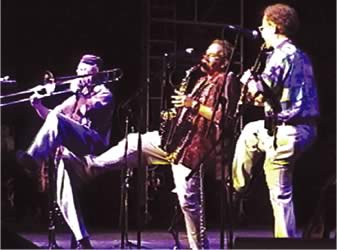
The Yiddishe Cup in actionLast night my wife and I had a nice treat. The wigglers were being happily baby-sat and we were on the town, Ann Arbor, Michigan to be specific. Yiddishe Cup*, the clown princes of klezmer, were back for their annual circus, and that is not something to miss. Yiddishe Cup is a delight to see live. Their stage show chronicles and fractures the history of Jewish music in America, mixing pre-war European klezmer melodies with postware Yinglish Borcht Belt show tunes, 1950's Jewish Latin-craze Mambo's, and 1980's world-beat fusions, all in an off-kilter, good natured, get-the-back-row dancing melange that Mickey Katz would have loved. Have you ever seen a group of hora dancers break into an Irish jig? A straight up klezmer tune with a Hawaiian lap guitar solo or a Tuvan throat singing intro? I saw all that an more last night. Definately a show to remember.

And Yiddishe Cup is generous with their stage. Band leader Bert Stratton not only had his son Jack playing drums, a regular occurance as I understand it, but gave Jack stage time for his own band, hastily named "The Boychicks" just before show time. The Boychicks had time for two fine pieces, the first was well played but a bit stiff, focusing on the interplay between Jack's drums and clarinetist Jeff Simon's melodic runs. The second song loosened up and lept out, giving the foursome (which included Justin Douglas on guitar and Chris Hagar on bass) a lot more room to stretch and explore. I talked to the Boys during the break and am hoping to get a recording of that piece into my next podcast. Loved it. In addition to the Boychicks, Yiddishe Cup invited the excellent lap steel guitarist (and Ann Arborite) Gerald Ross to join them for the Hawaiian numbers and invited commedian Seymour Posner for a bit of Catskills Jewish humor. Posner, in particular, stole the show and left us in stiches.

I do have a few minor complaints about the show, but these fall into the 'your milage may vary' category. While I enjoyed the performance thoroughly, I also felt that it never quite came together. I'm not sure if it was the audience being too polite and concert-hallish (though there was some great dancing going on) or the guys taking a while to loosen up or the particular configuration of the band last night (the trombonist doubled on violin, often leaving the band a bit thinly supported by a rhythm section of just drums and keyboards). Whatever it was, I left the show wanting more in both the sense of wanting the show to go on another hour and in the sense of wanting it just a bit tighter. Like I said, though, your milage may vary. There were an awful lot of happy faces on the way out of Ark last night and a lot folks (including me) who were already looking forward to next years show.

You can find out more about Yiddishe Cup, including their tour schedule, their available CD's, and booking information at the Yiddishe Cup website, CD Baby, and iTunes. There are also a couple of funny videos chronicling Yiddishe Cup playing at a Jewish weddings at YouTube (Video 1, Video 2). Check 'em out.

* I got into a discussion with a couple of people about the origin of the term Yiddishe Cup. While I don't know the story of how the band adopted the term, here's an explanation of the term itself from Postitive Anymore, a blog on American dialects and Yiddish:
"yidisher kop," (it varies slightly in different dialects, and "yidish kop" is one such dialectal alternative) which literally means "Jewish head," and figuratively means "innate intelligence." There is a related expression, "goyisher kop," (gentile head) that means, not surprisingly, "innate stupidity." ... Don't be too shocked by the overt bigotry of these phrases; every culture on Earth has at some point decided that it is superior to all others; why should Jews be an exception? You don't have to like bigotry, nor, of course, should you, but our outrage at the presence of bigoted sentiments in the traditional stock phrases of a given language should be minimal."

Thursday, December 20, 2007

"How come you're watching a Rabbi play electric guitar?"

Here's Yehuda Glantz on the Eli Yazpan show. I don't speak Hebrew well enough follow the interview, but seeing Glantz break into La Bamba and seeing his cameo on the TV show "Friends" is priceless. So is the duet of "Cuando El Rey Nimrod" he sings with Yazpan. I won't spoil the punch line to the "How come you're watching a Rabbi play electric guitar" question, though. You'll have to watch and see.

Yehuda Glantz in Eli Yazpan show


According ot his bio, Glantz is "is a true Renaissance man. Born in Buenos Aires, Argentina, he later immigrated to Israel in 1979 where he currently lives with his family. As early as 5 years old, his talent in music began to blossom. During these years he acquired deep and wide knowledge of music through a number of instruments. He has mastered 14 different traditional and ethnic South American instruments like charango, siku, pincuyo, guitar, accordion, keyboard, percussion, etc. He also writes, composes, and produces all his own music in his private studio in Jerusalem. Yehuda Glantz captures the hearts and souls of people around the world with the unique ground - breaking music and through electrifying and colorful performances on stage."

Check out Glantz' MySpace page for more info and lots of his music. Great stuff.

Update: I forgot to thank YouTube user Yair Peled for posting the video. According to his bio, Yair "has been an editor/animation director at Israel National News TV since 2002. Yair is also an illustrator and editor of video clips for religious musicians in Israel. Yair is presently have a new production company to be called "YAM Production" that doing video productions of jewish culture (TV/NET/CELL). Yair also work on is first music album produced by 'The Jerusalem Music Network'." Sounds like an interesting fellow. Peled's YouTube page has other videos of Glantz, a Moshav video, and an animation video.

Tuesday, August 28, 2007

Lawrence Dermer - Third House Rising

"A Jewish musical renaissance is bubbling and the sound is getting so loud..."

I got a nice email today pointing me to Lawrence Dermer's new album "Third House Rising." According to Dermer's website, he's "a BMI Award winning and Grammy nominated singer, songwriter, producer who is best known for his work with Gloria Estefan, Jennifer Lopez, Madonna, Cher, Lenny Kravitz and Barry Manilow." The new album, composed with is wife Robin and performed with his sons, is "a unique blend of Jewish Pop combining elements of R&B, Latin, Chassidic, Middle Eastern and soulful sounds with fresh contemporary lyrics."

The video below will give you an idea about the sound that Dermer's going for, but you need to listen to the sample tracks on his website or on his myspace page. This is great stuff. Check it out.

Music Goes Round

Tuesday, July 31, 2007

Hip Hop Hoodios - Viva la Guantanamera

Hip Hop Hoodios - Viva la GuantanameraI am now officially a member of (meaning I clicked to join) the myspace Jewish Rockers group. I may be 20 15 10 years too old to really be a rocker, but I figure it's not really a mid-life crisis if I never stopped listening to music and my new Dr. Marten's Quartz Cap Toe Shoe are just office-friendly replacements for my favorite harness Wellington boots. Am I sounding pathetic yet? My lovely wife just pats me on the head and smiles when I go on this rant. sigh.

Anyway, the first thing on the Jewish Rockers forum that caught my eye was a notice about the new Hip Hop Hoodio's EP "Viva la Guantanamera"
"Oye! Latino-Jewish crew Hip Hop Hoodíos will be releasing the “Viva la Guantanamera EP,” a special digital-only album benefiting Amnesty International, on August 1st. The new song “Viva la Guantanamera” is an allstar collaboration with members of two Grammy-winning artists (Ozomatli & The Klezmatics), and also features contributions from Kemo The Blaxican (of Latin hip-hop pioneers Delinquent Habits), and Walter Miranda (Beastie Boys, Plastilina Mosh). Hip Hop Hoodíos are tying in with Amnesty International’s campaign to close Guantanamo Bay Prison and encourage the full restoration of due process, and are donating 18% of net profits from digital sales of the “Viva la Guantanamera” single to Amnesty. You can listen to and preview the new single "Viva la Guantanamera" here: www.myspace.com/hiphophoodios"
I have to say, I've had the previous Hip Hop Hoodios EP, "Raza Hoodia" for a while and while I thought it was ok, it didn't grab me enough to get their follow-up album "Agua Pa' La Gente." After listening to the "Viva la Guantanamera" track on their myspace page, it's clear I need to revisit Raza and maybe shell out for Agua and Viva.

This is great stuff. Part of it is the production. Viva has the Hoodio's sound, but the production screams Ozomatli. Which is a great thing. WilDog from Ozo has a knack for setting hip-hop vocals against acoustic instruments (I mean horns, here) in a way that makes hip-hop more like Latino party music than a modern urban dance sound. I'm not sure that's a great explanation, but boy does it work for me. Ozomatli is also interesting to listen to because of the Arabic influences. WilDog has previous Jewish music credentials from doing a cool remix of Irving Fields version of Bei Mir Bist Du Schoen for a Reboot Stereophonic "Passover Remix" album.

Here's the Hoodio's Gorritos Cosmico from "Agua Pa' la Gente"