Tuesday, October 13, 2009

Two Views of Matisyahu

Chassidi NewsI ran across an fascinating description of Matisyahu's new album, Light in Chasidi News yesterday. Along with Light there were about twenty new Chassidic recordings featured, all of which were written up in the classic frum music promotion style. As I've mentioned before, I find this writing style both fascinating and frustrating in equal measures. It's fascinating because it provides a window into what this community prioritizes. It's frustrating because, to an outsider who prioritizes different things, the writing appears opaque and uninformative.

LightI've got a few thoughts on this, but first here's one view of the new Matisyahu album, Light, written by the Chasidi News. For twenty other album descriptions written in this style check the current issue of Chasidi News or any one of the frum music blogs I list.
Light - Matisyahu’s third album is now in the stores. After working on it for two years, ‘Light’, Matisyahu’s third album is released. After the meteoric success of his two previous albums, the Chasidic singer Matisyahu releases his third album which illuminates his unique musical style. Matisyahu worked on the album with best of musicians and musical producers, and together they brew the wonderful result, Light. The tracks on the CD range between different styles and let us feel Matisyahu’s modern special character, all of them together passing on a message of hope for peace and comradeship. The album, with 13 songs plus another bonus song, is not something to be taken for granted. “The meaning of being a singer, as far as I’m concerned, is to feel how the existence of the world echoes within you, and then express it,” explains Matisyahu, “It’s a process that changes all the time”. The album’s bonus song is called, “Two Child One Drop”, taking part in it are the cantor Yehuda Solomon and the musician Shalom Mor who plays the oud and the tar. Distribution: NMC United.
Now here's a second view of Matisyahu written by David Jeffries of the All Music Guide. The AMG, if you're not familiar with it, provides a database of music descriptions to a lot of commercial websites. I pinched this one from Pandora, but I'm sure it's on a hundred other websites as well.
As an American Hasidic Jewish reggae superstar, Matisyahu is an obvious outsider. After a debut album that felt live plus a follow-up album that was recorded live, the singer's ambition to do more with the studio presentation of his music left any sensible packaging up to the producer. The mismatch with fellow mystic Bill Laswell caused 2006's Youth to wander and sprawl, but industry vet David Kahne handles much of Light, and the difference is huge. Kahne packaged reggae-pop acts like Sublime and Fishbone -- whose members show up here -- before, but here he's primarily focused on Matisyahu's wide view, love of ancient history, and spiritual heart. The results are comparable to So and all the Peter Gabriel albums after, with high-tech and polish helping to drive home the artist's reverence and sense of wonder. Sounding like breakthrough hit "Chop 'Em Down"'s little brother, "Smash Lies" is an effective opener plus a dancehall-driven crowd-pleaser that'll give way to an album less reggae than any previous. Besides a little "singjay" in his vocal style, the grand, key track "One Day" has little to do with Jamaican music, and the equally moving "For You" is more likely influenced by Tears for Fears than Bob Marley. Joel Madden makes crunching punk-pop guitar the centerpiece of "Darkness into Light," and ethereal closer "Silence" could be passed off as from the Dave Matthews songbook if the lines written in Hebrew didn't give Matisyahu away. Whether using his voice as a whisper or as a giant call across nations, the depth of feeling comes through brilliantly, and if the musical soundscape isn't familiar, the empowering and sincere lyrics most definitely are. Add Kahne's instantly accessible production and Light is not only a welcome surprise, but an album that matches his debut.
Yeah, we're talking about the same album here.

What the frum music press prioritizes is tradition, community, and good character. Artist bios and album descriptions provide the artists credentials as frum Jews with familiar names and famous previous albums, and/or famous current collaborators. We're told the new songs are original, awe-inspiring, instant classics. We're told the names of individual songs, many of which were not written by the singer or band and were well known prior to the album. There will be vauge comments that the artist has an individual style, but there is rarely an attempt to describe that style. The result is that you're not given anything with which to discriminate the 20 album descriptions on the page from each other. But that's the point. The descriptions are to help you descriminate these recordings from the recordings not on the page...the million or so non-frum, non-community, non-Chassidic albums.

The fluffery used by mainstream Western popular music promotion and review writing, of which I am regularly guilty, tends to focus on and exaggerate minor stylistic differences, exaggerate artist musical prowess, and establish artificial musical lineages and comparisons. This is all in the attempt to help an audience understand how the bands or albums compare to each other and to previous albums the reader would have heard. The result is much more of a focus on the band's sound than on their suitability for a specific community.

There is a big caveat to this, though. If you read reviews or blurbs in zines or websites that are heavily focused on a specific narrow audience, you'll see a lot more Chassidic style writing. I remember being a teen eagerly tearing through print copies of Maximum Rock and Roll. A lot of the prose there focused on punk credentials as defined by what label the band was on and what well known punk band the members used to play in. Not much of a difference from the frum-pop writing. In both cases, the main thing was to justify membership in the community.

What's frustrating for me about the frum writing is that it's very difficult to deal with as an outsider. I'm not interested in discriminating based on community membership. I'm not part of the Chassidic community (though I happily rub shoulders with it on occasion). I'm trying to identify good music that I and my readers might be interested in. And the frum writing doesn't help at all. Which, of course, is my problem not theirs.

Lulu -An Auschwitz Fairy Tale

I was exchanging email recently with Daniel Hoffman, of Davka and the Israeli Ethnic Ensemble. While we were chatting about his upcoming tour of the US Midwest (I'll be seeing him play in Sandusky Ohio on Nov 7), he mentioned that he had recently scored his wife, Karine Koret's, "Lulu" a clown piece on the horrors Auschwitz.

I was intrigued. I've always been a fan of fantasy, magic realism, puppet and clown performances, and surrealist art. I find that having my sense of reality disrupted breaks me out of my comfort zone and helps me look at the well understood with new eyes (or ears). This technique works particularly well in areas where we've been overexposed and desensitized. And with sixty years of documentaries, books, films, plays, museums, and musical homages, there is little in modern Jewish culture that is as overexposed and desensitized as the Holocaust.

That's why I fell in love immediately with the short montage of Lulu that had been uploaded to YouTube. Her one woman show, co-written with the play's director Shlomi Golan, is a topsy turvy dream. Lulu's limited understanding and alternately playful and terrified recapitulation of her experience is deeply affecting. It also helped recapture the horror I felt when I was in my early teens first learning about the Holocaust, a feeling that has become a bit numb over the years. And for that, thank you.

Lulu -An Auschwitz Fairy Tale


Lulu premiered at the Teatronetto Festival of Solo Theater in Tel Aviv, Israel in April of 2009. I'm not aware of any plans for it to tour the US, but I'll let you know if I hear anything.

Friday, October 9, 2009

Etz Chaim Hi by Tanchum Portnoy and Blue Fringe

Shabbat Shalom and Chag Sameach everyone. I hope everyone has a great Simchat Torah.

For a get in the mood video this week, I thought I'd share a song and a story. Here's the story, last week I was at Shabbat services with my gang and the cantor led us in a version of Etz Chaim Hi that left me a bit befuddled. I was sure I'd heard the melody before, was sure that I'd never sung it, and was sure I hadn't heard it in the context of a service. So where did I hear it?

A little sleuthing later I think I've got it. The melody, composed by Tanchum Portnoy, is also used by the group Blue Fringe on their album "The Whole World Lit Up." I should say, they use a very different arrangement of a very very similar melody. I don't have the liner notes to WWLU handy. I'll dig them out or email Dov and see if I'm right.

Anyway, here's Portnoy's Etz Chaim Hi, sung by the choir at Rodef Shalom Congregation in Pittsburg, PA.


I haven't found a video or embedable player for Blue Fringe's Etz Chaim, but you can listen to it over at Last.Fm.

Hat tip to YouTube user Castodivo for posting the video.

Wednesday, October 7, 2009

Ignite: Five minutes, 20 slides. What would you say?

This is my friend Garrett's fault. I'm sitting back at my computer, two Teruah posts done, and am fiddling with Facebook. And Garrett posts "just submitted a proposal for a talk at #ignitea2". I could have ignored it. I could have pretended I didn't see it, but no. I had to bite. "What's #ignitea2" Oh..it's Ignite Ann Arbor. Five minutes, 20 slides. What would you say? Five minutes, and no more, to talk about something I'm passionate about. And the deadline for proposing is tonight.

So, yeah. I bit. I submitted a proposal.
The Silver Age of American Jewish Music is Happening Now! And Why We're Missing It.

Jewish music is exploding. Bands and labels and venues are multiplying. Rock. Hip Hop. Reggae. Punk. Klezmer. Sephardic. Choral. Chamber Music. Jazz. Chassidic-Pop. Breslov Techno. Niggunim. Pop-liturgical. Bible-gum. Beat Box. Boy Choirs. House. Yiddish Gothic. Indie. Weird hybrids. Avant-Garde experiments. Earnest devotion. But we're not immigrants clustered in tenements, in range of a local Yiddish radio station anymore. A revolution is happening but we're scattered across a big nation with no common media to connect us....except the net. Will it be enough?
I'll find out next week if I've been accepted. If so, I'll have two weeks to prep my slides and one additional week to practice. The Ignite event is on Nov 2. Yikes. Not much time to get a first rate dog & pony show together. I'll let you know how it goes. If I get to present, I'll post a video. Promise.

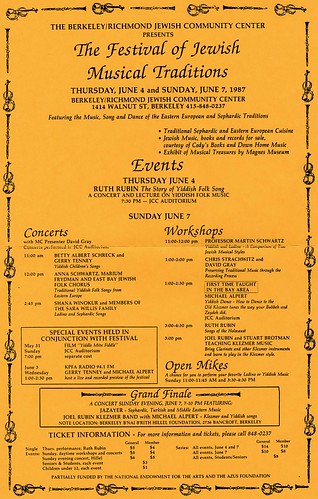
Jewish Music Festival (Berkeley, California) promotional materials, 1987-2009

The folks from Berkeley's Jewish Music Festival have recently uploaded a treasure trove of their historical documents to the web. I'm going to through these for weeks. If you want a crash course on the Klezmer Revival and on the emergence of Ladino music, this is it.

1987 Festival of Jewish Musical Traditions
"The Jewish Music Festival started in Berkeley, California, in 1986 as a one-day event produced and hosted by the Jewish Community Center of the East Bay (formerly the Berkeley-Richmond Jewish Community Center). Its programs have included performances, lectures and workshops devoted to instrumental music, song and dance inspired by the musical traditions of the global Jewish Diaspora. Initially called "The Festival of Musical Traditions," the initiative became the "Annual Jewish Music Festival" in 1989, and in 2009 reached its twenty-fourth edition. Over time, the Jewish Music Festival has developed a host of programs at venues in the greater San Francisco Bay Area as well as outside the United States. The Jewish Music Festival has been a steady vehicle for the development of the Jewish musical "revival" movements in North America, and specifically for Klezmer music, Yiddish and Ladino song; it has also provided a space for the presentation of the music of the Jews from the Islamic World and from Israel to north American audiences.

The collection includes digital copies of the promotional materials of the Jewish Music Festival collected and organized by its director, Ellie Shapiro. The materials document the history and development of the Jewish Music Festival from its second edition (1987) until 2009, and comprise program brochures, performance schedules, concert notes, flyers, mailers, postcards, anthological audio CDs, fundraising and survey documents and correspondence. These materials document the development of a community-sponsored public space in which a variety of musical genres inspired by the Jewish experience have been promoted."

A Bis'l Zun - Yiddish Theatre Concert with Cantor Michael Smolash

I mentioned recently that Yiddish Gothic cabaret musician Daniel Kahn will be playing locally in a couple of weeks. His concert is being organized by Cantor Michael Smolash of Temple Israel, in West Bloomfield, MI. Smolash loves Yiddish and is one of many (Hi Lori) currently working hard on maintaining and reviving the language.

In addition to organizing concerts for other Yiddish musicians, Smolash recently gave a concert of his own. Supported by Cantorial Soloists Aviva Chernick and Neil Michaels, his show, A Bis'l Zun, is classic American Yiddish Theater - the Catskills come to the North Coast. I missed the show, but I've been listening to this video sampler all week. Good fun.

A Bis'l Zun - Yiddish Theatre Concert with Cantor Michael Smolash


If you enjoyed the video, you can nab a full DVD from Temple Israel. The $$ goes to a good cause, Temple Israel religious school scholarships for needy families.

Friday, October 2, 2009

Shabbat Resouled: A Britpop Liturgy

Shabbat Shalom everyone,

As I mentioned recently, I've started hanging out at the local Reform synagogue and so I've got the Reform liturgy on the brain. Doubly so today, because not only is it Shabbat and Erev Sukkot, but Linda Hirschhorn a noted Reform cantor and leader of the group Vocolot will be stopping by. I'm looking forward to meeting her and will be blogging about it on Monday, I'm sure.

So I was delighted when I got followed on Twitter by Shabbat Resouled, an English Reform pop/songleader project. According to their MySpace page press info...
The musical project known as SHABBAT RESOULED has evolved out of the highly successful eponymous Kabbalat Shabbat service held on the third Friday of each month at the FINCHLEY PROGRESSIVE SYNAGOGUE in North London, which has been attended by over a thousand people since its inception in April 2007. With new music composed by DEAN STAKER (9½ Incas, Asylum Nation) and performed by a live band of talented musicians SHABBAT RESOULED is an attempt to provide an alternative to the standard modern Jewish liturgical songs which hereto have been dominated by compositions by American songwriters aimed at American audiences. Whilst acknowledging the contribution of the pioneers of Jewish contemporary music such as JEFF KLEPPER and DAN FREEDLANDER (KOL B’SEDER), DEBBIE FRIEDMAN, SAFAM and CRAIG TAUBMAN, SHABBAT RESOULED takes its inspiration from mainstream British artists such as THE BEATLES, CAT STEVENS, PINK FLOYD, THE MOODY BLUES and JETHRO TULL, giving the project a ‘British’ feel and establishing the ‘Anglo-Jewish sound’! With a full-length album scheduled for completion in 2009 and a burning ambition to take the project beyond British shores, Dean is currently working on new songs, demo versions of which are featured on this page. The band is also available to perform for services at synagogues throughout the UK – please contact us for details.
How cool. And their music is great. Excellent musicianship and songwriting chops. I always have a hard time listening to Reform pop liturgical/songleader music and imagining myself singing it in shul, so I can't comment on that. Someday I'll be better at that, I'm sure. I starting to get a lot more practice at it. So decide for yourself and let me know what you think.


Shabbat%20Resouled
Quantcast


As far as I'm aware, the Shabbat Resouled demo tracks aren't available for purchase and/or download anywhere. I'll let you know if I find out otherwise. For more info on Shabbat Resouled, see their website, MySpace page, ReverbNation page, or follow them on Twitter or Facebook.

Thursday, October 1, 2009

Toronoto's Jaffa Road & The Huppah Project

Jaffa RoadI got an email this morning from Toronto musician, Aaron Lightstone about his two groups, Jaffa Road and the Huppah Project. Both take a world music approach to Jewish music, mixing new and traditional melodies with "Classical Arabic and Indian music, modern jazz, rock, pop, and dub."

Jaffa Road, the full band, includes Lightstone on oud, and vocalist Avaiva Chernick , bass player Chris Gartner, percussionist Jeff Wilson and sax player, Sundar Viswanathan. Like many Jewish groups that have appeared in the last few years, they lean toward a Sephardic / Mizrachi sound. Unlike the DeLeon, the Sephardic indie-rock band I saw earlier this week, Jaffa Road has a warm open sound, gentle and passionate. I particularly enjoy the tracks where they introduce rougher, staticy, electronics squawks and buzzes. It's not quite on the level of DJ Olive's work with Uri Caine, but well done and convincing. (In fact, with cantor Aaron Bensoussan joining them as a guest vocalist, their recent album Sunplace, is very reminiscent of a lighter, warmer, version of Uri Caine's ZOHAR album.)

Here's Jaffa Road in concert.


As much as I enjoyed Jaffa Road (and will have to pick up their album), I'm even more taken with The Huppah Project. Centering around the interplay of Lightstone's oud and Aviva Chernick's vocals, The Huppah Project is a collection of music inspired by Lightstone's wedding and explores Jewish wedding music from a vantage that is intensely personal and at the same time open and inclusive. I love seeing artists take the traditions seriously, but at the same time using them as a jumping off point for their own exploration.

The Huppah Project


Check out Jaffa Road and the Huppah Project, and their albums Sunplace and Under the Canopy.

Tuesday, September 29, 2009

Sephardic indie-rockers Deleon hit the North Coast

Whew. I got the babysitter back home and now I'm flopped down to write about the great Deleon show I just saw. I've got their album quietly cranked. C'mon. It's midnight, you know what I mean.

I'm marveling at how natural and inevitable it felt to see a young band picking up the 500 year old Sephardic musical tradition, without irony or kitsch, and letting it shimmer and shake. The Sephardic music tradition is deeply passionate, religious and romantic, a passion that never gets old. And it's passion that's as well suited to Deleon's brand of indie-rock; frantic and bustling, spinning with layered bass and drum-beats and writhing under the evocative (yeah, I mean sexy) voices of Dan Saks and Amy Crawford. It's also well suited the stripped down acoustic of a jangly banjo and tambourine.

Deleon

And both versions of Deleon, electric and acoustic, were on stage tonight. You see, Deleon is normally a 5 piece. Opening for a large band like Os Mutantes on small stages like Detroit's Magic Stick, means that they were forced to strip down to the essentials and are traveling as a three piece: Saks on voice, electric guitar and banjo, Crawford on voice, tambourine, xylophone and melodica, and Kevin Snider on bass. That's the acoustic combo. For some of the songs, though, Snider kicked off a pre-recorded version of drummer Justin Riddle's complicated and off kilter drum tracks. Then the band, and the audience, jumped on board for a wild ride.

DeLeon - La Serena


Deleon is not the first contemporary band to take on Sephardic music. Bands including Galeet Dardashti's Divan, Basya Schechter's Pharaoh's Daughter and the Sarah Aroeste band, and Oren Bloedow and Jennifer Charles have all explored this space already. But Deleon's high-energy, high-passion, highly-intertwined pop mixed with their sly acoustic work are helping them carve out their own space. If you haven't seen 'em yet, get going.

You can check out their MySpace page for a tour schedule.

J.Viewz - Israeli freestyle chill

Just ran across J.Viewz, the brainchild of Brooklyn based, Israeli born, electronic musician Jonathan Dagan. Good stuff. Love Noa Lembersky's vocals and how they blend with Nina Simone's. The J.Viewz gang has a few upcoming shows in NYC (and one in WA) check 'em out if you're in the area.


According to the bio on the J.Viewz MySpace page, ...
"The J.Viewz project was established by Jonathan Dagan mid 2002. Whilst working with the band Violet Vision (see below) on their 2nd album, Jonathan used his spare time to record a solo project. Taking many diverse musicians into the studio, The J.Viewz project started to metamorphosize into 'freestyle chill' blending elements of soft breakbeat, trip-hop, 2 step, jazz and more, all in a mellow groove."