Yiddish Film Project
Worlds within a World: Conversations with Yiddish Writers
Beyle Schaechter-Gottesman: Song of Autumn
A VELT MIT VELTELEKH: SHMUESN MIT YIDISHE SHRAYBERS
BEYLE SHEKHTER-GOTESMAN: HARBSTLID
The League for Yiddish is pleased to announce that the film Beyle
Schaechter-Gottesman: Song of Autumn (BEYLE SHEKHTER-GOTESMAN: Harbstlid), the second film in our series Worlds within a World: Conversations with Yiddish Writers (A velt mit veltelekh: shmuesn mit yidishe shraybers) is ready and available for viewing and purchase.
THE FILM
Beyle Schaechter Gottesman: Song of Autumn is an edited interview conducted with this remarkable Yiddish poet, songwriter, and singer by her son folklorist/journalist Itsik Gottesman and enhanced by photo stills and Schaechter-Gottesman's music. The film is 72 minutes long. The interview is entirely in Yiddish WITH VERY ACCURATE AND COMPLETE ENGLISH SUBTITLES. In it, BEYLE, whose name has become synonymous with modern Yiddish song and who has played a central role in revivng and inspiring interest in Yiddish song and poetry among a whole new generation of artists, discusses her life and creative path: her upbringing in the Yiddish cultural milieu of Tshernevits (then Rumania) as the daughter of a remarkable traditional folk singer and a passionate Yiddishist, the war years in Rumania, her development as a modern Yiddish poet and songwriter in New York, and her views on Yiddish literature and creativity. What emerges is a rich picture of the world of a woman who recited poetry to the great Yiddish fabulist Eliezer Shteynbarg as a child, was part of a vibrant Yiddish enclave in the Bronx, and is the only Yiddish poet ever to be awarded a National Heritage Fellowship from the National Endowment for the Arts, the nation's top honor for folk arts.
DIRECTOR
The film is directed and edited by Josh Waletzky, director and editor of Image before My Eyes and Partisans of Vilna, and editor of Emmy Award-winning "Itzhak Perlman: In the Fiddler's House." Among other awards, Josh is the recipient of the Silver Ducat at the Mannheim International Film Festival for Image and First Prize at the Anthropos International Film Festival for Partisans.
PURCHASE
Both films make the perfect program for a Yiddish circle, class, or eveny our local Jewish or documentary film festival. The film is available in VHS or DVD format. TO ORDER, SEND $30 PLUS $5 POSTAGE (IN THE US) OR YOUR CREDIT CARD INFORMATION to LEAGUE FOR YIDDISH 64 FULTON ST. SUITE 1101, NEW YORK, NEW YORK 10038. Postage for Canada – $6.00 for either VHS or DVD. International postage other than Canada – $5 for the DVD and $12 for the VHS. You may also order at our website www.leagueforyiddish.org with a credit card or paypal. For inquires, please contact us at info@leagueforyiddish.org or call 212 889-0380.
Tuesday, May 27, 2008
Beyle Schaechter-Gottesman: Song of Autumn
Saturday, May 24, 2008
A Guide Kaddish in 16 Tracks
I ran into a great article recently that I thought I'd share. Cantor Andrew Bernard writing in the Reform Jewish Magazine in the Spring 2007 issue offers an article "Sounds of Kaddish" along with a companion set of audio samples, "A Guide to Kaddish through 16 Music Tracks." The article and audio samples highlight the variety of forms and presentations of the Kaddish prayers.To give you an idea of the article content, here's the first section. To read whole thing, go to "Sounds of Kaddish."
"When most Jews think of the Kaddish, they automatically think of the Mourner’s Kaddish, but we understand there are other forms. Could you tell us about them?I had great fun going through Cantor Bernard's 16 audio selections. Quite the surprising variety. Here are two of my favorites. You can hear the rest at "A Guide to Kaddish through 16 Music Tracks."There are actually five forms of Kaddish.
Originally, Kaddish was used to conclude a time of study. This first form, known as Kaddish d’Rabbanan or the Rabbis’ Kaddish, probably dates from the Second Temple period and includes prayers for the blessing of scholars and their disciples, as well as praise of God.The next two forms of Kaddish serve as prayer markers, telling us where we are in our liturgy. The Chatzi Kaddish—also known as Half Kaddish or, in our Reform prayer book, the Reader’s Kaddish—marks the conclusion of a particular section of the service. Kaddish Shaleim or the Full Kaddish marks the conclusion of the entire service. In this way, Kaddish migrated from the house of study to the house of prayer.
It wasn’t until much later, possibly as late as the thirteenth century, that the fourth kind of Kaddish, Kaddish Yatom or the Mourner’s Kaddish, came into the service, probably in response to the severe persecutions of Jews in Germany at the hands of the Crusaders.
The fifth form is the little-used Kaddish l’ithad’ta or Burial Kaddish. Written at the beginning of the Middle Ages, it is recited at the graveside at the time of burial. Interestingly, it is the only form of Kaddish that includes any reference to death or to resurrection."
Cantor Bernard also offers "The Sounds of Kaddish: Discussion & Study Guide".Track 1: Leonard Bernstein, Kaddish Symphony, Example I. In the first statement, a Din Torah, in which choir and orchestra present the strident, atonal theme, God is called to judgment for the terrible things going on in the world. From the CD “Kaddish Symphony,” Leonard Bernstein, Royal Liverpool Philharmonic Orchestra and Choir, Conductor: Gerard Schwarz, Milken Archive 8.559456, Naxos American Classics. To order click http://www.milkenarchive.org/cds/cds.taf?cdid=37
Track 5: James Raphael, Kaddish, Example I. Raphael’s Kaddish takes the listener on a journey from mournful lament…From the CD “Kaddish” for piano, James Raphael, Ars Musici Freiberger Musik Forum 1999 AM 1282-2
Friday, May 23, 2008
Moshe
Update: Like I said above, it's hard to find info on Moshe on the web. I just got an email from him clarifying things a bit. Here's what he had to say..."
"I'm not from montreal i just did a gig there. I'm based out of new york. My dream is to create a fusion of spiritual music and ideas to inspire people! my music is an eclectic blend of reggea, folk, and rap. I just did a concert in florida for lag b'omer, there will be a video coming out soon"Hat tip to YouTube user zoox01 for posting the video and to the Apple 770 blog.
Thursday, May 22, 2008
Shulmusic.org, A repository of mostly Ashkenazi Jewish liturgical music
If you're interested in liturgical music, you should check out the new Shulmusic.org website. It just launched today and loaded with video and audio files, sheet music, and instructional material. And a list of 1700 liturgical composers compiled in the 1950's. I had no idea.Here are a couple of recordings I particularly enjoyed.
Yismechu by Robert Brody
Wednesday, May 21, 2008
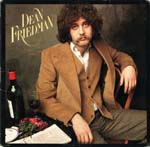
Dean Friedman's 1977 homage to Paramus, New Jersey (and Jewish girls in peasant blouses)
Trolling around YouTube (as I'm known to do) I ran across this gem. The song "Ariel," written and performed by Dean Friedman in 1977, chronicles a young man's romance with a Jewish girl. The song is a hoot, wonderfully descriptive of the time period and blissfully poppy. How have I lived this long without this one? The Franky Valley squeaks alone are priceless. According to wikipedia, this song reached #26 on the billboard charts. Even better, Friedman is still actively writing and gigging. Check out his website for more information and to order one of his many albums. I just snagged his first album "Dean Friedman" (the one with Ariel) off of eMusic. Can't wait to give it a spin.For the record, I don't know if Friedman is Jewish or not. But since he has an album entitled "A Million Matzoh Balls" with tracks titled "A Million Matzoh Balls" and "In My Sukkah" I can only imagine.
Update: Youtube User abmcw just got back to me about the video and said "Glad you enjoyed it! It's a video I made using clips from the Prelinger Archive, an public domain archive of educational films, newsreels, commercials, etc." Great job and thanks so much.
Update II: I got a nice email from Dean Friedman tonight. First, he digs the video. Good job, abmcw. Second, about the Jewish songs. "A Million Matzoh Balls is a collection of mostly silly Hebrew School songs I wrote for the local synagogue when asked to teach music when my kids were little. They've been picked up by synagogues and JCC's around the US. Fun stuff. It's not on eMusic but you can download the album via my website (or order the CD)." I'll do that.
Tuesday, May 20, 2008
Radio Free Yidishkeit: Y-Love's 'This is Babylon'
...static pink noise detuned and oscillating WE GON' RISE...(bump bump) KEEP THE PARTY DIVINE (bump bump).... sirens rise against a slow base beat .... TWIST YOUR NECK MAKE YOUR HEAD MOVE SIDE TO SIDE .. machinery clanking . ARE YOU CONNECTED REJECT MISDIRECTED BELIEVE AND RECEIVE DIVINE DIALECTIC ... radio static static grind ... THIS CULTURE'S BABYLON SIN FEST ... quiver and semi-quaver, a power grid played like a theremin... WE GON' RISE ...MAKE THE PARTY DIVINE .........I don't love this album, but I'm afraid of it. It owns my stereo and my attention like a radio broadcast from a warzone. I have to work to make out the lyrics over the hiss and crackle and when I can tune them in, the broadcaster is telling me that it's time to grab my family and run. But I'm too entranced by the rhythm and wordplay, the grinding soundscape. I have this feeling that I'm going to have to transcribe each song and learn them before I'll be able to shake it.
This is album is clearly hip-hop, but to me the unrelenting grind of it hits me like a good punk song does, right in the gut with no apologies. It lacks some of the humor, bounce, and gleeful language juggling of the earlier DJ Handler productions (like My Garden) and that lack turned me off at first. But 'This is Babylon' has it's own logic that is deeper and more compelling. While the slightly less dark "New Disease" will probably be the first single, songs like "Make the Party Divine" and "Mind Transit" goes right for the jugular. People have been asking me for a while who is going to pick up the torch from Matisyahu and bring to the masses a world class Jewish popular music. This is it folks.
The folks from Modular Moods have graciously provided this Y-Love samples radio. Enjoy
| Add Y-Love Samples to your page |
If you want to know more about Y-Love, you can listen to an interview on Public Radio International's The World.
You can find out more about Y-Love through his MySpace page or Modular Moods.
Monday, May 19, 2008
Heeb News Flash: Jews Are Neurotic!
This morning I got a nice note from Arye Dworken, a music writer associated with Heeb and a variety of other outlets. He said "You should pick up Heeb again when you get the chance. We've been really tight with the music coverage in the past few issues. No more of that shticky comedian-review bit. I think you'd dig."
Cool. I'm always ready to give something a second try. Thanks for suggesting it. So I went to the Heeb online archive figuring I'd read the music writing from the last couple of issues. Issue 16. Nothing. Issue 15. Nothing. Issue 14. Bingo. Heeb writer Todd Goldstein has an article on Marrisa Nadler "The Little Freak-Folk Artist Who Could." The article is generally well written, if a bit vanilla, talking admiringly of Nadler's "finger-picked acoustic guitar and ... wispy, disembodied voice" and chronicling how she "originally had hopes of being a painter, but became disillusioned with the creativity-stifling competition at Providence’s Rhode Island School of Design." Then comes the money quote “I have a neurotic impulse to create that I think is very much a Jewish thing.”Now, let's be clear. I'm not picking on Nadler. I haven't heard her music (for some reason I can't get her MySpace page to play her tracks) but she's gotten lots of good reviews. And I'm really not picking on Goldstein. (Ok, maybe a little bit). But mostly I'm picking on Heeb for letting Goldstein anchor the last paragraph of the article on this clunker. Is this really the best you can do, folks? Jews are neurotic? Thats it?
What's the point of having a Jewish magazine if passing off 30? 50?100? year old stereotypes about the urban Jew is the best you've got? If Nadler can't make a interesting connection between her music and her religion (not that she needs too), let it go at that. Or demand that your writers be real interviewers and help her explore the connection (if, in fact, there is one).
But this, to be blunt, is crap and the reason I let my subscription die.
I do appreciate Ayre inviting me to take another look at Heeb. I sent him an email asking if there were better examples of recent writing that he could point me to. If he can point me to a couple of examples of good Heeb music writing I will let everyone know. Until then...bleah.
Sunday, May 18, 2008
Músicas na Rua: Portugese klezmer band Melech Melaya looking cool on street corners
Saturday, May 17, 2008
Kikar Israel: Your Central Spot for Israeli Music
Israel's 60th birthday has gotten the spotlight aimed at Israel for something other than it's domestic crises for once. And Israeli's have risen to the occasion, burnishing their collective image with lots of new media activity. One new website that grabbed my attention is Kikar Israel "Your Central Spot for Israeli Music." It's an English language website with music videos, charts, band bio's and headline news. If you consider statements like "Ninet shaves her head!" as being a headline.As a teaser for the good stuff available through Kikar, here's Yael Naim and Din Din Aviv's video for "Mashmauyot"
Betty Rules!
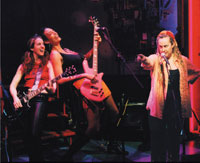
BETTY Rules!BETTY is a a five-piece pop rock band fronted by Elizabeth Ziff, Alyson Palmer and Amy Ziff (L to R in the photo below) I haven't seen them play yet and I am, as we speak, missing their performance at Ann Arbor's Ark theater.
BETTY isn't specifically a Jewish band, though from the major Jewish bling that Elizabeth is sporting in the photo I'm guessing the sisters Ziff are Jewish. BETTY has been playing together for 20 years or so, and has recently put together an Off-Broadway stage show called BETTY Rules! which tells the story of, brace yourself, a "feisty punk-pop-alternative-rock trio formed 20 years ago in the basement of the Ziff family manse." Autobiography is a beautiful thing. Adding a bit more Jewish cred, BETTY Rules! was in residence at the Theater J (at the Washington DC JCC) for a while. They're getting great reviews and racking up the tour miles.
Here's what BETTY has to say for themselves...
"Bonded since an unfortunate incarceration, BETTY began as an edgy a’cappella/spoken word/techno-beat trio in Washington DC. Fierce Elizabeth (vocals, guitar), funky Alyson (vocals, bass) and funny Amy (vocals, cello) are the songwriters, while virtuoso guitarist Tony Salvatore and sizzling drummer Mino Gori complete the band, now based in downtown NYC. Activist entertainers, the band is known for fighting fiercely for what they believe: equal rights, feminism, finding cures for breast cancer and AIDS, Planned Parenthood, the Pro-Choice movement, an end to sexual violence and everybody’s inalienable right to safely dance naked in the streets."Anyway, I loved the photo and thought the tracks on their website were a hoot, so I figured I'd share.
It Girl

If theatrical "feisty punk-pop-alternative-rock" makes you smile, check out their website and the BETTY rules site for more tracks, their gig schedule, and their 5 or so albums.