Every Passover produces a flood of fun new music. If the Idelsohn Exodus 2.0 mix isn't your cup of kosher wine, maybe this video from Dovid Kerner will do the trick...
music: Hank Williams Sr.'s Jambalaya arrangement based on John Fogarty's recording of Jambalaya art work: the Kerner kids (ages 7 and 3)
Update: Dovid sent me a link to a new and hi-rezzier version that meets the approval of graphic artist (his 7 year old). Those fickle artists :)
I love it when I get scooped by non-Jewish media. It gives me hope. Today I was beaten to the punch by my favorite blog, Boing Boing, who featured this pretty fabulous mix tape of Passover music clips compiled by the gang at the Idelsohn Society. The mix isn't really DJ quality, certainly not up there with Socalled's Seder, but does a fine job of collecting a bunch of odd and wonderful recordings.
The best part....you can download it right now and use it for your pre- or post-seder sound track. I know I'm going to. Or throw it on a thumbdrive as a great present for your afikomen finders. (If you do, wrap the it in a $5 bill. Just sayin')
Tracks include: Richard Tucker, "The Kiddush" Darondo, "Let My People Go" Socalled, "The Four Questions" Moe Jaffe & Henry Tobias, "Passover Time on the Range" G-d Is My Co-Pilot, "Dayenu" Steven Bernstein, "Manishtana" (vs. The Wonder Kids) Bas Sheva, "Caravan" Joy Division, "Passover" Rabbi Kahn, "Your Passover Seder" vs. Flying Lotus Harold Stern, "Jewish Cowboy" The Carter Family, "On My Way To Canaan's Land" Charles Mingus, "Freedom" Nina Simone, "I Wish I Knew How It Would Feel To Be Free" Gershon Kingsley, "What Does It Take (The Ten Plagues)" Socalled, "Dayenu" Egyptian Lover, "Egypt, Egypt" vs. The Malavsky Family Ray Barretto, "Exodus" Benjamin Lapidus, "Las Cuatro Preguntas" Ray Charles, "Where Can I Go?" James Harman Band, "The Four Questions" The Velvet Underground, "I'm Set Free" Roosevelt Charles, "Let My People Go"
I just received this pretty awesome Passover greeting card from my rabbi, which has a really great message. This unique card celebrates what really makes Passover beautiful by getting insightful perspectives and uplifting messages from inspirational leaders of many different faith communities. The card features Conservative Rabbi's David Wolpe, Nicole Guzik and Rabbi Deborah Schuldenfrei, as well as Imam Jihad Turk, Pastors Cecil Murray, Mark Whitlock and Reverend Liz Munoz.
Craig N' Co teamed up with American Greeting Cards to create this Passover message. Last year, their Hanukkah Card became American Greetings most downloaded card of the holiday season. This Passover, I'm sure the card will make just as much of an impact. I hope you will feature this free Passover card on your blog this upcoming Passover. It is a beautiful way to celebrate the essence of the holiday.
Pesach is coming fast, but this year's Purim videos are starting to pop up on YouTube. Here's a good one from New York-based folk-hop singer-songwriter Jim Costello, aka Ya'akov-Yisrael.
Chapter four of Megillat Esther as told by Ya'akov-Yisrael
The video was recorded on Feb 24, 2010 in Philadelphia at the Collaborative Purim spiel. Go hop over to Jim's website for a free .mp3 download of this and some of his other songs and for the full lyric sheet.
Keith Kahn-Harris of the Metal Jew blog took his turn at the Ignite microphone recently. His talk "My Dream Came True but I'm Still Not Satisfied: The Journey of a Metal Jew" is a riot. Have at it people...
Proudly part of Global Ignite Week
Hosted at The Luminaire on 02 March 2010
I hope that this is the start of a trend. Both Keith and I have done our turns...how about you? Get up and tell your Jewish music story and email me the link to the video. It's just a five minute talk. It'll be great. Promise.
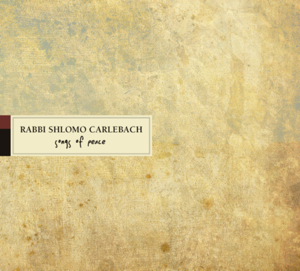
I've got a happy heart right now. I'm back at my computer after a night at the JCC Stephen Gottlieb Music Fest watching the Shlomo Carlebach documentary "You Never Know." All the way there and all the way back I was listening to a review copy of the new Sojourn Records album "Shlomo Carlebach - Songs of Peace" a posthumous release of material from a pair of 1973 concerts. This is as good as it gets, folks. I'm riding a serious Jewish high right now.
Carlebach was an amazing figure, a controversial Lubavitch Chassidic rebbe who took his faith to the streets and lifted the hearts and souls of the people he met there. And in the process helped revolutionize Jewish music and prayer in both the traditional and liberal Jewish movements. If you hear someone pickup a guitar and sing a prayer in Hebrew, you're hearing Carlebach's echo (as well a few others).
While rough in pacing and erratic in focus, "You Never Know" is an excellent documentary. It is less about Carlebach than it is about his legacy and his impact on people. It avoids narrative, historic or biographical, and instead hops around in time and place letting a diverse set of people talk, dance and sing about how Carlebach had touched their lives. It paints a picture of a rebbe who was more interested in inspiring disaffected Jews than delivering lectures to frum yeshiva students. The cost of this was his reputation in traditional circles, the benefit was his success at his mission.
And it's important to remember that if you get a chance to listen to Songs of Peace. This is a concert. It has a stage, a singer, a guitar. It's also a prayer gathering and religious experience. Carlebach breaks from his songs to tell stories and teach. The album admirably captures both the music and teaching. I'm not Chassidic and can sometimes get overwhelmed by the mystical language that permeates Chassidic thought, but I could listen to Carlebach any time (and often do). He has a gift for making the ephemeral concrete and relevant to daily life.
Carlebach has a long discography. Wikipedia notes 23 albums (5 of which are available on Sojourn Records) and I'm aware of a lot of other bootlegs and non-commercial recordings floating around. I'm not nearly enough of a connoisseur to say whether this is among the best of his records. But I can say whole heartedly that it's an excellent introduction. The recording has that wonderful audio distance of historic recording, but is clear and listenable. Carlebach's voice and guitar are in fine form and the teachings are well chosen, short and moving.
To hear samples from Songs of Peace, check out the Sojourn Records website. For a quick hit of one of the giants of Jewish music, check this video out. YouTube has a ton of Carlebach. I chose this one because it's from the same time period as Songs for Peace
Shlomo Carlebach Boi B'Shalom 1973
A couple of final notes. First, Sojourn Records also recently released a fine album by Carlebach's daughter Neshama. It deserves, and will get, it's own review sometime next week. Second, I've got an .mp3 of a great lecture explaining some of the reasons that Carlebach was controversial in the orthodox community. I'd provide a link, but I can't find it on the web anymore. If you're interested let me know and I'll get it to you.
Finally, the FCC wants you to know that I got no compensation for this review other than a free digital review copy of the CD. And I got in free to the movie because I was taking tickets. Isn't that exciting to know?
Klezmer music is one of those musical forms (the good ones) that both inspire and defy definition. I have some tounge-in-cheek definitions of my own...
The shtetl band, wanting to perfectly recreate the sound of pre-war Eastern Europe. (e.g. Budowitz and Adrienne Greenbaum)
The revival band, honoring their American golden age klezmer progenitors and Yiddish theater favorites, and so very (sometime depressingly) serious about making new Jewish culture (e.g. Klezmatics and the Shirm Klezmer Orchestra).
And of course, the hard-working local simcha band (we play weddings, bar mitzvahs and brisses), actually expecting the audience to dance to songs with 'hora' in their name (e.g. Michigan's Heartland Klezmorim and New England's Wholesale Klezmer Band).
And then there's the jazz-klezmer band, where violins become horns, accordions become upright basses, and Minsk becomes Manhattan (Frank London, Enrico Fink).
The post-klezmer (or prog-klezmer) band, where klezmer is a point of departure not a destination (or something profound like that). (e.g. Klezmer Madness, Klezmafour)
The Pop-klezmer, where pop music has an illicit love affair with klezmer (e.g. Oi Va Voi,Golem)
And finally, the Roots / World music klezmer, where klezmer is whipped up with most any other rootsy music around to prove that every indigenous music form in the world loves accordion (Red Sea Pedestrians, JUF, Beyond the Pale)
I've been wanting to get that written down for a while. I'm sure that my friends in the klezmer community will take issue with this and with good reason. Categories are always limiting, often wrong and best are marginally helpful. But they can be helpful. And I needed a bit of help today.
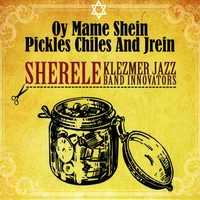
The Sherele Jazz Band Innovators is one of my favorite contemporary klezmer bands, well grounded in the tradition but also well planted in their place (Mexico) and time (now). A fine woody clarinet over tockity drums, acoustic and electric guitars, and bass. Wailing and soulful, jangly and full of life. Their recent album, "Oy Mame Shein -Pickles, Chiles and Jrein" is great fun. And, of course, my categories both help and hurt my ability to describe them. Definately not a shtetle band. They've got the jazz feel of a late-revival band but happily weave in elements of (Mexican) roots and post-klezmer. The guitar playing was particularly fascinating, sometimes a Spanish, almost flamenco, style acoustic guitar sometimes a cutting electric guitar. All in all a lovely blend.
Here...give'em a listen.
Sherele klezmer medley
Sherele has gotten a bump in popularity late through their inclusion on the new Putumayo sampler cd "Jazz around the World."For a band who's self description is "Like a happy Rabi waking up in a Moldavian shtetl, dancing love letters in Buenos Aires, eating tacos in Guadalajara (3 a.m. after mariachi and tequila) and head banging to your grandmother’s music in 50 plus minutes of Latin American Klezmer extravaganza" a world music album is natural home.
I'm pretty excited about the website "The Yiddish Song of the Week." I'm pretty excited about it. If the first, and only so far, blog post sets the tone this should be a fun ride. The blog post offered a quick biographical sketch of Yiddish folksinger Lifshe Schaechter Widman (1893-1973), as well notes, lyrics, and a lovely recording of her singing "Fintster Glitshik". Here's the official blurb....
Welcome to the website/blog “The Yiddish Song of the Week” presented by the An-sky Jewish Folklore Research Project (AJFRP). This initiative is part of a larger effort by the AJFRP to revitalize traditional Yiddish folksinging performance and research on the subject. To that end, this website will emphasize field recordings of traditional Yiddish folksingers from around the world contributed by folklorists, ethnomusicologists, musicians, singers and collectors.
Each Yiddish song will be presented with Yiddish words and translation, along with commentary from the contributor. Since the website is a blog, we hope that each song contribution will elicit comments from others on the song itself, or on the singing style of the singer. Perhaps others will contribute a variant of the song from their recordings, etc.
I'm pretty excited about this. Blogs like this are an important tool for expanding our communities awareness of this largely hidden treasure. There is increasing interest in expanding the range of performed Yiddish song. (Not to mention interest in increasing the amount of spoken Yiddish, but that's a different challenge.) So go check out this blog and stay tuned. It looks like more good stuff to come.
Here are a few of my favorite contemporary Yiddish singers. These folks are all amazing and bring a lot of energy to Yiddish song. In fact, maybe the An-sky Jewish Folklore Research Project should match their historical Yiddish Song of the Week with a "New Yiddish Song of the Week" website.
When I stand in front of people, virtually or physically, and tell them that we're in a silver age of Jewish music, exhibit A is often the Jewish hipster record labels Shemspeed and JDub. Labels successfully packaging Jewish music, approached from both religious and cultural perspectives, for hip 20-somethings? If that's not evidence that something fabulous is happening, I'm not sure what would be. So I look forward to every new release from these labels and am always happily surprised and challenged by them. These two albums, though, don't quite live up to my expectations.
The first album, Darshan's "Lishma EP" has taken me a month or so of listening to get into it, but I'm getting there. Here's their official blurb...
Darshan is "astral rap, liturgical jazz, audio alchemy. Harmonizing Hebrew chant with hiphop, folk rock with electro-pop, love poetry with kabbalistic psychology, Darshan is a unique and organic weave of world wisdom traditions and modern musical styles"
Darshan is a project of one of my favorite new vocalists, Shir Yaakov, and rapper & producer Eprhyme. Driven by Shir Yaakov's liturgical melodies and slow slow slow delivery and built on Ephrhyme's equally slow, staticky productions, this album sounds in many ways more like an Aphex Twin electronica album than it does hip-hop. I'm not sure that it works. There's a riskiness; a certain urban dreaminess to it that I can appreciate, but also a certain grinding tedium I can't. I'm told by folks that have seen them that their live show is outstanding. I can believe it. The raw material in these tracks is great. I could see Yotzer Or, my favorite track on the album, shaking the house. I can imagine the interplay between Shir Yaakov's melodic vocals and Ephryme staccato rap. The EP, though, seems held back by the lack of stage energy.
Why imagine it? Here's Darshan performing Yotzer Or at their album release party a couple of weeks ago.
Good stuff. But for me the EP doesn't quite live up to it.
Similarly, the second new Shemspeed release, Dreams in Static, draws on a large sonic palette, but the resulting picture is a bit blotchy. According to the official blurb,
"Dreams in Static conjures up the aesthetic of James Bond, Prefuse 73, & Pulp Fiction. Each song is the soundtrack to a film in a genre of its own. This is music that exists beyond pop and yet overflows with it. Serene Poetic strikes a balance between Diwon, a Brooklyn-based hip-hop producer, and Dugans, a multifaceted guitarist-composer from Texas. Using live drums, samplers, analog synths, electric pianos and guitars, Dreams in Static transcends genres and breathes new life and depth with each subsequent listen. The album teems with life, beauty and depth; it's an instrumental masterpiece that resurrects live instrumental music and guitar-based symphonies. It pops in a world where popular music has been left in a state of static."
Ok. Whew. That's a lot to cram into an album. And the album feels a bit crammed into. I'm an electronica fan from way back and can be really happy with broad-brush sonic adventures like this. At its best, this recording is happily deconstructive, breaking down pop genres into bits and reassembling them into long tone poems. My favorite tracks, including American Pastoral and Standing in Shadow live up to hype. They have a rich internal life that gets me immediately invested. Many of the tracks, though, sound more like demo reels than a movie soundtracks. Sounds flicker and weave, but never resolve into anything. I really dug this album when I first listened, but over repeated listening it didn't wear well. Your mileage may vary...check Dreams in Static out on their myspace page and in this video. Let me know what you think.
Dreams in Static feat. Eytan "I'm Gonna Get Back Up" Live
I do want to point out that I'm a big fan of Diwon, and in particular love his Tikkun Klalki remix. Download it from Shemspeed here. And check out the video.
Tikkun Klali # 10 (diwon dancedancetantz remix of Erez Yechiel)
Over at my day job, we've at had a big software delivery this week and I'm pretty fried. Very ready for Shabbat. Here's a 'get in the Shabbos groove' video from Yehuda Green. I as mentioned yesterday, I got hooked on Green while prepping for my Jewish music talk and am excited to go pick up his new album*.
Yehuda Green performs at the Carlebach Shul - January 5th, 2008
*I think the FCC wants me to say that I haven't gotten any compensation for plugging this album. I didn't even get a freebie in the mail. Though I'd like one.
I'm a Conservative Jew living in a Christian farm town in Michigan, USA. For me, Jewish music used to be Adon Olam, Hava Nagila, and Fiddler on the Roof. I started getting a clue a few years ago. Jewish music is Klezmer dances, Sephardic ballads and Chassidic niggun. It's thousand year old hymns, three hundred year old Shabbat table songs and 60 year old partisan resistance songs. It's contemporary hip-hop, punk rock, electronica, jazz, and chamber music. In addition to loving its musical and spiritual qualities, Jewish music helps me connect my family with a much broader and diverse Jewish culture than is available locally. The Teruah blog helps me document my exploration and share it with others. Why the name Teruah? Teruah is a call on the shofar on Rosh Hashanna.
Hear me interviewed on the Israel National Radio show "The Beat with Ben Bresky" Please email me about your band, event, album, blog, podcast, research or favorite Jewish music obsession. I'd love to hear it or about it.




 Posts
Posts

