Saturday, July 23, 2011

End of JDub. What's next for New Jewish Culture

The news broke about a week ago. JDub, the not-for-profit hipster Jewish music, is shutting down. Zeek has more info and an excellent summary of the state of "New Jewish Culture." This is a sad day, without a doubt, but not unexpected. I've heard lots of rumblings about JDub for a while now, they've had money problems, questionable management, maybe a bit overreaching in projects. Sounds like a typical not-for-profit, right? But they'll be missed. They were a focal point for folks like me to point to when trying to get people excited about New Jewish Culture.

But just because the organization is folding up doesn't mean the bands are going away, the fans are going home, or the enthusiasm is diminishing. It's more a question of what kind of organizations are needed and what kinds of business models work. So what comes next? Should someone else try to make a go of a Jewish label? Does the New Jewish Culture scene need record labels? And if so, for what? A&R and advance funding on recording (audio and video)? Public relations & marketing? Band management and tour management? Album distribution?

What about on the fan side? I've been expecting that someone will start a slick and stylish Pitchfork style website with a wide vision of Jewish music. There's finally a decent online radio station in Jewish Rock Radio. But it's pretty narrowly focused. There's an "International Jewish Presenters Association" but it doesn't seem to be particularly active. Shemspeed is still turning out great music, mostly hip-hop. There is, of course, the always active Orthodox & Chassidic scene, but they don't make much effort to reach outside their primary audience. (And, yeah, I'm still doing Teruah).

So what's next? Not sure. But, to paraphrase a recent tweet from the klezmer-punk band Golem....exciting new Jewish music was happening before JDub and it will continue to happen after JDub. But JDub will be missed.

So...here's a quick blast from one of my favorite current JDub groups...Girls in Trouble. I've raved about GiT before and will continue to do so, led by Alicia Jo Rabins, Git is somewhere between the next Regina Spektor and the next Debbie Friedman. And I don't take either comparison lightly. Who's going to help me champion GiT and all the other new Jewish bands out there?

Girls In Trouble - We Are Androgynous

Friday, July 8, 2011

The Russian Jewish Experience Part II: Shalom Comrade!

Shalom Comrade! album coverIn doing a little more homework on Russian Jewish music, I came across a wonderful archive album titled "Shalom Comrade! Yiddish Music in the Soviet Union 1928-1961." The album, which was produced in 2005 by ethno-musicologist Ritta Ottens and ethno-musicologist / klezmer musician Joel E. Rubin, both through it's music and extensive liner notes helps fill a critical gap in Russian Jewish history. As I noted in yesterday's post, there is a tendency by American Ashkenazim Jews (including myself) to marginalize the history and experience of Soviet and post-Soviet Jews. It defies the 'escaping the old world of the Shtetl (poverty, orthodoxy, anti-semitism) to the new world of America (opportunity, liberalism, assimilation)' foundation myth that underlies a lot of our cultural narrative. The Soviet Jews didn't escape. Instead, under pressure of the Soviet system they were slowly transformed, with results no less dramatic than the transformation Ashkenazi Jews experienced in the West.

One of the drivers for the Russian transformation was the conflicted view that the Soviet leaders had toward Judaism. As Ottens and Rubin note,
"Stalin’s cultural ideologues planned to deploy the music of the Yiddish-speaking Jews of the Soviet Union as a building block for the new Soviet music, whereas the Jewish religion with its traditional way of life was damned as counter-revolutionary."
As I've written previously, when talking Russian Jewish art music, there was an amazing output of art music in the early days of the Soviet system that drew on Yiddish folk and Jewish liturgical music. This music was composed by Jews and non-Jews alike, including Dmitri Shostakovich, one of Soviet Russia's premier composers. This activity faded though as the religious life of Soviet Jews came under more and more attack by the Soviet regime. As Ottens and Rubin note, not more than 200 to 300 (Yiddish popular and liturgical music) recordings were released up to 1967. They compare this with approximately 10,000 similar pieces recorded in the West.

This scarcity of these recordings make the Shalom Comrade! album that more special. At 24 tracks, it contains over 10 percent of the entire recorded output of Soviet Jewish music of that period and covers a range of thematic topics the show integration and tensions of Soviet Jews. This first sample (from Rubins website) is a Yiddish art song composed by B. Bergolt, lyrics, and Moses Milner (score). The song is performed by Misha (Mikhail) Aleksandrovich, who was born in Latvia, lived in Britain, and after World War II became one of Soviet Russia's most popular performers. Here's a translation of the lyric from the album liner notes.
Last night grandma suddenly remembered how grandpa came back from the Civil War front. Her big tears shone happily as she embraced him, danced and cried. That’s how they partied, into the deep of night, the tables broke under all the honey-cake and wine. A glass and another glass, higher and higher in the hand, to spite the enemies and to the joy of our country. Many years pass by with peace everywhere, and an old lady sits with her grandchildren around her and tells of the Great Fatherland War [World War II] and what a holiday it was when grandpa came back in victory.
Misha Aleksandrovich / Di bobe hot zikh dermont (Grandmother Recalled)(M: Moses Milner; T: B. Bergolts)


This second sample was, as Ottens and Rubin note, "belonged to the handful of warhorses which every Soviet interpreter of Yiddish song had to have in his or her repertoire." This version, performed by Zinovii Shulman, was the one that popularized the song.
Oh dear! Where do you get flour to make varnitshkes? [A plain
dumpling ]?
Without yeast or salt, or pepper or fat. Where do you get a board
to roll out the varnitshkes? Where do you find a stove to cook
the varnitshkes? And where do you find a lad to eat the
varnitshkes? Without yeast or salt, or pepper or fat. Where do
you find one, where?
Zinovii Shulman / Varnitshkes


The album can be purchased through The Workman's Circle and, of course, Amazon. And did I mention the extensive liner notes?

Wednesday, July 6, 2011

The Russian Jewish Experience: Soviet Jewish alienation with excellent production values

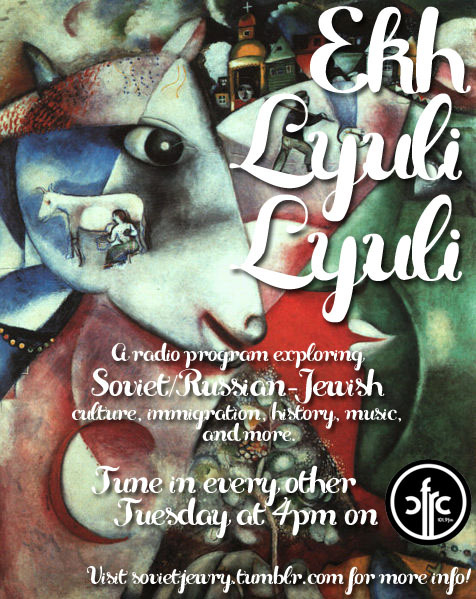
Ekh Lyuli Lyuli radio program posterI've been chatting on twitter with Russian/Canadian Jewish blogger @vladislavab. She did a fascinating mini-documentary recently called "Soviet-Jewish Alienation within the "Bagel-and-Lox Culture" with an accompanying blog and now radio program & podcast. She's interested in how her experience, the Soviet Russian Jewish experience, differs from and enriches the dominant North American Ashkenazi Jewish culture. I'm looking forward to chatting more with her. We share (I think) very similar views about a mutually enriching trans-national, trans-denominational Jewish community.

What we've been chatting about is, of course, Jewish music. She was looking to add to the collection of interesting Russian Jewish musicians that she plays on her show. I tossed out a few of my favorites including Lampa Ladino, Lana Ross, Psoy Korolenko, and Turetsky's Choir. This got me obsessing about Russian Jewish music and needing to find more.

Enter Yakov Yavno. Actor. Singer. Russian Jewish Icon. My new music crush.

Like Turetsky's Choir, he mixes the over-the-top theatrics and earnest sincerity that I love about Russian productions. There is no ironic detachment here. This is the Russian Jewish experience to the max, baby. More is definitely more.

Here's his blurb...
Yakov Yavno, also known as YaYa, is one of the most preeminent performers to immigrate to the United States from the former Soviet Union.
He was raised and came of age surrounded by the intertwining of a variety of cultures and peoples that have shaped and developed whom he is as a human being and as a performing artist. Within this melding of cultures, he often faced a difficult daily reality, witnessing firsthand the struggle between the ancient and modern, opposing religious factions and cultures, and in particular, the unique journey of the Jewish people of Russia.
Following studies at the Gnesin's Academy of Music in Moscow, Yavno became the leading star of the Jewish Musical Chamber Theater of Moscow. In 1987 the Russian government awarded him the coveted title of “Artist of Special Merit”.
His captivating performances are filled with a sense of purpose; a vision, as is evident with numerous sold-out concerts throughout Europe, Asia, Australia and the Americas. His festive staged showcase "The Road Home" incorporates an orchestra with choirs and contemporary dancers as well as cameos by well-known local guest-stars from the countries in which he performs. It was filmed as part of a documentary by the same name. Yavno’s solo show, “Revelations”, intersperses a musical program with tales of the artist’s journey from Russia to America; it features international combos integrating storytelling and philosophical discussions. His memorable solo performance, “Songs of Our Soul”, premiered at New York’s Kauffman Concert Hall in 2007.


Unlike Turetsky's Choir, he's based out of New York City, which means I have a chance to see him perform live. I will make this happen. I will. I will.

Getting back to vladislavab's point about how Russian Jewish culture should be thought of as enriching Ashkenazi culture, and not being an inferior shadow of it. Who in the Ashkenazi community hits the stage with the energy of Yavno or Turetsky's Choir? Yeah we've got some great cantors concerts. And no shortage of klezmer bands. And my favorite Jewish pop bands. (Yes Matisyahu, I'll be seeing you on Sunday night). But they don't even get close. We Ashkenazim have got a lot to learn.

Michigan Jewish Music - upcoming events

Lots of great Jewish music happening on the North Coast this summer. Check it out.

July 10: Matisyahu plays at Detroit's St. Andrews Hall

Matisyahu "Known for blending traditional Jewish themes with Reggae, rock and hip hop beat-boxing sounds, Matisyahu's single "King Without a Crown" was a Top 40 hit in the United States of America" I've seen Matisyahu twice before. He's fantastic live.

July 16: Michigan State Klezmorim and Wisaal play at Detroit's Concert of Colors.

Michigan State KlezmorimOne of Lansing's two great klezmer groups hits Detroit as part of a huge two day free music fest. While you're there also check out Arab fusion band Wisaal, who "attempt[s] to fuse elements of the Arabic musical heritage with Klezmer, Indian, and American influences while respecting the spirit of these traditions.

July 20: Israeli jazz saxophone / clarinet player Anat Cohen plays the Detroit Jazz Fest (at the Detroit Jewish Community)

Anat CohenSince arriving in New York in 1999, Israeli born Anat Cohen has established herself as one of the primary voices of her generation. The saxophonist/clarinetist is a bandleader and composer, conversant in jazz, classical, Brazilian, Argentine and Afro-Cuban styles. Her historic engagement at the Village Vanguard in 2007 marked her as the first female reed player and the first Israeli to headline at the club. She topped the Rising Star-Clarinet category in DownBeat Magazine’s critics poll in both 2007 and 2008, and placed prominently in a total of four categories including Rising Star Jazz Artist.

I'll probably be ushering. Come say hi!

July 20: Heartland Klezmorim play at the Meridian Historic Village in Okemos

Heartland Klezmorim Detroit's other great klezmer band play an outdoor show at the Meridian Historic Village.


July 23: Heller, Steyer & Green will be playing Java Havdallah at Temple Kol Ami

Heller, Steyer & GreenHeller, Steyer & Green features the talents of Cantor Penny Heller Steyer of Temple Shir Shalom and her children Tiffany Steyer Green, cantorial soloist at Temple Kol Ami, and Matthew G. Steyer, visiting cantorial soloist at Temple Kol Ami and Temple Shir Shalom. They stole the show at the Detroit JCC's Stephen Gottlieb Music Fest a couple of months ago.

August 26 to 29: Adrienne Cooper, Daniel Kahn, Susan Leviton, Judith Eisner and Douglas Cole, Neil Alexander and Klezmer Fusion Band, Cantor M. Smolash, and Cantorial Soloist Neil Michaels, along with the PuppetART theater of Detroit and dancer Steve Weintraub, perform at the International Association of Yiddish Clubs 14th Conference in Novi

Check out the IAYC conference entertainment page for bios of all the bands. So much great music. I may have to crash this party.

The Red Sea Pedestrians play pretty much everywhere and everywhen.
My favorite local roots jazz klezmer gang have a crazy busy gig schedule and a brand new album out. They'll be playing near you soon, so no excuses.


Electronic press kits


Steve Klaper, The Jewish Troubadour, will be hanging out at the Song & Spirit Institute for Peace in Berkley MI and Congregation Shir Tikva in Troy, MI

Tuesday, July 5, 2011

Ravid Kahalani's Yemen Blues

The excellent music blog Aspara "genre- and tradition- crossing music from around the world" recently ran a nice piece on Yemen Blues, an Israeli group led by Ravid Kahalani. As Aspara notes, Kahalani mixes "blues blended with Yemenite Jewish chants, West African percussion, funk, and much, much more. Great stuff. Check out the Asapra article for the full story.


You can get more info on Yemen Blues at the usual places including YemenBlues.com, twitter, and their MySpace and Facebook pages. YB is touring North America right now, so check out their gig schedule (this means you NY, Chicago, Calgary and LA).

Sunday, July 3, 2011

Lana Ross: Jewish Classical Guitar

Here's what I know. Lana Ross plays classical styled guitar and has three recordings on CD Baby, two of which are Jewish themed. Lana Ross based out of Canada and is associated with married to Russian - Canadian classical / flamenco guitar player Andrei Krylov. That's it. That's all I've got. Which is very weird, normally musicians go to great lengths to provide all sorts of bio material and contact information. Ah well. We can just enjoy the music.

Variations on themes of Odessa, Klezmer, Sephardic, Hasidic, Jewish Folk Songs and Dances for Classical guitar, (2011) and Fantasy on Themes of Sephardic, Hasidic, Odessa Jewish Folk Song and Dances (2009) are sprawling series of finger-picked folk and classical style guitar pieces that, as the title suggests, cover a lot of territory through Jewish music. Which in itself is a small wonder. I rarely see that much specific knowledge of Jewish music repertoire in single recording. Ross plays beautifully, with a lot of bounce and humor, weaving classical and folk sounds in a manner that reminds me a bit of John Fahey style 'primative guitar." Not quite at Fahey's level, but very solid.

To get a feel of her work, check out these tracks. From Variations, the lyrical and lush Bessarabia Romance sits next to aptly named Klezmer Guitar - Funny And Sad. From Fantasy, her Fantasy to theme of Jewish folk song Avinu Malkeinu and Variations to theme of Jewish folk song Lo Jisa showcase her classical and folk styles.

Bessarabia Romance


Klezmer Guitar - Funny And Sad


Fantasy to theme of Jewish folk song Avinu Malkeinu


Variations to theme of Jewish folk song Lo Jisa
If anyone knows more about Ross, please let me know. I'd love to track down a live recording or video or, even better, to catch her performing live. I've contacted Krylov and will report back if I get more information.

Update: I was able to reach Krylov, who confirmed that Lana Ross is his wife and that they live pretty far out in the country and don't use the internet much. Anyone interested in Ross's work can grab the albums from CD Baby or get in touch with her through Krylov's website.

Saturday, July 2, 2011

Jewish Rap music? Not for this kid.

YouTube user likewowwowwow does NOT like Jewish rap. Nope. Not a bit.

My thoughts on Jewish Rap Music


Specifically, she's not impressed with the following BibleRaps track.

Moses Rap - A Pesach / Passover Music Video


She isn't wrong. BibleRaps is an educational outfit, but even for 'educational' Jewish music, this is pretty weak stuff.

But it isn't all weak. Check out Prodezra's Rosh Hashana Song for more thematic Jewish rap done right. For more straight up Jewish rap, likewowwowwow should check out Matisyahu, Socalled, YLove, Kosha Dillz and Eprhyme. (I'd recommend the Hip Hop Hoodios too, but maybe they're a bit adult for her. Hey, I'm a dad... I haven't played HHH for my girls yet either).

So, likewowwowwow... good job! If you do any more reviews let me know.

The Wondering Jew Talks Jewish Music

I was catching up on Jewish music vids to hit Google recently and stumbled across this gem. The Wondering Jew, an anonymous "Benjamin something-that-sounds-like Chielminitzy", an Orthodox Jew in Brooklyn, recently started a video blog. One of his first topics is frum Jewish Music, and why he just can't get into it. If you want a crash course in contemporary frum Jewish Music that's laugh-out-loud funny in spots and dead on accurate, check it out.

The Wondering Jew: Jewish Music


To be fair, there are some really good and really interesting musicians who are frum and playing to frum audiences. Yosef Karduner may not be Sting, but his voice and music work are as deep as it gets. And I have to differ...I really dig Lipa and actually listen to Carelbach for the music as well as the stories. Really. But still, this is priceless.

Friday, July 1, 2011

Ofra Haza & Jonathon Elias' The Prayer Cycle'

Shabbat Shalom everyone.

This isn't exactly a 'get into the Shabbat grove' video, but I thought I'd share it anyway. I recently ran across an Ofra Haza track that I'd never heard. The track is called 'Forgiveness' and comes from composer Jonathon Elias composition / album "The Prayer Cycle." In this song-cycle, Elias explores faith through music and invited a wide range of top-flight vocalists to sing in a wide variety of languages. Haza's Forgiveness track is the Hebrew language offering. She sings with Nusrat Fateh Ali Khan, who is singing in Urdu.

Forgiveness


I nabbed the album from eMusic and found the entire composition quite moving. It's also available through Amazon. Enjoy.

Hat tip to YouTube user SuperShims for posting the video.

Thursday, June 30, 2011

Reb Yosil Rosenzweig - Still rocking and davening

You want to hear a track that rocked my world recently? Press play.


Now go read the story.

Wow. What an wonderfully simple, wonderfully intense recording and an immediate add to my playlist.

So who rocked my world? Reb. Yosil Rosenweig, my (handsome and modest) pal Benji's dad, and long time Jewish music fixture. I want to say icon, but can't quite. Reb. Yosil has written songs and made music with two of the most important folks in Jewish music in the 20th century; Chassidic rabbi and folk singer Shlomo Carlebach and Avraham Rosenblum, founder of the Diaspora Yeshiva band, the seminal Israeli Jewish rock group. But he, himself, never rose to the icon status of Carlebach or Rosenblum. But, icon or not, Reb Yosil has been making great Jewish music for a long time. And as evidenced by the track above, he's still doing it as well as anyone.

Pitchu Li album coverAbout a year ago Reb Yosil released Pitchu Li, his first solo album. It's a recording of Reb Yosil with his Kosher Gravy Company live in concert, with Reb Yosil telling stories, giving Torah, and singing some of his many songs. He's backed by a fine, bluesy jam-band. Doing a more detailed review of the album had been on my to do list for a while (sorry Benji), but I'd had trouble getting started. I'm not much of a fan of fine, bluesy jam-bands. Just not my style. And Reb Yosil's voice is a bit rough in spots. I bet I would have loved the show... but the album? Good, but not great.

But then I heard Reb Yosil's Rosh Chodesh recordings. Particularly the Mah Ne'Daber. And I was hooked. There's a fire to his solo recordings that I didn't get from Pitchu Li. Mah Ne'Daber is incandescent. I now look forward every month to his next Rosh Chodesh song. They're offered monthly for free download. If you've missed them, go get them. Or wait a couple weeks. Pretty soon they're going to get bundled up as Reb Yosil's next album. It'll be a great collection. Then he'll start the process over with a bunch of new songs, one per month.

I got the chance to sit down recently with Reb Yosil and hear a bit of his life story. I was really interested in finding out more about his relationship with Carlebach and Rosenblum and, given his obvious talent, why he ended up in their shadows. And why the new recordings now after all this time? The answer revolves around the life of a Canadian pulpit rabbi and musician who found himself in Israel in the late 1960's, a moment when North American ba'al teshuva were coming to Israel in waves and creating a new Jewish music scene that mixed rock music and spirituality, Zionism and Torah.

Reb Yosil and Shlomo CarlebachReb Yosil, far right with glasses and white yarlmuke, and Shlomo Carlebach, left with silver yarlmulke and guitar)

Reb Yosil moved to Israel in 1968 for "a four year summer." During that time he started composing music and met and played with Carlebach. Like Carlebach, Reb Yosil was interested in being able to use music as an emotional component of prayer. (And like everyone who knew Carlebach, he has some great Carlebach. Listen to the intro to Reb Yosil's Gam Ki Eilech for classic from the days of the Yom Kippor war.) At the same time he met and married his wife (whom he met at a Carlebach wedding) and opened a restaurant, and in 1971 started a band with Avraham Rosenblum called B'nai Tzion that included original material and popular Jewish song by The Rabbi's Sons and the Simchatones. B'nai Tzion played regularly on the stage in Reb Yosil's restaurant and at NCSY event. At that time he composed the songs Tzadik Katamar Yifrach and Pitchu Li, songs that went on to be hits for Rosenblum's next band, The Diaspora Yeshiva Band. Performed by DYB, Pitchu Li won Israel's 1976 Chassidic Song Festival. In 1978 DYB won again, this time with Reb Yosil's song Hu Yiftach Libeinu.

Reb Yosil (guitar, on right) Avraham Fried (the fellow with the beard who's standing and singing) and friends
Reb Yosil (guitar, on right) Avraham Fried (standing and singing) and friends

But DYB won these songfests without Reb Yosil, who was never a member of the band. Yosil wanted to be a rabbi, not a full time musician. Prompted by that and the opportunity to work with the Canadian Zionist organization, Yosil and his wife had already moved back to Canada when Pitchu Li won the festival. Yosil spent the next 30 years as a pulpit rabbi and raising a family, using music in his rabbinic work and playing community concerts and kumzitz. After a recent bout with illness, Reb Yosil retired from the pulpit and started playing music regularly again, putting together the Kosher Gravy Company band and playing concerts around Ontario and Detroit.

It's pretty exciting for a Jewish music geek like myself to see someone writing and performing new material in the style that was popular in Jewish music the late 1960's / early 1970's at that birth of Jewish rock. Particularly, it's exciting to see that music from someone who was there at the time and contributed classic songs to the repertoire.