Sunday, November 30, 2008

Lights: Celebrate Hanukah Live - Coming to a Television Near You!

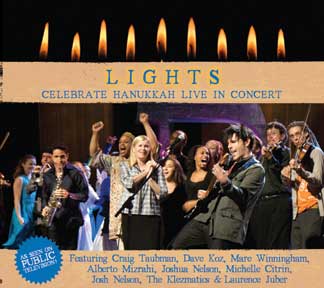
Album cover for LightsWhile I'm pretty passionate about the renaissance in Jewish music that's happening right now, let's face it...I've got a cozy seat in the press box but Craig Taubman is up on the stage making it happen. After years of recording his own music, including the ground-breaking Friday Night Live, and producing the popular Celebrate compilations, Taubman has given us all a Hanukkah present that will be remembered a long time. This year Taubman produced a performance called Lights: Celebrate Hanukkah Live In Concert that will be aired on your local PBS station sometime in the next few weeks. For us up here in chilly Michigan, it will be a prime time spectale airing at 8:00pm on Thursday, Dec 11 on Michigan Public Television. My kids are already primed and are asking daily if tonight's the night. Not yet girls, but soon.

Lights includes a range of performers that will be familiar to fans of the Contemporary Jewish music scene in general and the Craig 'n Co label in particular: Craig Taubman, The Klezmatics, Mare Winningham, Josh Nelson, Michelle Citrin, Caren Glasser, Cantor Alberto Mizrachi, Joshua Nelson, Dave Koz, and Laurence Juber. The performances mix uptempo takes on well-worn favorites, with a few new pieces mixed in. Citrin does a fine freshening up of Peter Yarrow's Light One Candle. Taubman and Juber give an earnest Maoh Tzur. Most notable of the new songs are the Klezmatics arrangements of two Woody Guthrie Hanukkah songs and Winingham's marvelous, if a bit off topic, Convert Jig.

Lights does have a few clunkers. As much as I admire Alberto Mizrachi, his take on Flory Jagoda's Ocho Kandelikas is ponderous and over-wrought. And I can't imagine what Taubman was thinking when he approved Dave Koz's elevator music cover of Somewhere Over the Rainbow. Musically and thematically it breaks the flow of the program.

All in all, it's a spirited, if uneven, program. It's easy to say I could imagine a stronger line-up and some better song choices (Lori Cahan-Simon singing Ven kh’tsindt di likhtlekh on, di akht – When I Light the Eight or The Leevee's singing Latka Clan), but like I said, I'm just in the press box. This is Taubman's show and he made it happen. And I can't wait for it to air.

Saturday, November 29, 2008

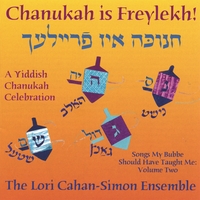
Lori Cahan-Simon Ensemble - Chanukah is Freylekh

There is a strange phenomena of embarrassed self-importance I've noticed about Hanukkah albums. The description of the new album is often preceded with a muttered explanation that previous Hanukkah albums are mostly terrible and that the musician wanted to contribute something of quality to the holiday. Here are two recent examples, first The Leevees in the context of their 2006 album 'Hanukkah Rocks', and second Erran Baron Cohen in the context of his 2008 album 'Songs in the Key of Hanukkah.'
"Name four great Hanukkah songs. OK, then how about two good Chanukkah songs? Not easy, huh? Adam Gardner (Guster) and Dave Schneider (the Zambonis) have taken up the important task of writing a bunch of great, rockin’ Hanukah songs." The Leevees, promotional website
"To take Hanukkah, which is a great festival that I always enjoyed as a kid singing all the songs. I remember we had this terrible record our parents played with children singing slightly off tune to a really old piano player. As the years went on, I realized they were all really bad tunes and all badly played. So the idea was to use story of Hanukkah and take some of the music of it and update it to make it really cool." Erran Baron Cohen, intervied by NY Magazine
Lori Cahan-Simon's got no patience for this attitude and her album "Chanukah is Freylekh! A Yiddish Chanukah Celebration. Songs My Bubbe Should Have Taught Me: Volume Two" should be considered a dope-slap and a wake-up call to contemporary Jewish musicans and fans. The album says, confidently and eloquently, that we've been at this Hanukkah music thing a while and have a huge backlog of quality material to draw from. If all you know is "I Have a Little Driedel," then you're missing out.

Album cover from Chanukah is Freylich!Chanukah is Freylekh! is an album of Yiddish Hanukkah songs, with arrangements that center on Cahan-Simon's lovely and spirited vocals. The album arrangements have a strong klezmer and Yiddish folk feel, and Cahan-Simon does the neat trick of singing folk music professionally without turning it into theater music. Her band, including David Chernyavsky, Henry Shapiro, Alexander Fedoriouk, Adrianne Greenbaum, and Walt Mahovlich, is wonderful and, like Cahan-Simon, presents the music with confidence but without overstatement. Greenbaum's flutework in particular is a delight.

While many of the songs on Chanukah is Freylech! are new to me (which, of course, is the point of the album), Cahan-Simon ends with the popular "Oy Khanike, Oy Khanike / Oh Chanukah, Oh Chanukah." Thinking about Oy Khanike, though, brought out my one complaint with the album. Cahan-Simon wants very much to help revive Yiddish and creating this album of Yiddish Hanukkah songs is aimed to support that goal. And it is, in my opinion, a remarkable CD that should on the shelf of every Jewish library and in the CD player of every klezmer musician (and serious fan). But I wish it could be taken further. One reason that 'Oh Chanukah' has become a standard in America is the English translation. It can be sung in Yiddish, English, or Hebrew (or blends) depending on skills and interests of the singer. While Cahan-Simon's extensive liner notes offer translations, without hearing any of them sung I have a hard time imaging them gaining much traction. Which is a shame, they're lovely songs.

Here are samples from a couple of my favorites.

Ven kh’tsindt di likhtlekh on, di akht – When I Light the Eight


Drey zikh, dreydele – Spin, Little Dreydl


This is a CD to be enjoyed as well studied. You can listen to more samples and order the CD through CD Baby.

Friday, November 28, 2008

Street Corner Klezmer

Whew, what a week. I've made and eaten a ton of food, had a great "staycation" with my wife (took the week off but didn't go anywhere), and had a ton of relatives come by for Thanksgiving. All good stuff. Not much action on Teruah, but that's ok. I've got a bunch more music reviews and videos coming up next week. I'm looking forward to Shabbat to rest up a bit.

For the moment, I'm still in a busy buzzy mood. So here's a video of some great busy buzzy street corner Klezmer musicians from Buenos Aires, Argentina.

Klezmer music on "feria de san telmo"


Hat tip to YouTube user diogob for posting the video.

Monday, November 24, 2008

American Crypto-Jews and Consuelo Luz

A Crypto-Jewish SukkotI was taken aback this morning. I was sitting in a doctor's waiting room leafing through the October 2008 issue of Smithsonian Magazine and ran across an article titled "The 'Secret Jews' of San Luis Valley: In Colorado, the gene linked to a virulent form of breast cancer found mainly in Jewish women is discovered in Hispanic Catholics." The article discusses the possibility that a region of New Mexico and Colorodo were settled by "crypto-Jews," Jews who had been forced to hide there beliefs and heritage by the Spanish Inquisition. Here's Smithsonian's description of that settling process, which summaries research by Stanley M. Hordes presented in his 2005 book, To the End of the Earth: A History of the Crypto-Jews of New Mexico. Hordes is a professor at the University of New Mexico and was New Mexico's official state historian during the 1980's.
" Following the Jews' expulsion from Spain, crypto-Jews were among the early settlers of Mexico. The Spanish in Mexico periodically tried to root out the "Judaizers," but it is clear from the records of trials that Jewish practices endured, even in the face of executions. According to Hordes' research, settlers who were crypto-Jews or descended from Jews ventured up the Rio Grande to frontier outposts in New Mexico. For 300 years, as the territory passed from Spanish to Mexican to United States hands, there was almost nothing in the historical record about crypto-Jews. Then, because of probing by younger relatives, the stories trickled out. "It was only when their suspicions were aroused decades later," Hordes writes, "that they asked their elders, who reluctantly answered, 'Eramos judíos' ('We were Jews')."
So, this is another chance for me to demonstrate my ignorance in public. I had heard the term crypto-Jew a number of times before, but always in the context of the Jewish expulsion from Spain in the 1490's. The story, in the versions I'd been aware of, always trailed off pretty soon after that. One block of Jews, who became the Sephardic community were able to flee to the northern and southern Medeteranian. The other group, for some by choice and for many by lack of choice, officially converted to Catholocism and were absorbed into Spanish culture, holding on to some remenants of Jewish tradition but largely forgotten by history. Guess I'm way off on that last part. It turns out that there are self-aware communities, and many not-so-self-aware communities, of crypto-Jews scattered around the globe.

As someone mildly obsessed with Jewish music, I sprang into action. From an academic perspective, the primary work on Crypto-Jewish music seems to have been conducted by Dr. Judith Cohen though I could not find much useful information on line. Dr. Cohen notes that, speaking of the Crypto-Jews of Portugal, that "They have very, very few songs which are not common to everyone else in the areas they live in." I'll keep digging. I'm sure there is better information out there and I'll report in as I find it.

Adio album coverIn terms of contemporary music, I found a lovely recording by Consuelo Luz, a "Cuban-Chilean singer-songwriter." Her new album, Adio, deals with the Crypto-Jewish experience. The official album description notes that "Crypto Jews" is a term used to describe those "hidden" Jews, who, for survival's sake, needed to hide their heritage. Today a movement is emerging of Crypto Jews, especially in the US Southwest, wanting to explore their Sephardic Jewish background and sometimes integrate it with their Indo-American heritage. This CD "Adio" is a musical reflection of this desire for integration, combining Latin, Middle Eastern, Flamenco and Indigenous elements to evoke a historic journey, a fusion of traditions and the Sephardic soul's survival and path of transcendence." And, it's quite lovely. You can listen to it at CD Baby.

Friday, November 21, 2008

Kol Ish - Anim Zemirot

Shabbat Shalom folks,

My gang and I are having some folks over for Shabbat dinner tonight. We're really excited about it. Our guests are one of my daughters new Hebrew school friends and her family. We do lots of singing at our Shabbat table, I hope they're ready for it. My only annoyance is that a couple of months ago I had big plans of laying in a stash of the B'kol Echad bencher that we use. But, of course, I forgot. That's ok. We'll wing it.

So, to get in the spirit of singing tonight, here's the singing group Kol Ish performing at the University of Maryland Hillel in October. By the way, if you're in the Maryland area, they do simcha's. Give 'em a yell. (By the way, rumor has it that they travel!)

Kol Ish Anim Zemirot


Hat tip to YouTube user YoYo73188 for posting the Kol Ish video.

Chai FM - South Africa Jewish Radio

I just ran across a promo video for the brand new Chai 101.9 FM Johannesburg, South Africa, a 24 hour a day Jewish radio station. Mazel Tov folks.

CHAI FM 101.9FM


Here's their station description...
"Chai Fm is a Jewish community radio station broadcasting to the greater Johannesburg area on 101.9fm. The station is talk format with 20% Jewish music. Programming is determined by community research and reflects the diverse views of the community. Based on "Tools for Life", Chai Fm provides programming that is informative, educational, entertaining and relevant to the community.

The objectives of Chai Fm are to: Unite the Jewish community, to build the connection between the community and the land of Israel, to reflect ourselves to ourselves and to provide programming that is relevant, informative, intelligent, honest, engaging, reflects a diversity of views and is entertaining.

Chai Fm is for all the Jews of Johannesburg, irrespective of observance levels, age, gender, race or financial status.

"The station aims to provide a platform for debate and a diversity of opinion" says Kathy Kaler, a director of Chai Fm. She adds: "It's so easy to think that our communities are insular and we can forget we are each part of a greater "whole".

Chai Fm was granted a community broadcasting licence in June 2007 and will begin broadcasting in September 2008
The magic words here are will begin broadcasting. The website is pretty much a mess, so I'm betting they're not on air yet. But hopefully they'll get things straightened out and running smooth soon.

Good news from South Africa. According to Lisa Gordon of Chai FM, as of December 2008 they have started broadcasting. They hope that in a year or so to be streaming their show world wide via the internet. I did a quick bop over to their website and it's looking much more put together now. Great job, folks. Mazel tov.

Thursday, November 20, 2008

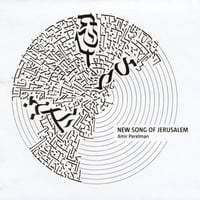
Amir Perelman's 'New Song Of Jerusalem'

Amer PerelmanWhat is there to say about Jerusalem that hasn't been said, loudly, with banners and guns, wailing prayers and chants, in streets, assembly halls, on television and the radio. A city as much disected as divided. What is there to say?

A lot, it turns out. And words aren't necessary.

Amer Perelman's New Song for Jerusalem opens to emptiness. A rolling, moaning, emptiness in desert colors. Long tones roll and toll from a distance. The tracks progress, plucked instruments and rattled ones make small noises of quite contemplation. Emptiness can be beautiful, we are reminded, and does not need to be bleak. Small moments of life are just as rich as larger gestures. There is a dream embedded in these rhythms, a quiet prayer, a coming to life. That emptiness can fill with complimentary dissonances and life can form.

The beauty of this album, and it is beautiful, is the gentle interweavings that fill it. Violins and hand held percussion, oud's and guitar, at once primitive and sophisticated. The understated rhythms and melody fragments pull at each other. bu bu bum bum tick tock tick tock tick. What is Jerusalem? Fragments pulling at each other, but from the complementary dissonances comes life.

Perelman, according to his bio, was "[b]orn in Israel in 1967 ... During his formatory years Amir was exposed to different and varied musical influences such as Jazz, Rock, Latin, Indian, Armeniam and Mediterenean musical heritage that are reflected in his work, by fusing rythms and scales from east and west , he has created his own personal sound and style." You can hear those influences, synthesized and unified, clearly. At moments Arabic sounds dominate, at other time, such as the song 'F drop,' Perelman seems to be drawing on American Primative guitar original John Fahey.

To hear samples for Perelman's New Song of Jerusalem and buy a copy (you should), visit his CD Baby page or his MySpace page. For the moment, here's Perelman's New Song of Jerusalem Quintent playing "Barchuni." While not an album track, it gives you a feel for what the album is about.


Hat tip to YouTube user abperi for posting the video.

The Power of a Niggun

Here's a fun video about the power of a niggun to bring Jews together.

Oorah CD - Sfashkanaz Video


The video was put together to promote Oorah, an organization that supports traditional Jewish education opportunities in the United States.

Hat tip to YouTube user AhavsY for posting the video and to Yosef for pointing met to the video.

Wednesday, November 19, 2008

Life Magazine Photo Archive

Folks, another treasure trove has been opened up. Google has made the entire photo archive of Life Magazine available on the internet. (We loves the internets). Here's a description from Ewen MacAskill writing for the Guardian (UK).

"One of the biggest photo collections in the world that ranges from the 1880s through to the seminal moments of the 20th century and on into the present day was made available to the public online from today. The bulk of the archive is from Life magazine, the premier platform for photojournalists in the 20th century. About 10m images will be available, from Marilyn Monroe and JFK to Barack Obama and Hillary Clinton. About 97% of the pictures have never been seen before. Google announced today it had done a deal with Life to put their pictures online. Also available is work from other archives, much of it collected by the former Time publisher, Henry Luce."

Here are a few fabulous photo's that I found on a quick skim the through the collection. But don't stop here, do your own searches.
A scene showing the cast from the light comic opera, A scene showing the cast from the light comic opera, "La Belle Helene", as produced by Jewish group. Photograph by John Phillips, 1943, Israel.


Ceremony of a Jewish Hasidic wedding.Ceremony of a Jewish Hasidic wedding. Photograph by Yale Joel, 1959, US.


Israeli pilgrims
Israeli pilgrims to shrine on Mt. Meron of 2nd century Jewish mystics, celebrate Lag B'Omer day with music. Photograph by Paul Schutzer, 1960, Israel.

Tuesday, November 18, 2008

A Carlebach Jam at Toronto's The House

Just a quick morning shout-out to the folks at Toronto's The House. The House describes itself as being "experiential, interactive, passionate, intellectual, open, reflective, engaging, compelling, and creative. We bring together the heart and the mind in a rich blend of intellectual discovery and spiritual exultation." If this video from a recent post-Havdalah "Carlebach Jam" is any indication, they sure are.

JAM 6 -honoring the life of Reb Shlomo Carlebach @ The House


Hat tip to the YouTube user JewishRenewal for posting the video.