Friday, July 4, 2008

The Teapacks - Israeli Afrobeat Jewish Punk

The TeapacksI've been feeling a bit stodgy lately. I've been blogging about a lot of great Jewish music, but a lot of it has been serious, or at least, meaningful stuff. I've had a long week and serious stuff is not what I need right now. I need to get back to basics (my basics, at any rate). I need some music that's big, crazy, cranky, and full of life.

(My 3 year old daughter just ran through the room singing "This is not what I want, this is NOT WHAT I PLAN" from High School Musical 2 at the top of her lungs. That qualifies too. Sort of.)

Fortunately, the Teapacks fit the bill. These guys bump, shuffle, and squawk with the best of them. They remind me of when I used to go to shows all the time and would slam, pogo, and otherwise do off-kilter punk boy dances to ska bands up from New York or Washington DC. Ska bands at a punk club were a beautiful thing. We all had an evening off from glowering (musically) at and slamming in to each other. This was our fun music.

And the Teapacks have got it down. They've got the grooves and attitude, the beat and they lyrics. Listen to the lead singer Kobi Oz ranting about leaders going to push the button (see below). It's as topical today as it was 20 years ago, though the leaders are different and the button is different. And ranting about it on stage with a good band at your back is still great street theater. C'mon everyone, maybe we won't change the world (we're not hippies, y'know) but at least we can look the world in its crummy grimey face. bump bump cue the horns.

Teapacks - "Push The Button" (Israel 2007)

I love the fact that Teapacks were Israel's entry to the Eurovision last year. What a great antidote to the insipid pop that usually floods the contest. You can find out more about the Teapacks at their myspace page and their website.

Hat tip to YouTube user EurovisionAndMore for posting the video. This video was just what I needed today.

Thursday, July 3, 2008

Kabbalah Kirtan - Echad B'Echad (Jewish Renewal Group Chant)

Yofiyah of Kabbalah KirtanWhew. I've been on the road for work most of this week and will be again all of next week. Right now I'm stuck in the office waiting for some of my engineers to get my demo system installed on my laptop. sigh.

At least the waiting around gives me a minute to write another post. Today I want to share a video of the musician Yofiyah (aka Susan Deikman) leading an interesting form of communal devotional chanting at a Jewish Renewal event. (Sorry, I'm not sure where/when the video was shot). This particular form of chanting, which she calls Kabbalistic Kirtan is heavily influenced by Hindu rituals but adopts and adapts them for Jewish practice. This adaption/adoption reminds me a lot of how the Chassidic community has a history of "redeming" or "finding the spark" in non-Jewish music and making it holy. With the Jewish Renewal community's ties to the Chassidic community mystical approach, it's not surprising to see this sort of musical redeeming flower here as well. Here's Yofiyah's explanation of how Kabbalistic Kirtan works...
"Hebrew Kirtan is an invitation to sing to, with, and ultimately as God. This music and the experience of singing it offer you a direct encounter with God, the Source and Substance of all reality.

Kirtan is the Sanskrit word for ecstatic devotional singing using the repetition of a name or names of God. Like “om,” “mantra,” “karma,” and other Sanskrit words it has entered the English language without translation. In and of itself “kirtan” has no religious content. It is simply the ecstatic devotional singing of God’s name. When sung in Sanskrit using Hindu names for God, kirtan becomes Hindu Kirtan. When sung in Arabic using Moslem names for God, kirtan becomes Sufi Kirtan. When sung in Hebrew using Jewish names for God, kirtan becomes Jewish, Hebrew or Kabbalistic Kirtan. It is not the form that defines the Jewishness of Hebrew Kirtan, but the content.

Hebrew Kirtan is the call and response repetition of sacred Jewish text and Hebrew Names of God. These Names and short phrases are doorways through which you can encounter God. The sound of these Names and phrases, the vibrational quality they establish when chanted aloud, open the small self (mochin d’katnut) to the spacious self (mochin d’gadlut) and allow you to transcend the ego and experience the Divine."
You can get more info about Kabbalah Kirtan, order a CD, or track her events, at Yofiayah's myspace page and her website.

Hat tip to YouTube user JewishRenewal for posting the video. JR has over 50 videos of Jewish Renewal events & music. Check it out.

Tuesday, July 1, 2008

a fast top 10

I got a nice email the other day from someone who doesn't "know the first thing about Jewish music ... [but] and every Jewish song I've heard sounded beautiful, so I was hoping you'd let me know what to get & where to start etc?"

So, here's a fast top 10 I put together. The goal of the list was to give a broad overview of traditional styles, focusing on some personal favorites & contemporary recordings. The list was not meant to be comprehensive and short-changes lots of wonderful bands & recordings. What do you all think? What's your top 10? What would you recommend?
First, you might listen to this last.fm radio station

http://www.last.fm/listen/user/Leyele/personal

The user is a friend of mine and has great taste. You'll hear lots of great Jewish music.

Jewish music encompasses a number of different genre's, so I'll tell you a bit about the most important ones as I do my top 10 list, ok?

Klezmer - Eastern European Ashkenazi Jewish music (e.g. from Russia, Poland, Germany). This is secular folk dancing music. Klezmerim were traveling musicians who played at parties and weddings. It can be very moody and dark as well.

1. I haven't listened to it yet, but the new Rough Guide to the Klezmer Revival has a nice sampling of contemporary Klezmer.
http://www.amazon.com/Rough-Guide-Klezmer-Revival/dp/B0013D8JTW/ref=sr_1_6?ie=UTF8&s=music&qid=1214388866&sr=1-6

2. The band Budowitz, from x is one of my favorite contemporary klezmer groups. Their album "Mother Tongue" is marvelous.
band website: http://www.budowitz.com/Budowitz/Home.html

3. One of my favorite albums of all time, Andy Statman and Dave Grisman's "Song of our Fathers" is a lovely contemporary album mixing klezmer and Jewish Hassidic songs
http://www.amazon.com/Songs-Fathers-Statman-David-Grisman/dp/B000003919/ref=sr_1_7?ie=UTF8&s=music&qid=1214389080&sr=1-7
"
4. Another one of my personal favorites, Davka's Judith mixes klezmer with chamber music and gives it a wild middle eastern lilt.
http://www.amazon.com/s/ref=nb_ss_m?url=search-alias%3Dpopular&field-keywords=davka+judith&x=0&y=0

5. While not klezmer, Wolf Krakowski does an amazing job mixing Yiddish folk music with American roots music. This one has been in heavy rotation lately. http://www.tzadik.com/index.php?catalog=7166

A second major strain of Jewish music comes from the Sephardic Jews, whose culture was established in the 1400's in Spain and was then dispersed around the Mediterranean. The song Ocho Kalendekas that [my correspondant] sent the link to is a contemporary American Sephardic song written by Flory Jagoda, a Sephardic Jew from Yugoslavia.

6. Flory Jagoda. Jagoda is a top notch singer and musican in the Sephardic style. The rhythms of her music has a definite Balkan feel.
http://www.floryjagoda.com/

7. Janet & Jak Esim Ensemble. The Esim's are from Turkey and play in a wonderful lyrical style. You can hear samples at
http://www.oz-ist.com/artist.asp?id=13 and see their recordings at
http://www.cdroots.com/esim.shtml

8. Pharoah's Daughter. Basya Shecter and her band play an amazing modern Sephardic music, strong in tradition buy dizzyingly psychedelic at times too. http://www.pharaohsdaughter.com/ My favorite album is Out of the Reeds http://www.tzadik.com/index.php?catalog=7187

The third major area of Jewish music is Misrachi, or Middle Eastern.

9. Ofra Haza is the queen of Misrachi music. She was an Israeli Jew of
Yemenite descent. Her album Homeland Songs is my personal favorite.
(more about her - http://en.wikipedia.org/wiki/Ofra_Haza) You can find
a lot of her albums on Amazon
(http://www.amazon.com/s/ref=nb_ss_gw?url=search-alias%3Dpopular&field-keywords=ofra+haza&x=0&y=0)

10. David Broza is an Israeli pop singer who brings together elements of Ashkenazi, Separdic and Misrachi music. His album Massada 99 - Starting to Breath is one of my favorites.
http://www.israel-music.com/david_broza/massada_99_starting_to_breath/

And finally

11. Fiddler on the Roof. This is a classic American musical and is just as loved today as it was when it was first produced.
http://www.amazon.com/Fiddler-Roof-Special-Topol/dp/B00005N7YZ

There are a lot of aspects of Jewish music I haven't mentioned, but hopefully these are a good start. If you find things you like, let me know and I can point you to more.


So what do you all think? What would your list look like?

Saturday, June 28, 2008

Lipa Schmeltzer's New Album: A Poshiter Yid

Lipa's new album is out. It will be fun to watch the fireworks.

Lipa's a controversial figure at the moment in the traditional Jewish communities. He's known for over-the-top songs and performances (see my post on his fabulously nutty "Oy Channukah" video) that some in on the Charedi, ultra-orthodox, side strongly disapprove of. The big stink recently was over the banning of his Big Event concert days before it was supposed to happen. This was a big deal debacle in the Orthodox / Chassidic music community and was discussed endlessly in j-blogosphere. My post on it was little more than a me-too addendum to the dialog compared to the excellent posts at BloginDm and LifeOfRubin.

So now he's back with a new album "A Poshiter Yid" (a simple Jew). Blog in Dm has already posted a great review of it, commenting that "This is a very subversive disc. The graphical elements in the packaging, marketing, and music all work together to set up the theme, Lipa the "Poshiter Yid", the simple Jew ... It's going to be difficult for the rabbonim to argue with that pseudo-modest self-assessment." and "A number of these songs are going to be in the simcha rotation this season in Brooklyn, I'd guess. My prediction: "Yomam Volayla", "Asher Yotzar", and "Hentelech" will make the second dance set at Brooklyn weddings this season."

It's going to be interesting to watch the response to the album.

Here's a short promo video for the album. You can also hear an interview with JM in the AM's Nachum Segal and listen to a 7 minute preview of the album. (Both courtesy of Chaim at the LifeOfRubin blog)

Lipa Schmeltzer's New Album: A Poshiter Yid


Hat tip to YouTube user CeeRubin aka Chaim at the Life of Rubin blog for posting the video.

Friday, June 27, 2008

Fortuna - Brazilian Sephardic Vocalist sings Shalom Aleichem

Shabbat shalom everyone,

For my weekly 'get in the Shabbat groove' video, here's Fortuna's lovely performance of Shalom Aleichem. Fortuna is Jewish Brazilian vocalist steeped in the Sephardic music tradition, which, according to her bio, she discovered on a trip to Israel in 1991. "It a was a magic moment," she says. "I felt all the beauty, sweetness and wisdom contained in these songs. It resulted in a complete turnaround in my career and also in a deeper contact with Jewish culture, religion and customs". (quote from her website) Since then, she's released a series of albums on the MCD label that both mine and preserve this tradition. This video is a clip from her Caelestia DVD and CD. In addition to her own albums, Fortuna has been features compilation albums from Putumayo World Music including "Dreamland," singing the Ladino lullabye "Durme, Durme", Tango Around the World, singing "Tango Idishe" (Yiddish Tango), and "A Jewish Odyssey", singing "Shalom Aleichem". A video of Fortuna's Tango Idishe has been posted on Vimeo, go check it out.

Fortuna - Shalom Aleichem


Hat Tip to YouTube user CRISativa for posting the video. If you liked this video, please consider supporting the artist and purchasing one of her cd's or videos.

Thursday, June 26, 2008

Dona Dona - by Eva, Melle and Kris

Here's a lovely, informal, version of the Yiddish classic "Dona Dona." I don't know anything about the performers, Eva, Melle, and Kris, other than they did a lovely job with the song. This is my favorite kind of video, just a couple of folks loving a good song and reminding us of how much life this music still has in it.

"Dona Dona" was originally written by Aaron Zeitlin (lyrics) and Sholom Secunda (music) for the Yiddish musical "Esterke" in the early 1940s. The song became a favorite of the American folk revival in the 1960's has been performed and recorded many times by folks including Joan Baez, Donavon, and Theodore Bikel. You can read the full lyrics in Yiddish and English at Wikipedia.

Dona Dona - by Eva, Melle and Kris


Hat tip to YouTube user OrangeJunk20 for posting the video.

Update: Sigh. One click on OrangeJunk20's YouTube page clarified things a bit. The Kris (the guy) in the video is singer/songwriter Kris Shred.

Train De Vie - Gypsy meets Klezmer music

I just ran across this fabulous scene from the movie Train de Vie where Gypsy and Jewish peasants and musicians collide. I'm sure I've seen it before, so here's a general hat tip to whichever blog or mailing list go it first. Train de Vie is a film by Radu Mihailenau which tells the story of a fictional "small Jewish village in Central Europe [that] organize[s] a fake deportation train so that they can escape the Nazis and flee to Palestine." (Quote from IMDB)

Jewish klezmer vs Gipsy music - Train de vie


Hat tip to YouTube user TaraDeHaidouks for posting the video.

Wednesday, June 25, 2008

Lori Cahan-Simon, folklorist, vocalist, and guest DJ

I've enjoyed having a Last.FM radio widget tacked on to my blog lately. Dialed to the 'Jewish' tag, it's spun a delightfully random stream of clips ranging from Matisyahu to European heavy metal band Rootwater's Hava Nagila to a Noam Chomsky lecture. But I thought I'd share the fun. I've invited critically acclaimed singer/folklorist Lori Cahan-Simon to guest DJ the Teruah radio for a while. Lori's Last.FM radio station will stream vintage and post-revival klezmer including Dave Tarras, Les Yeux Noirs, Naftule's Dream, Den Flygande Bokrullen, and the Klezmer Conservatory Band. Give it a listen and let us know what you think.


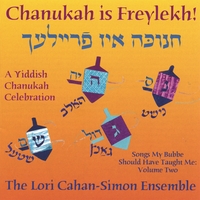
Lori's got a series of excellent albums that are well worth checking out including "Vessel of Song: The Music of Mikhl Gelbart," "Songs My Bubbe Should Have Taught Me; Volume One: Passover," and "Chanukah is Freylekh! A Yiddish Chanukah Celebration. Songs My Bubbe Should Have Taught Me: Volume Two"
Vessel of Song: The Music of Mikhl GelbartReleased in late 2003, Lori Cahan-Simon's "Vessel Of Song" is another fine collection of Yiddish songs by this outstanding Yiddish singer. Sub-titled "The Music Of Mikhl Gelbart", the album presents fifteen songs (two of which are medleys) by one of Yiddish song's greatest composers. Born near Lodz, Poland in 1889, the son of a poor khazn (cantor), Gelbart started writing music for a theatre group he toured with between 1909 and 1911 before immigrating to the United States in 1912. There he continued his theatrical and compositional activities, eventually also teaching singing, first at the Workmen's Circle in New York. Mikhl Gelbart died of bone cancer in 1962 and is still remembered by many of his students with great affection. He left a huge body of work that includes six oratorios, fifteen operettas, eight orchestral pieces, and settings of the works of some one hundred and twenty poets. He also published some twenty books of Yiddish songs. Gelbart's music is of a deeply folk-rooted nature and thus was often assumed to be traditional folk music of anonymous origin. The Lori Cahan-Simon Ensemble's "Vessel Of Song" presents a superb if necessarily tiny cross-section of Gelbart's vast body of Yiddish songs.

Songs My Bubbe Should Have Taught Me; Volume One: PassoverIn the desire to cast off the ways of the old world and in the ashes of the Nazi death camps, most of the songs included here have been lost or forgotten by the majority of Yiddish performers. But in the first of what will presumably be a series of recordings documenting Yiddish songs for all occasions, singer/folklorist Lori Cahan-Simon collects fourteen Yiddish Passover songs and performs them with her top-notch ensemble of local and national Yiddish vocal and klezmer talent. On half the numbers, Cahan-Simon shares vocal duties with Michael Alpert, best known for his work with klezmer group Brave Old World. The instrumentalists include Steven Greenman, violinist for the group Khevrisa, cymbalomist Alezandr Fedoriouk, who has worked with jazz artist Herbie Mann and John Cale of the Velvet Underground, and Walt Mahovlich, who currently leads the East European folk group Harmonia.

A work of incalculable folkloric value, as well as an entertaining and educational tool, Cahan-Simon's CD is well-annotated with extensive background notes and complete lyrics, transliterated and translated into English. The musicianship is on a very high level, and Cahan-Simon is a compelling, theatrical vocalist, whether she is tackling the cantorial-style, rubato phrases of "Avodim Hoyinu (We Were Slaves)" or the intimate cabaret-pop of "In dem land fun piramidn (In the Land of Pyramids)" by "sweatshop poet" Dovid Edelshtadt. "Shvimt dos kestl afn nil (The Little Basket Floats on the Nile)", laced with flute by Mahovlich, has an appropriately Middle Eastern feel to it, and "Dayeynu" is rendered in an upbeat, klezmer-to-jazz arrangement. The highlight of the recording is the swinging, imaginative duet between Cahan-Simon and Alpert on "Der Bekher (Tayere Malke)". Henry Shapiro's acoustic bass keeps the tune moving at a speedy pace, and the musicans interpolate eight rollicking, traditional klezmer tunes in between the verses." -- Seth Rogovoy (Author of The Essential Klezmer), Sing Out! Magazine

Chanukah is Freylekh! A Yiddish Chanukah Celebration. Songs My Bubbe Should Have Taught Me: Volume Two Most people, if you ask them to name a Chanukah song, will tell you “I Have a Little Dreidel”, and not be able to go any further. Some will tell you the Hebrew songs “Mi Yemalel” or “Maoz Tsur”. On this recording you will find the finest Yiddish Chanukah songs I could find, including one from the earliest Yidish songbook published with melodies, from 1727, up to those written through the end of the 20th century. Also present are the original Yiddish versions of the above mentioned dreydl song and “Oh Chanukah, Oh Chanukah”. These may be the only tunes that are familiar to you, but don’t let that stop you listening. Some of you may remember these songs from when you went to Yiddish school, but I think most of you won’t know them at all. These are marvelous songs which deserve to be heard and not forgotten in a dusty book, moldering on a neglected shelf somewhere.

Tuesday, June 24, 2008

Diamond Days, or When Is a Jewish music fest not a Jewish music fest

Diamond Days posterI love summer music festivals. I love the 'this will never end' feeling of a whole series of bands taking their turn. I love not being able to decide which which bandstand to settle into and knowing that I'll probably duck my head into all of them. I love going to see a favorite band and coming home with three new ones, and their albums bought from kid brothers behind card tables. And meeting other fans, as we shuffle between venues or snack lines.

There is a whole series of Jewish music festivals in the US showcasing a wide variety of Jewish related music from the US, Israel and around the world. If you're near a big city, there will like be one near you and I strongly urge you to check it out. I've got a list of them started in one of the Teruah side panels. If I've missed yours, please let me know. I'm particularly delinquent on adding the Israeli and other non-US festivals. Working on it...

Ok. This brings me to Diamond Days and the question of what makes a Jewish music festival. Diamond Days is a new music fest in Oakland California in July. Its officially sponsored by Heeb Magazine and is being organized by DJ and Heeb editor Jay Diamond. Regular Teruah readers know that I'm not very keen on Heeb magazine. I'd like to be. I'd like to be excited about a magazine about young Jews being hip and clever. The problem is, I find the underlying message of the magazine to be 'you can be a hip and clever young Jew if you wear a cool Jewish themed t-shirt and hang out with one or two other hip and clever young Jews, just don't actually be serious about anything, particularly Judaism." Diamond Days is a great example of this.

Total bands playing = around 30.
Number of Jewish music (defined as loosely as you like) band's playing = 0
My opinion of Heeb = dropping like a rock

I'm not much of an investigative journalist, but I thought I'd email Jay and get the story from him. Fair is fair. If I'm going to get grumpy, he should have the chance to speak for himself. Here is, more or less, what's going on. Jay is putting on a music fest because when "I was younger, I started getting really into punk rock, and my friends and I would set up these shows for our friends bands, and bands on tour. I've just always loved the energy behind live music, and the idea of a festival has always appealed to me. "

While Diamond Days isn't primarily a fund raiser, "we are donating profits to the Ella Barker Center for Human Rights in Oakland (http://www.ellabakercenter.org) which is a wonderful organization, that I couldn't be happier to be associated with. They have a few really amazing programs which I am very supportive of, and I hope we can help get them some support. .... Diamond Day's isn't a fund raiser in the traditional sense. It's a music fest, but I try and focus on the local side of things, which I think a lot of bigger indie festivals tend to forget about. I feel like including a local non-profit like Ella barker is important to that idea of community."

So this is all good stuff and a good reasons to organize a music festival. It's the sort of thing I've always wanted to do but never did. But why did it get branded a Heeb event? "I've tried to think of ways of explaining the Jewish connection to this fest, but aside from the fact that I am Jewish, and that Heeb is a Jewish magazine the only overall Jewish things that I can take from this is the sense of community that I talked about"

Ok. But that's just not good enough for me. To me that says that Heeb magazine just doesn't get it. We're at a point when Jewish music is exploding. There are new bands announcing themselves almost daily. We've got both massive crossover artists like Matisyahu and Y-Love and great new indie bands (the Shondes). We've got an jazz scene. Sephardic music is coming alive and the classical scene is growing fast. And, of course, the klezmer revival has hit a point where I can't imagine a town in the US with any reasonable sized Jewish community not having at least one klezmer band. Jewish songleader (singer/songwriter) types are on constant tour.

But evidently none of that matters. Because, to Jay and Heeb, having a vague "sense of community" is enough. Don't worry if that community has no Jewish character. Don't worry if that community perpetuates the marginalization of Jewish culture, even in the face of it's resurgence. Don't actually be Jewish (what ever that means to you). None of that matters. Just don't forget to show up, bring a friend, and wear the damn t-shirt.

Friday, June 20, 2008

viel Herz und Gefiehl - Andrea Giani and Gefilte Fish

I was looking for my weekly pre-Shabbat "get in the mood" video when I ran across this lovely montage of Andrea Giani and Gefilte Fish. It gets partial credit in the Shabbat department for the Giani's Adon Olam segment in the middle. Giani has an amazing voice. According to her bio she "was born in Cologne. She studied Piano and Voice in her native city and at the »Richard Strauss Conservatory« in Munich...Her repertoire extends from jazz standards to French and German chansons and on to Yiddish and Jewish songs, which – with her versatile and expressive dark voice – she sings with a lot of heart and soul: »viel Herz und Gefiehl«." I'll say. The Gefilte Fish band, which includes Joe Rappaport on violin, Tobias Schwartz on upright bass, Roman Chowdhury on guitar, and Angeliki Koufou on accordion provide her just the right jazz cabaret feel to support her without overwhelming her or loosing their own identities. I particularly loved Koufou's accordian playing.

This video seems to be songs recorded on the Gefilte Fish album "Sol Sejn" available as an import through your favorite music store or online at Amazon, CD Universe, or Tower Records. According to the YouTube notes "These recordings/filming took place at ODEON studios Athens Greece January 28 2007 for David Nachmias' show TIMIS ENEKEN (Under the auspices of Greek National Television ERT)"

GEFILTE FISH Jiddische Lieder Kompilation (Athens recording)


Hat tip to YouTube user "Kombothekras" for posting the video.